
XRP: Is a $20 Target Realistic in 2026?
The question of whether XRPXRP-- can reach $20 by 2026 is not just a speculative exercise-it's a test of the cryptocurrency's ability to scale beyond its current technical and institutional momentum. While most analysts project a more conservative range of $3.10–$10, the interplay of macroeconomic tailwinds, regulatory clarity, and institutional adoption creates a compelling case for a $20 target. Let's break down the evidence.
Technical Momentum: A Channel Breakout on the Horizon
XRP has been trading within a descending channel since late 2024, but recent price action suggests a potential breakout. As of early 2026, XRP is consolidating near $2.12–$2.18, outperforming Bitcoin and Ethereum, which have seen gains of less than 10% during the same period. This strength is supported by robust on-chain metrics: exchange-held balances are at multi-year lows, making the market highly sensitive to demand shocks.
Key technical checklist items for a bullish confirmation include a daily close above the 21-period EMA and a successful retest of that EMA as support. The Taker Buy/Sell Ratio, a measure of buyer dominance, has also risen to 0.991, indicating that buyers are increasingly in control of price action. Analysts project a 60% probability of an upside break from the channel, targeting $3.10–$3.30 in the short term, with extended scenarios reaching $8–$10. While $20 remains a distant target, the technical foundation for a multi-stage rally is firmly in place.
Institutional Adoption: ETFs and Regulatory Clarity Fuel Demand
The most transformative development for XRP in 2025 was the resolution of the SEC lawsuit in August, which paved the way for U.S.-listed spot XRP ETFs. These ETFs have absorbed $1.18 billion in net inflows since their November 2025 launch, acting as a structural buyer in the market. This inflow has locked up 746 million XRP tokens in custody, tightening circulating supply and amplifying price sensitivity to demand shifts.
Institutional confidence is further reinforced by Ripple's strategic acquisitions (e.g., Palisade, Rail) and the launch of its regulated stablecoin, Ripple USD (RLUSD), which has processed $15 billion in cross-border transactions. The legal clarity provided by the SEC settlement has also attracted major players like BlackRock, Grayscale, and Franklin Templeton to launch XRP ETFs, targeting pension funds, endowments, and sovereign wealth entities. These developments position XRP as a legitimate component of institutional financial infrastructure, not just a speculative asset.
Macroeconomic Tailwinds: Liquidity, Tokenization, and Derivatives
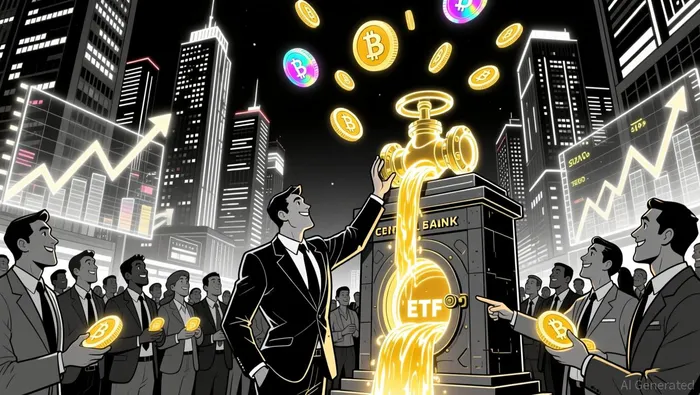
The broader macroeconomic environment in 2026 is shaping up to be a tailwind for XRP. Central banks are expected to ease monetary policy, with rate cuts and balance sheet expansions making traditional assets less attractive. This liquidity injection could drive demand for digital assets, particularly those with real-world utility like XRP.
Tokenization of real-world assets is another catalyst. Regulatory frameworks like the U.S. CLARITY Act and Europe's MiCA are enabling the tokenization of treasuries, real estate, and corporate debt, creating new demand for XRP as a liquidity bridge. Additionally, while open interest (OI) in XRP derivatives has declined, signaling reduced speculative leverage, this could paradoxically increase price volatility during breakouts due to thinner liquidity. If institutional demand continues to outpace speculative activity, XRP's price could surge beyond current projections.
The $20 Scenario: Transformative Adoption or Overreach?
Reaching $20 would require XRP to dominate cross-border payments, capturing a significant portion of SWIFT's $20+ trillion market. Ripple's On-Demand Liquidity service already processed $15 billion in 2024, but exponential growth in transaction volume and utility would be needed to justify a $20 price.
Market cap analysis suggests XRP's smaller size ($120 billion) compared to Bitcoin's ($2 trillion) allows for outsized gains from institutional allocations. A $500 million ETF inflow could move XRP by 5–10%, versus 0.5% for BitcoinBTC--. If XRP's adoption in cross-border payments and RWAs accelerates, its market cap could expand to reflect its utility, not just speculative demand.
However, $20 remains a high bar. Conservative estimates project XRP at $2.50–$3.00 by year-end 2026, assuming steady ETF inflows and gradual adoption. A $20 target would require a perfect storm of macroeconomic stability, regulatory tailwinds, and transformative adoption-a scenario that is plausible but not guaranteed.
Conclusion: A $20 Target is Possible, but Conditions Must Align
XRP's technical strength, institutional adoption, and macroeconomic tailwinds create a compelling case for a $20 target in 2026. However, this outcome hinges on continued ETF inflows, regulatory clarity, and XRP's ability to scale its real-world utility. While the current trajectory points to $3.10–$10, the interplay of liquidity injections, tokenization, and institutional demand could push the price higher. Investors should monitor key catalysts: a BlackRock XRP ETFXRPI-- filing, Federal Reserve rate cuts, and Ripple's progress in capturing SWIFT's market.
For now, XRP is a coin on the move-whether it reaches $20 depends on how well it navigates the next phase of crypto's institutional evolution.





Comentarios
Aún no hay comentarios