
XRP's 20% Drop Amid Whale Activity on Binance: A Contrarian Opportunity?
In October 2025, XRP's 20% price correction has sparked intense debate among investors. The token's decline below $2.60 coincided with a surge in whale activity on Binance, raising questions about whether this represents a capitulation or a contrarian buying opportunity. By dissecting on-chain behavior and market sentiment, we can assess the interplay of short-term volatility and long-term fundamentals.
On-Chain Signals: Whale Selling vs. Institutional Accumulation
A $63 million whale outflow to Binance in October 2025 directly correlated with XRP's price drop below $2.60, signaling short-term distribution pressure, according to a BeInCrypto analysis. This activity, combined with elevated open interest ($1.36 billion) and leveraged positioning, amplified market uncertainty, the BeInCrypto analysis adds. However, not all whale movements were bearish. A $55 million internal transfer from Ripple's treasury wallets (31 to 1) was part of the Midnight Glacier Drop — a non-speculative allocation for airdrops, according to a Currency Analytics report. Such distinctions are critical: while exchange inflows often indicate selling, internal consolidation suggests long-term strategic planning.
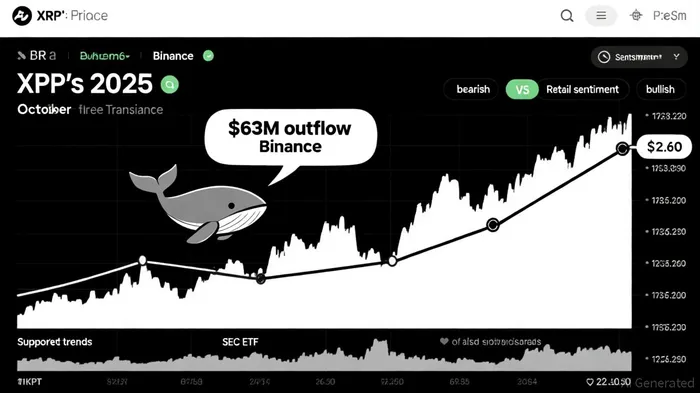
Historically, XRPXRP-- whales have favored Binance for large transactions, with daily deposits ranging from 0.2 billion to 6.9 billion tokens. This pattern reinforces Binance's role as a liquidity hub but also highlights the exchange's influence on price dynamics. Analysts warn that sustained whale selling could drive XRP to $2.34, according to a Cointelegraph analysis. Yet institutional inflows in September 2025 ($210 million) and cold storage activity indicate accumulation by long-term holders, the BeInCrypto analysis reports. The coexistence of bearish and bullish on-chain signals underscores a market at a crossroads.
Market Sentiment: Fear, Contrarian Bets, and Regulatory Catalysts
Retail investor sentiment has turned decisively bearish, with the bullish-to-bearish commentary ratio slipping below 1.0-a level historically linked to fear-driven selloffs, per a CoinDesk analysis. Yet, this extreme negativity may signal a contrarian opportunity. Past market cycles have shown that retail pessimism often precedes rebounds, as seen in 2023 when similar sentiment shifts coincided with XRP's 30% rally from $0.40 to $0.52, a trend the CoinDesk piece highlights.
Institutional confidence remains a counterbalance. Ripple's treasury management and cross-border payment partnerships continue to attract institutional capital, with $210 million in inflows recorded in September 2025, according to the BeInCrypto analysis. Meanwhile, the U.S. SEC's impending decisions on spot XRP ETF applications (October 18–25) could act as a catalyst, notes the Currency Analytics report. Analysts estimate that approvals could unlock billions in institutional capital, potentially propelling XRP toward its all-time high of $3.66, the Cointelegraph analysis suggests.
Technical Indicators and Derivatives Markets
XRP's price action forms a descending wedge pattern, with resistance at $3.02 and support at $2.80, the BeInCrypto analysis observed. A breakout above $3.02 could target $3.61, while a breakdown below $2.55 risks a 23% decline to $2.34, the Cointelegraph analysis warns. Derivatives markets reflect this duality: open interest has surged to $8.95 billion, with short positions building near $2.65–$2.66, per the BeInCrypto analysis. This suggests a high-stakes battle between bulls defending support and bears capitalizing on weak hands.
Is This a Contrarian Opportunity?
The interplay of whale activity and sentiment creates a nuanced picture. While short-term selling pressure is evident, the combination of institutional accumulation, cold storage inflows, and regulatory catalysts suggests a potential inflection point. Retail pessimism, when extreme, has historically acted as a tailwind for buyers. However, investors must remain cautious: a sustained breakdown below $2.55 could trigger further panic selling.
For those with a medium-term horizon, the $2.34–$2.55 range may offer a compelling entry point, particularly if the SEC's ETF decisions tilt favorably. Conversely, aggressive short sellers should monitor whale consolidation and derivatives positioning for signs of stabilization.






Comentarios
Aún no hay comentarios