
XRP's $2 Support: A Structural Buy-Point Backed by Institutional Demand
The XRPXRP-- price has long been a focal point for investors navigating the crypto market's volatility, but recent on-chain and institutional data suggest a critical inflection point. As of late 2025, XRP has demonstrated a robust structural support level around $2, reinforced by unprecedented institutional accumulation and shifting supply dynamics. This analysis examines the mechanisms underpinning this support, the role of ETF-driven demand, and the implications for XRP's trajectory in 2026 and beyond.
Institutional Accumulation: ETFs and Whale Activity
A key driver of XRP's $2 floor is the surge in institutional demand, particularly through spot ETFs. According to a report by , spot XRP ETFs absorbed 1.35 billion XRP tokens into custody over 60 days in late 2025, reducing exchange-held balances by 45% and tightening liquidity. This structural absorption has created a natural floor, as fewer tokens are available for immediate sale, amplifying the impact of buying pressure.
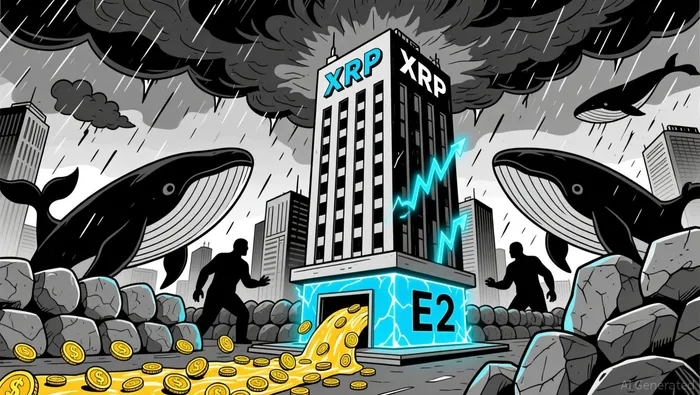
Whale activity has further solidified this support. Large holders accumulated 340 million XRP between September and November 2025, signaling confidence in the $2 level as a strategic entry point. This accumulation coincides with a broader trend of institutional investors treating XRP as a core holding, driven by its role in cross-border payments and regulatory clarity post-Ripple's legal resolution.
Structural Supply Dynamics: Exchange Balances and On-Chain Metrics
The reduction in exchange-held XRP balances to multi-year lows is another critical bullish input. With fewer tokens circulating on exchanges, the risk of large-scale dumping has diminished, creating a more stable environment for price discovery. This dynamic is further reinforced by on-chain metrics such as Coin Days Destroyed and cost-basis clustering, which indicate sustained accumulation near $2.
highlights that XRP's exchange-held balances now represent less than 10% of the total supply, a stark contrast to its 2021 peak when this figure exceeded 25%. This structural shift reduces downward pressure on the asset, as selling pressure is increasingly concentrated among long-term holders rather than retail traders or speculative funds.
Technical Analysis: Consolidation and Pathways to Breakout
Despite these fundamentals, XRP's price action has shown signs of consolidation. After a 25% rally in early January 2026, the token reached $2.40 before retreating, currently trading within a descending channel. Analysts emphasize that a successful retest of the 200-day EMA as support and a decisive break above the channel top near $2.30 are prerequisites for a sustained bullish move.
The 200-day EMA, currently at $2.15, has acted as a psychological barrier, with failure to hold above this level risking a retest of the $2 floor. However, the structural supply constraints and institutional demand suggest that any pullback is likely to be met with buying interest, particularly from ETFs and whale holders.
Future Outlook: Risks and Opportunities
XRP's trajectory in 2026 will hinge on three factors: regulatory stability, macroeconomic conditions, and continued institutional adoption. While the SEC's finalization of XRP ETF rules has provided clarity, macroeconomic headwinds-such as rising interest rates or a broader market selloff-could temporarily undermine momentum. Additionally, large whale distribution cycles pose a risk if long-term holders decide to monetize gains.
That said, the structural underpinnings of XRP's $2 support remain intact. If macroeconomic conditions stabilize and institutional inflows persist, XRP could retest $3 by mid-2026, particularly if the token breaks above its descending channel and gains broader adoption in institutional portfolios.
Conclusion
XRP's $2 support level is not merely a technical reference point but a structural floor reinforced by institutional accumulation, ETF-driven supply absorption, and whale activity. While short-term volatility is inevitable, the long-term outlook is bolstered by a tightening supply environment and growing institutional confidence. For investors, this creates a compelling case to view $2 as a strategic entry point, provided macroeconomic and regulatory risks are carefully monitored.






Comentarios
Aún no hay comentarios