
XRP's 1.2B Token Exchange Surge: Is This a Strategic Accumulation or a Sell-Off Prelude?
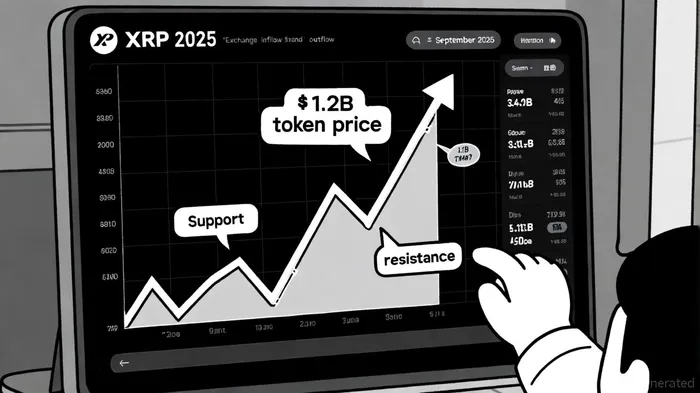
The recent 1.2 billion XRPXRPI-- token surge into exchange reserves has ignited fierce debate among market participants. While traditional on-chain analysis often interprets such inflows as bearish—a sign of increased selling pressure—the broader context of institutional ETF activity, regulatory developments, and macroeconomic factors suggests a more nuanced narrative. This article dissects the interplay between exchange dynamics, ETF-driven sentiment, and market positioning to determine whether the surge signals strategic accumulation or a prelude to a sell-off.
Exchange Inflows: Liquidity Prep or Bearish Signal?
On September 10, 2025, XRP's exchange reserves swelled by 1.2 billion tokens within 24 hours, with Binance alone adding 610 million XRP to its reserves[1]. Bithumb, Bybit, and OKX also reported significant inflows, with OKX's holdings nearly doubling from 112,000 to 233 million tokens[1]. At first glance, this appears bearish, as increased exchange inventory typically correlates with higher selling pressure. However, the timing of the surge—occurring as XRP tested its key support level of $2.73—suggests a potential reversal in sentiment.
Blockchain analytics firm Coinglass noted that the inflows coincided with a 74% month-over-month increase in CME XRP open interest, signaling rising institutional demand[1]. This divergence between on-chain metrics and futures activity hints at a possible accumulation phase, where large holders or exchanges are positioning for anticipated ETF-driven demand. Historically, when XRP has traded at or above its 30-day support level, the average 30-day return has been approximately 8%—though with a win rate of only 47–50%, indicating limited statistical significance[1].
ETF-Driven Sentiment: A Catalyst for Accumulation
The institutional landscape for XRP has evolved rapidly in 2025. Canada's 3iQ XRPQ ETF (XRPQ) now manages over CAD 150 million in assets under management (AUM), bolstered by Ripple's early investments and a 0% management fee for its first six months[2]. Meanwhile, the U.S. regulatory environment remains in flux. The SEC's delayed ruling on Franklin Templeton's XRP ETF application—now pushed to November 14—has created uncertainty, yet market odds of approval remain high at 92% on Polymarket[3].
The impending launch of the first U.S. spot XRP ETF, the Rex-Osprey XRP ETF, on September 12 adds urgency to the narrative[3]. Analysts predict that ETF approvals will attract billions in institutional inflows, potentially driving XRP's price toward $10 by year-end[3]. This anticipation may explain the recent exchange inflows, as market participants prepare for liquidity demands post-approval.
On-Chain Metrics: Institutional Confidence or Concentration Risk?
Ripple's control of 42% of XRP's supply through escrow accounts has long been a point of contention. However, recent on-chain data reveals a surge in institutional-grade wallet activity: 2,708 addresses now hold over 1 million XRP, the highest level in the asset's 12-year history[3]. This suggests growing confidence among institutional investors, who are likely accumulating XRP for long-term exposure or ETF-related strategies.
That said, the 1.2B token surge into exchanges could also reflect a distribution phase. If large holders are liquidating positions ahead of ETF-related volatility, the inflows might signal a bearish setup. Yet, the absence of direct ETF purchases during this period—no mention of 3iQ XRPQ or U.S. ETFs buying during the surge—leaves this theory unproven[3].
Macroeconomic and Regulatory Tailwinds
XRP's recent price action above $3 was partly fueled by softer-than-expected U.S. Producer Price Index (PPI) data, which eased inflationary fears and boosted risk-on sentiment[1]. Additionally, Ripple's partnerships with institutional players like Ondo Finance—launching tokenized treasuries on the XRP Ledger—highlight the asset's growing utility in real-world applications[3]. These factors, combined with regulatory clarity in the EU and anticipated U.S. approvals, position XRP as a high-conviction play for institutional investors.
Conclusion: A Tipping Point for XRP
The 1.2B token exchange surge represents a critical inflection point for XRP. While traditional bearish indicators persist, the confluence of ETF-driven demand, institutional accumulation, and macroeconomic tailwinds suggests a strategic buildup rather than a sell-off. Investors must monitor the Rex-Osprey ETF's launch and SEC rulings in the coming weeks, as these events could validate or refute the accumulation thesis. In a volatile altcoin landscape, XRP's unique positioning—bridging utility, regulation, and institutional adoption—makes it a compelling case study in market dynamics.






Comentarios
Aún no hay comentarios