
XRP's $1,000 Price Thesis: Structural Scarcity and the Domino Effect
In 2025, XRPXRP-- has emerged as a focal point for institutional investors and macroeconomic analysts, driven by a confluence of structural scarcity, regulatory clarity, and utility-driven adoption. The digital asset's journey toward a $1,000 price tag hinges on a cascading "domino effect" where controlled supply dynamics, institutional infrastructure expansion, and global macroeconomic tailwinds align to create a self-reinforcing cycle of demand and value appreciation.
Structural Scarcity: The Foundation of XRP's Value Proposition
XRP's fixed supply of 100 billion tokens, coupled with Ripple's controlled release mechanism, creates a unique scarcity profile. Only 60.1 billion tokens are in active circulation as of late 2025, with the remainder locked in escrow or held by early stakeholders. Ripple releases up to 1 billion XRP monthly, but most are re-locked for future use, effectively reducing net supply inflation to near zero according to analysis. This structural constraint ensures that rising demand-particularly from institutional players-cannot be offset by increased supply, setting the stage for a potential supply shock. Analysts argue that DeFi lock-ups, staking, and operational utility in cross-border corridors are further removing XRP from circulation, tightening supply even further.
Institutional Adoption: From Legal Clarity to Ecosystem Expansion
The resolution of Ripple's SEC lawsuit in August 2025 marked a turning point. By reclassifying XRP as a digital commodity rather than a security, the ruling eliminated a major regulatory barrier, enabling institutional investors to deploy XRP in compliance with U.S. law according to reports. This clarity catalyzed the launch of spot XRP ETFs in mid-November 2025, with the ProShares Ultra XRP ETF alone attracting $1.2 billion in inflows within weeks. These ETFs, mirroring the success of BitcoinBTC-- and EthereumETH-- ETFs, are projected to inject billions into XRP markets by 2026, deepening liquidity and institutional participation.
Ripple's strategic acquisitions, including Hidden Road (now Ripple Prime), have further solidified its institutional infrastructure. Ripple Prime now offers clearing, financing, and OTC trading services, while the RLUSD stablecoin is being used as collateral in trading desks and for on-chain settlements according to analysis. Meanwhile, Ripple's On-Demand Liquidity (ODL) service processed $1.3 trillion in transactions in Q2 2025, demonstrating XRP's utility in reducing cross-border settlement costs and times. These developments position XRP as a bridge asset in global finance, distinct from speculative cryptocurrencies.
Macroeconomic Tailwinds: Risk-On Sentiment and Rate Cuts
XRP's price dynamics are increasingly tied to broader macroeconomic trends. Favorable U.S.-China trade developments and easing inflation data have fueled a risk-on sentiment, with XRP correlating closely to the S&P 500. Analysts note that XRP's performance mirrors equity markets, particularly in anticipation of Federal Reserve rate cuts, which could reduce the opportunity cost of holding high-yield assets like crypto. Additionally, XRP's utility in cross-border corridors and tokenized asset settlements positions it to benefit from global liquidity shifts, especially as central banks explore CBDCs according to market analysis.
The Domino Effect: Scarcity, Adoption, and Price Appreciation
The interplay of structural scarcity and institutional adoption creates a self-reinforcing cycle. As demand from banks, payment processors, and ETFs grows, XRP's limited supply constrains its ability to meet this demand, driving up its price. Higher prices, in turn, incentivize further institutional adoption, creating a feedback loop. This "domino effect" is amplified by macroeconomic catalysts such as rate cuts and geopolitical stability, which reduce risk aversion and boost capital flows into XRP according to experts.
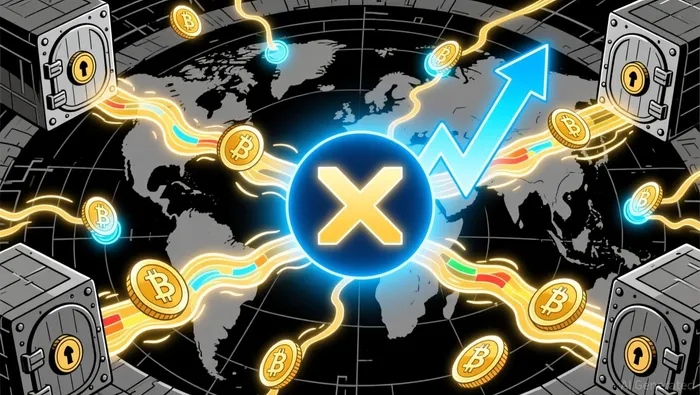
Price predictions reflect this trajectory. By late 2025, XRP is projected to reach $3.50–$4.50, with estimates climbing to $5–$8 by 2026 and $12–$25 by 2030 according to market forecasts. A $1,000 price tag, while ambitious, becomes plausible if XRP's utility expands into tokenized real-world assets and CBDC corridors, while structural scarcity remains intact.
Conclusion: A Multi-Digit Catalyst
XRP's $1,000 thesis is not a speculative leap but a logical outcome of its structural design and institutional momentum. The combination of fixed supply, controlled releases, and utility-driven adoption creates a framework where rising demand cannot be met by increased supply, forcing prices upward. As macroeconomic conditions favor risk assets and regulatory clarity removes institutional barriers, XRP is poised to transition from a niche digital asset to a cornerstone of global finance.






Comentarios
Aún no hay comentarios