
XLP vs. VDC: Which Consumer Staples ETF Is Better for Income and Stability in 2026?
In an era marked by economic uncertainty, the consumer staples sector remains a cornerstone for investors seeking resilience and income. Two of the most prominent ETFs in this space-XLP (Consumer Staples Select Sector SPDR Fund) and VDC (Vanguard Consumer Staples ETF)-offer distinct approaches to capturing this defensive sector. As 2026 unfolds, the question for income-focused and risk-conscious investors becomes: Which ETF better balances dividend yield, diversification, and risk-adjusted returns in volatile markets?
Dividend Yield: XLP's Edge, but at What Cost?
Dividend yield is a critical metric for income-oriented investors. As of 2026, XLP offers a trailing twelve-month yield of 2.69%, significantly outpacing VDC's 2.22% according to analysis. This 20% gap is not trivial, especially in a low-yield environment. Over the past decade, XLP's dividend growth has also outperformed VDC's, with a 46.3% increase versus 25.9% according to research.
However, XLP's higher yield comes with a caveat: concentration risk. XLPXLP-- holds approximately 50 stocks, with heavy exposure to large-cap consumer non-durables as reported (67.12%). This contrasts with VDC's 110+ holdings, which include a broader mix of retailers and non-durables (58.85% non-durables, 33.64% retail trade) as reported. While XLP's focus on high-yield giants like Procter & Gamble and Coca-Cola can amplify returns, it also exposes investors to single-stock volatility. For example, during the 2020 pandemic, XLP fell 8% during the market crash but rebounded quickly, whereas VDC's broader base may have cushioned some downside.
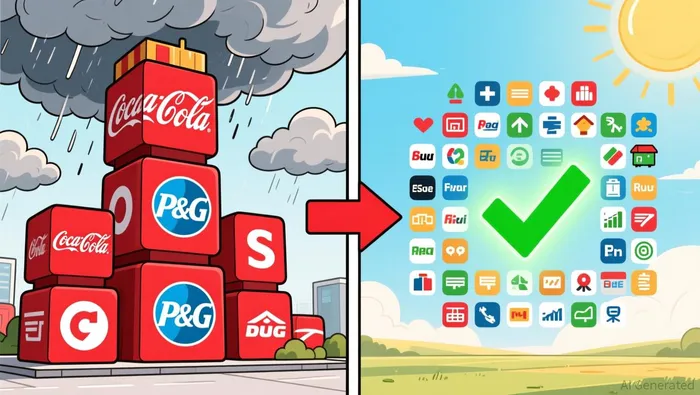
Diversification and Stability: VDC's Defensive Strength
Diversification is a double-edged sword. VDC's broader portfolio reduces single-stock risk but dilutes yield potential. This trade-off becomes critical during downturns. During the 2008 financial crisis, both ETFs faced steep drawdowns (XLP: -35.89%, VDC: -34.24%) according to financial data, but VDC's Sharpe ratio (-0.15) slightly outperformed XLP's (-0.19) according to analysis, suggesting marginally better risk-adjusted returns. Similarly, in 2020, VDC's resilience in retail trade holdings (e.g., Walmart) may have offset declines in non-durables.
Long-term growth also favors VDCVDC--. Over five years, VDC delivered a 6.78% annualized return, compared to XLP's 5.76% according to research. Over ten years, the gap widens further (7.83% vs. 7.34%) according to analysis. For investors prioritizing capital appreciation alongside modest income, VDC's diversified approach appears more sustainable.
Risk-Adjusted Returns: A Tale of Two ETFs
Both ETFs struggle in risk-adjusted metrics. XLP and VDC have negative Sharpe ratios (-0.19 and -0.15, respectively) and Sortino ratios (-0.18 and -0.12) according to financial data, reflecting underperformance relative to the risk-free rate. Their volatility is nearly identical, with daily standard deviations of 13.90% (XLP) and 13.75% (VDC) according to analysis. Beta values (0.58 for XLP, 0.6 for VDC) indicate both are less volatile than the S&P 500 as reported.
Yet, XLP's concentrated portfolio introduces unique risks. For instance, its top ten holdings account for over 50% of assets according to analysis, meaning a downturn in a key stock (e.g., a dividend cut by Coca-Cola) could disproportionately impact returns. VDC's broader exposure mitigates this, though it sacrifices yield.
ESG Considerations: A Subtle but Growing Factor
Environmental, social, and governance (ESG) metrics are increasingly relevant. XLP's ESG score (6.72) slightly edges out VDC's (6.45) according to data, but both lag behind sector averages. Carbon intensity metrics (XLP: 37.33 tons of CO2e per $M sales; VDC: 39.01) and low exposure to alternative energy highlight the sector's reliance on traditional staples according to analysis. For ESG-conscious investors, neither ETF is a standout, but XLP's marginally better score could tip the scales.
Conclusion: Balancing Income and Stability
The choice between XLP and VDC hinges on investor priorities. XLP is ideal for income-focused investors willing to accept higher concentration risk for a 2.69% yield and stronger short-term dividend growth. Its performance during the 2020 pandemic-quick recovery despite an 8% drawdown-underscores its appeal in volatile markets.
VDC, however, suits those prioritizing stability and long-term growth. Its broader diversification, slightly better risk-adjusted returns, and resilience during the 2008 crisis (-34.24% drawdown) according to financial data make it a safer bet for conservative portfolios. While its yield is lower, VDC's 6.78% five-year annualized return according to research and broader ESG exposure may align with evolving investor priorities.
In 2026, as economic uncertainty persists, the optimal choice depends on whether investors value higher income (XLP) or broader stability (VDC). For those seeking a middle ground, a balanced allocation to both ETFs could offer the best of both worlds.







Comentarios
Aún no hay comentarios