
XLM's Sudden Sell-Off: A Warning Signal or a Buying Opportunity?
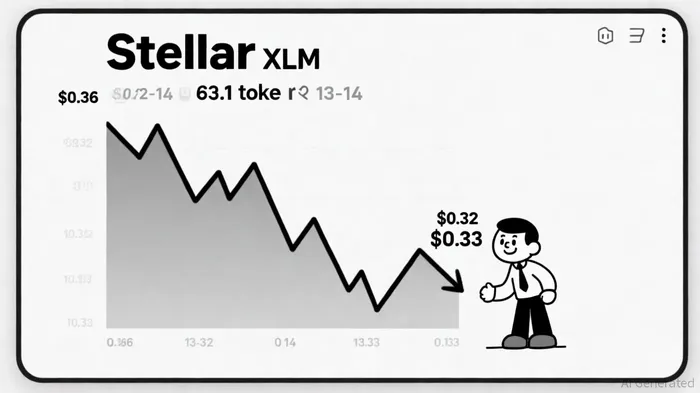
The recent sell-off in StellarXLM-- (XLM) has sparked intense debate among investors and analysts. On October 13-14, 2025, the token plummeted 8% to $0.33 amid a trading volume surge to 63.1 million tokens-well above its 24-hour average of 36.85 million[1]. This sharp decline, coupled with a breakdown below critical support at $0.34, raised alarm bells. Yet, a closer examination of market sentiment and liquidity dynamics suggests this may not be a terminal bearish signal but rather a tactical opportunity for discerning investors.
Market Sentiment: Panic or Positioning?
The sell-off initially appeared to reflect widespread panic. XLM's price fell to a local low of $0.32 before staging a late-day rebound to $0.33, driven by institutional buyers accumulating at discounted levels[1]. This pattern-sharp declines followed by rapid rebounds-points to a market dominated by algorithmic trading and institutional positioning rather than organic retail-driven fear.
Technical indicators further complicate the narrative. Open interest in XLMXLM-- derivatives surpassed $300 million during the sell-off, signaling increased institutional confidence[1]. Analysts note that the token's intraday volatility between $0.38 and $0.39, coupled with robust buying activity at lower levels, suggests a "buy the dip" mentality among long-term holders. Projections from blockchain news outlets even suggest XLM could testTST-- $0.41–$0.43 in the short term and $0.45–$0.48 by mid-2026[2]. These forecasts hinge on XLM's role in the 2025 Fedwire and SWIFT modernization efforts, which position it as a critical infrastructure asset for cross-border payments[1].
Liquidity Dynamics: A Test of Resilience
Liquidity metrics provide additional clarity. While the October 14 sell-off saw trading volume spike to 63.1 million tokens, average daily volume in 2025 had been around $308 million[3]. This suggests the selloff was concentrated in a short window, likely driven by large institutional or algorithmic players rather than a systemic liquidity crisis.
The rebound in the final hour of trading on October 14-when XLM rose 0.4% to $0.33-further underscores the token's liquidity depth. Institutional buyers appeared to step in aggressively, absorbing the oversupply and stabilizing the price. This behavior aligns with historical patterns in crypto markets, where liquidity providers often exploit volatility to accumulate assets at discounted levels[1].
A Warning or an Opportunity?
The sell-off's context is critical. XLM's price had already rebounded from a 2025 low of $0.22 to $0.49 by July, creating a volatile but fundamentally bullish backdrop[2]. The October decline merely tested key support levels, which held firm enough to trigger a rebound. For investors, this raises a pivotal question: Is this a warning of a broader bearish trend, or a correction within an ongoing bull market?
The evidence leans toward the latter. XLM's technical setup-strong support at $0.38–$0.39, rising open interest, and institutional accumulation-suggests the token is being positioned for a long-term rally. Notably, historical data shows that XLM's price has never closed below its 60-day rolling minimum since 2022[4], indicating robust support levels that have historically held firm. This resilience further supports the case for viewing the current dip as a strategic entry point.
Conclusion
XLM's October 2025 sell-off is a textbook example of crypto market volatility. While the sharp decline and volume spike may unsettle casual investors, the underlying dynamics-robust liquidity, institutional buying, and a resilient technical structure-point to a buying opportunity rather than a crisis. Investors who can stomach short-term turbulence may find XLM's discounted levels attractive, particularly given its role in the evolving financial ecosystem. As always, however, caution is warranted: the crypto market remains a high-risk asset class, and even the most compelling fundamentals can falter in the face of macroeconomic headwinds.






Comentarios
Aún no hay comentarios