
Why XLM and HBAR Are Poised for Explosive Growth in the Post-ETF Era
In the post-ETF era, the crypto landscape is shifting toward utility-driven assets. Two projects-Stellar (XLM) and HederaHBAR-- (HBAR)-stand out as undervalued, high-utility altcoins with strong institutional adoption and regulatory tailwinds. As spot ETFs for both tokens edge closer to approval, their real-world applications and technical upgrades position them for explosive growth in 2025 and beyond.
XLM: The Cross-Border Payments Powerhouse
Stellar's value proposition is rooted in its ability to facilitate low-cost, high-speed cross-border transactions. The Protocol-23 upgrade, which enhanced scalability and transaction efficiency, has made XLMXLM-- a formidable player in decentralized finance (DeFi) and institutional finance, according to a PortfoliosLab comparison. Partnerships with Visa and IBM, coupled with compliance with the ISO 20022 standard, have expanded XLM's institutional footprint, as noted in CoinMarketCap's Hedera updates. For example, Franklin Templeton's integration of StellarXLM-- for asset tokenization underscores its role in bridging traditional and crypto markets, as reported by Currency Analytics.
From a technical standpoint, XLM has shown consolidation and bullish momentum. Whale accumulation and stable exchange inflows suggest institutional positioning, with analysts predicting a potential retest of $0.50 if the token holds above $0.40 - a view covered in the Currency Analytics piece. Despite a $11.8 billion market cap, XLM remains undervalued relative to its utility in real-world asset tokenization and DeFi infrastructure, according to Cryptois facts. Its inclusion in ETFs like Hashdex's multi-asset fund further validates its regulatory standing, as highlighted in the PortfoliosLab comparison.
HBAR: Enterprise Adoption and Tokenization Catalyst
HBAR's growth is driven by its enterprise-grade utility in asset tokenization and supply chain management. Major institutions like State Street, Fidelity, and LGIM have adopted Hedera's network for tokenizing real estate and carbon credits, per an OKX analysis. The Reserve Bank of Australia's Project Acacia and Lloyds Bank's first institutional FX trade on Hedera highlight HBAR's role in cross-border settlements, as detailed in CoinMarketCap's Hedera coverage. Technological upgrades, including v0.62 and v0.63, have improved scalability and developer tools, making Hedera a robust platform for commercial applications - a point also discussed in the OKX analysis.
HBAR's energy-efficient proof-of-stake mechanism and governance model-backed by 30+ global organizations-add to its appeal for eco-conscious investors, per Cryptois facts. The proposed HBARHBAR-- ETF by Canary Capital (0.95% fee) could unlock institutional liquidity, mirroring Litecoin's ETF strategy described in the OKX analysis. Recent price action, including a breakout above key resistance levels, signals growing investor confidence, as covered in CoinMarketCap's Hedera updates. However, historical backtests of breakout strategies reveal mixed outcomes: buying HBAR on a breakout above its 50-day high and holding for 30 days yielded an average return of -7.7%, underperforming a simple buy-and-hold approach by 22.4 percentage points over the same period, as shown in the PortfoliosLab comparison.
Performance Metrics and Risk-Adjusted Returns
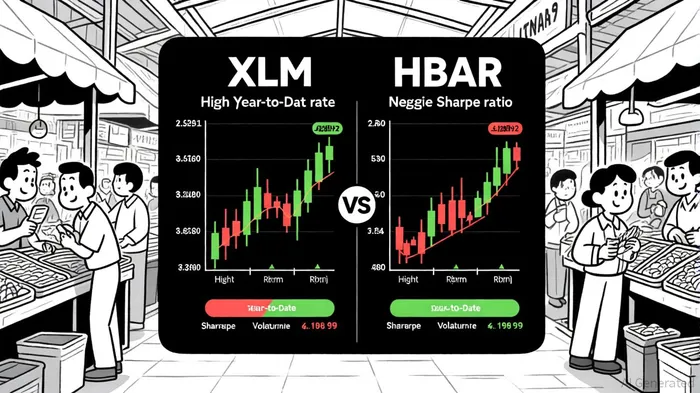
While XLM has outperformed HBAR in 2025, both tokens exhibit high volatility. As of August 2025, XLM-USD delivered a 16.01% YTD return with a Sharpe ratio of 2.34, compared to HBAR-USD's -13.93% YTD return and 2.20 Sharpe ratio, per the PortfoliosLab comparison. This suggests XLM's stronger risk-adjusted performance, though HBAR's enterprise adoption and ETF potential could close the gap.
Risks and the Path Forward
Regulatory delays, such as the U.S. government shutdown slowing SEC reviews, remain a risk, as discussed in the OKX analysis. However, both projects' utility-driven models mitigate speculative concerns. XLM's focus on cross-border payments and HBAR's tokenization capabilities align with macro trends in financial infrastructure modernization.
Conclusion: Strategic Accumulation in Undervalued Utility-Driven Assets
For long-term investors, XLM and HBAR represent compelling opportunities. XLM's institutional partnerships and DeFi integration, combined with HBAR's enterprise adoption and tokenization use cases, make them well-positioned to capitalize on the post-ETF era. As ETF approvals near, strategic accumulation in these undervalued assets could yield significant returns, particularly as their real-world utility continues to expand.






Comentarios
Aún no hay comentarios