
Xiaomi's YU7 SUV: A Tesla Disruption Catalyst—Why This $35K EV Could Rewrite China's EV Market Rules
The electric vehicle (EV) market in China is about to get a major shakeup. Xiaomi's upcoming YU7 SUV, priced at ¥253,500 (≈$35,360), directly challenges Tesla's Model Y, which starts at ¥263,500 ($36,600)—a 4% price undercut in a market where every yuan counts. But this isn't just about cents. The YU7 combines aggressive pricing, ecosystem synergies, and rapid production scalability to position itself as a TeslaTSLA-- disruptor. For investors, this could be the catalyst for a 25-30% revaluation of Xiaomi's stock by 2026, as the company capitalizes on its IoT dominance and scales globally.
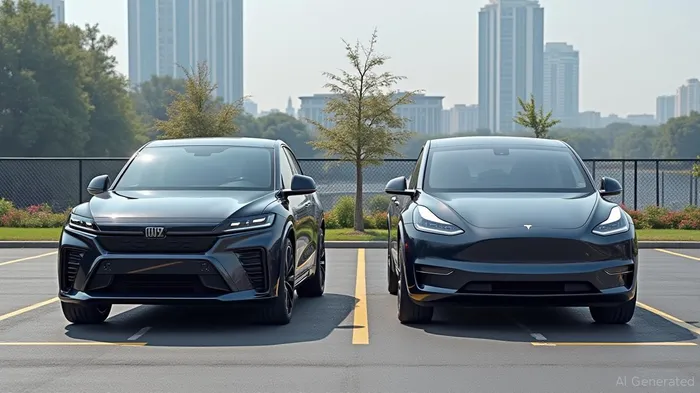
The Pricing Edge: Undercutting Tesla While Outperforming
The YU7 isn't just cheaper—it's better. Its 96.3 kWh LFP battery delivers a CLTC range of 835 km, versus the Model Y's 593 km for the base RWD variant. The YU7 Max variant, with a 101.7 kWh ternary lithium battery, achieves a 760 km range and 3.23-second 0-100 km/h acceleration, outpacing Tesla's 4.3-second best time. Add an 800V charging architecture—enabling 620 km of range in 15 minutes—and the YU7's specs are a direct hit on Tesla's weaknesses.
Tesla's Model Y has long dominated China's midsize EV market, but the YU7's $35K price point targets cost-conscious buyers without sacrificing performance. With 200,000 pre-orders secured in minutes, Xiaomi has shown it can mobilize demand at scale—a capability Tesla's premium positioning may struggle to match.
Ecosystem Synergies: Xiaomi's “Human × Car × Home” Play
The YU7 isn't just a car; it's the旗舰 of Xiaomi's IoT ecosystem, which boasts over 700 million connected devices. This integration creates a sticky, closed-loop experience:
- HyperVision Dashboard: A 1.1-meter-wide Mini LED screen controls smart home devices, video calls, and navigation—all synced with Xiaomi's Xring O1 SoC (shared with the Pad 7S Pro and Mix Flip 2 smartphone).
- AI Integration: Voice commands from Xiaomi's AI glasses or earphones can adjust climate settings, play music, or control home appliances via the car's system.
- Data Monetization: Subscriptions for navigation, cloud storage, and OTA upgrades create recurring revenue streams.
This ecosystem isn't just about convenience—it's about lock-in. Xiaomi users are more likely to buy an EV that integrates seamlessly with their existing devices. For investors, this means the YU7 isn't just a hardware play but a software-driven flywheel that strengthens Xiaomi's IoT moat.
Production Scalability: Xiaomi's SU7 Proven, YU7 On Fire
Xiaomi's SU7 sedan already outsells Tesla's Model 3 in China, with 271,000 units sold in 2024. The YU7's 200,000+ pre-orders in three minutes signal even stronger demand. Xiaomi's vertical integration (e.g., shared battery tech with CATL, a supplier for both EVs and IoT devices) and local manufacturing hubs enable fast scaling.
By 2026, Xiaomi aims to achieve a 25% gross margin, leveraging the YU7's economies of scale and ecosystem synergies. While risks like supply chain bottlenecks or regulatory hurdles exist, the SU7's track record and pre-order frenzy suggest Xiaomi can execute.
Global Ambitions and the 2027 Inflection Point
China is just the start. The YU7's €35,000 European price tag undercuts Tesla by 15-20%, while its 800V architecture and right-hand-drive variants cater to global markets. By 2027, Xiaomi plans to establish localized production in Southeast Asia and Europe, reducing costs and tariffs.
For investors, this expansion could unlock $50 billion in untapped EV markets by 2030. Xiaomi's stock, currently valued at ~$45 billion, is undervalued relative to its ecosystem potential and growth trajectory.
The Investment Case: Targeting a 25-30% Upside by 2026
Xiaomi's stock (XI) trades at 12x forward EV/Sales, a discount to Tesla's 22x and BYD's 20x. But Xiaomi's YU7 could narrow that gap as it:
1. Steals Tesla's China market share (Model Y's ~20% EV market share is ripe for disruption).
2. Monetizes its IoT ecosystem via subscriptions and data, boosting margins.
3. Scales production globally, unlocking a $46 billion addressable market outside China by 2027.
A 25-30% upside by 2026 is achievable if the YU7 captures 300,000+ annual sales and Xiaomi's EV division hits its 25% gross margin target. Risks include execution delays and Tesla's planned cost reductions, but the YU7's ecosystem-first strategy gives Xiaomi a unique edge.
Conclusion: Xiaomi's YU7 Isn't Just a Car—it's a Tesla Disruption Machine
The YU7 SUV is a triple threat: a price-competitive EV with superior specs, a flagship for Xiaomi's IoT ecosystem, and a scalable production marvel. For investors, this launch isn't just about cars—it's about owning a piece of the future of connected living. Xiaomi's stock is primed for a revaluation, and the YU7 could be the spark that lights the fuse.
Action: Buy Xiaomi (XI) now, targeting a $30+ price by end-2026 (up from ~$24 today), as the YU7 reshapes China's EV market—and investors' portfolios.





Comentarios
Aún no hay comentarios