
Xiaomi's Strategic Acceleration: A Bold Counteroffensive in the Premium Smartphone Wars
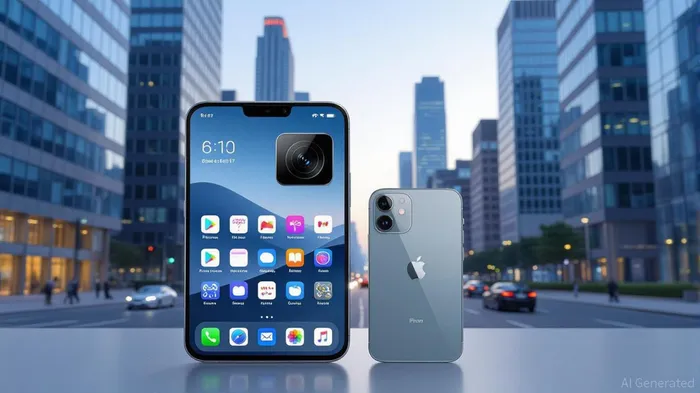
In the high-stakes arena of premium smartphones, Xiaomi's 2025 flagship launches—the Xiaomi 15 and 15 Ultra—represent a calculated and aggressive response to Apple's iPhone 17. By leveraging cutting-edge hardware, ecosystem integration, and aggressive pricing, Xiaomi is redefining its market positioning to directly challenge Apple's dominance in the premium segment. This strategic acceleration underscores Xiaomi's ambition to transition from a value-driven brand to a global technology leader.
Hardware Innovation: Closing the Gap with Apple
The Xiaomi 15 Ultra, unveiled in February 2025, boasts specifications that rival—and in some cases surpass—those of the iPhone 17. Powered by the Qualcomm Snapdragon 8 Elite chipset, the device delivers performance on par with Apple's A19 chip, while its 6.73-inch WQHD+ AMOLED display (3,200-nit peak brightness) outshines the iPhone 17's 3,000-nit Super Retina XDR panel[3]. Critically, Xiaomi's quad-camera system, anchored by a 200MP periscope lens, positions the 15 Ultra as a photography-centric device, directly competing with Apple's 48MP Dual Fusion camera system[4].
Pricing further amplifies Xiaomi's competitive edge. At €1,499 for the 512GB variant, the 15 Ultra is priced 30% below the iPhone 17 Pro Max's $1,499 (assuming a 256GB equivalent), offering investors a compelling value proposition[4]. This pricing strategy aligns with Xiaomi's historical emphasis on “premium at a discount,” a tactic that has driven its 13.8% global market share in Q3 2024[5].
Ecosystem Expansion: Beyond the Smartphone
Xiaomi's competitive response extends beyond hardware. The 15 Ultra integrates seamlessly with the company's expanding ecosystem of smart home devices, wearables, and even electric vehicles (EVs), such as the SU7. This ecosystem-driven approach mirrors Apple's closed-loop strategy but introduces a key differentiator: interoperability with non-Xiaomi devices. For instance, the 15 Ultra supports file transfers with Apple, Android, and Windows devices, broadening its appeal to multi-platform users[2].
Moreover, Xiaomi's investment in AI and satellite communication—features embedded in the 15 Ultra—signals a long-term vision to position smartphones as central hubs for connected living. The company's R&D spending of RMB 30 billion ($4.12 billion) in 2025, with 25% allocated to AI, underscores its commitment to innovation[2].
Market Positioning: A Premium Rebranding
Xiaomi's 2025 strategy reflects a deliberate shift toward premium branding. While the Xiaomi 15 (priced at €999) targets mainstream consumers, the 15 Ultra is explicitly designed to compete with the iPhone 17 Pro Max and Samsung's Galaxy S25 Ultra. This dual-tier approach allows Xiaomi to capture both price-sensitive and high-end markets, a tactic that has historically fueled its growth in emerging economies[4].
The timing of the 15 Ultra's launch—months before the iPhone 17's September 2025 debut—also suggests a strategic effort to capture early market momentum. By establishing a premium foothold ahead of Apple's release, Xiaomi aims to sway consumers who prioritize cutting-edge features over brand loyalty.
Investment Implications
For investors, Xiaomi's 2025 strategy presents both opportunities and risks. The company's aggressive R&D investment and ecosystem expansion could solidify its position as a global tech leader, particularly in markets where Apple's premium pricing is a barrier. However, sustained profitability will depend on Xiaomi's ability to balance innovation with margin pressures, as its hardware-centric model often relies on ecosystem services for long-term revenue.
Conclusion
Xiaomi's 2025 flagship launches exemplify a strategic acceleration that challenges Apple's dominance in the premium smartphone segment. By combining hardware innovation, ecosystem integration, and aggressive pricing, Xiaomi is not only closing the gap with Apple but redefining the parameters of competition. For investors, this represents a high-conviction opportunity in a sector where differentiation and ecosystem strength are increasingly decisive.





Comentarios
Aún no hay comentarios