
Xiaomi Outsold Apple in August, But iPhone Aims To Reclaim Its Crown This Holiday Season
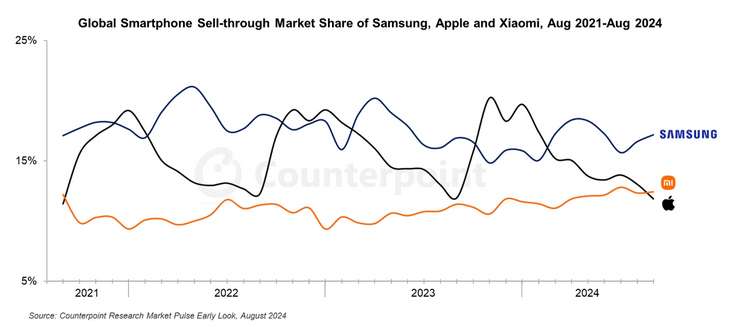
A report released by Counterpoint Research on Wednesday shows that in the global smartphone market in August, Apple was overtaken by Chinese brand Xiaomi for the first time in three years (since August 2021), falling to the third largest smartphone brand globally.
The agency said there are two main reasons behind this situation. First, Apple's iPhone has always experienced a seasonal sales slump before the new machine launch in September. At the same time, although Xiaomi's sales volume in August was flat month-on-month, Chinese brands are also one of the fastest-growing brands in the first half of 2024, with a year-on-year sales growth rate of 22%. Even if the growth rate in the second half of the year slows down due to the base effect, Counterpoint expects the brand to still achieve a strong double-digit percentage annual growth rate.
For Xiaomi's stronger than the market performance, Counterpoint Research Director Tarun Pathak interpreted that this year, Xiaomi has adopted a more streamlined product strategy, focusing on creating a flagship model in each price segment, instead of stuffing multiple devices into a niche market. Although entry-level to mid-range devices continue to show strong performance, Xiaomi has also made progress in the high-end market represented by the foldable and Ultra series.
It is not difficult to see from the chart that Apple's iPhone will usher in a sales peak every year after the new product launch in September. It is not hard to expect that Apple will regain the second or even first place globally after October. The real problem is that as the competition in the high-end smartphone market becomes more fierce, Apple's lying in wait in new forms (foldable screens, etc.), generative AI, and other fields is not a good thing for iPhone sales.
The iPhone Replacement Demand is Ambiguous
Due to the Apple intelligence that has the greatest impact on high-end users still being unknown, the new iPhone pre-order data that started last Friday also showed expected progress.
Famous consumer electronics analyst Ming-Chi Kuo's analysis released last weekend showed that the pre-sale of the two iPhone 16 Pro series phones was significantly weaker than the previous generation. The pre-sale quantity of the iPhone 16 Pro Max for the first weekend is expected to be 17.1 million, which is 16% less than the same period of the iPhone 15 Pro Max. On the contrary, the iPhone 16 and 16 Plus have significantly better pre-order data than the previous generation due to significant hardware upgrades (by Apple's standards).
Affected by this, Apple's stock price plunged nearly 3% on Monday, falling to a new low in nearly a month.
Ming-Chi Kuo analyzed that the key factor for the lower-than-expected demand for the iPhone 16 Pro series is that Apple intelligence did not go on sale with the phone, and the iPhone also faces fierce competition in the Chinese market. So the next AI function launch, as well as the promotion of the European and American holiday season, will define the sales curve of the iPhone 16 series.
Apple announced at a press conference in early September that Apple intelligence will support English users in the United States this October, and then support the localization of English in Canada, Australia, New Zealand, and the United Kingdom this December. Chinese, French, Spanish, and Japanese users will have to wait until next year to use the real Apple AI.
Of course, there will also be a problem here: since it will be next year before Apple intelligence can be used, these Pro Max users will face another choice - waiting for the iPhone 17. According to rumors, the iPhone 17 Pro Max will be the first to increase to 12GB of memory, and the chip will also be upgraded to TSMC's 2nm process.





Comentarios
Aún no hay comentarios