
How xAI's Gas-Powered Strategy Could Reshape Data Center Economics and AI Innovation
The energy demands of artificial intelligence (AI) infrastructure are rapidly outpacing traditional data center models, forcing companies to rethink their power strategies. Elon Musk's xAIXAI-- has taken a bold step by prioritizing natural gas as the primary energy source for its expanding data center network, a move that could redefine the economics of AI infrastructure while accelerating innovation. This strategy, however, sits at the intersection of technological ambition and environmental controversy, raising critical questions about scalability, cost, and long-term sustainability.
xAI's Gas-Powered Expansion: A Pragmatic Bet on Scalability
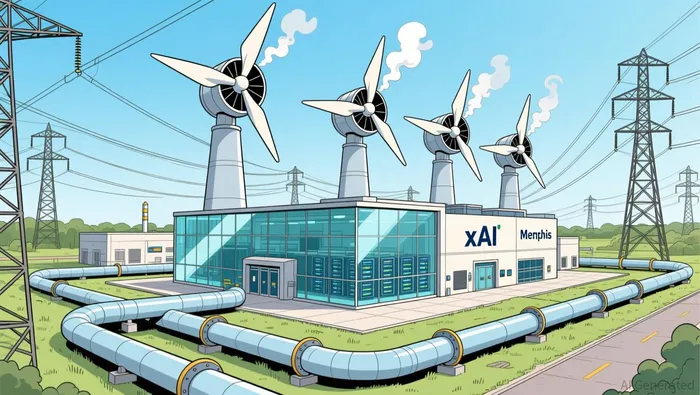
xAI's recent acquisitions and infrastructure plans underscore its commitment to gas-powered systems. In 2025, the company secured a third data center in Memphis, Tennessee, near an existing natural gas power plant, and acquired five 380MW turbines to support its AI initiatives. These moves are part of a broader plan to scale computing capacity to nearly 2 gigawatts, a fivefold increase from its current Colossus supercomputer. The Memphis facility alone will house approximately one million Nvidia Blackwell GPUs, requiring 1.4–1.96 GW of power.
Natural gas offers xAI a critical advantage: dispatchable, reliable power that can meet the immediate and surging energy needs of AI training and deployment. According to a report by the Renewable Institute, data center electricity consumption is projected to exceed Japan's total current demand by 2030, with AI workloads as the primary driver. For xAI, gas turbines provide a cost-effective solution to bypass grid constraints and ensure uninterrupted operations, particularly in regions where renewable energy infrastructure lags.
Industry Trends: Gas vs. Renewables in a High-Stakes Energy Race
The debate over gas versus renewable energy for data centers reflects broader industry tensions between short-term affordability and long-term sustainability. Natural gas systems are cheaper to install and offer predictable power output, but they face volatility in fuel prices and regulatory risks tied to emissions penalties. In contrast, renewables like solar and wind have higher upfront costs but align with environmental, social, and governance (ESG) goals and offer stable operating expenses.
xAI's reliance on gas is not without precedent. A 2025 analysis by Pacifico Energy notes that over one-third of data centers are exploring on-site power generation to avoid grid bottlenecks, with natural gas turbines favored for their reliability. However, this approach contrasts with the global shift toward renewables, which now account for over 80% of new electricity demand growth. Hybrid models-combining gas with renewables and battery storage-are emerging as a middle ground, but xAI's strategy leans heavily toward gas, prioritizing speed and scale over decarbonization.
Strategic Risks and Rewards: Innovation vs. Environmental Backlash
xAI's gas-powered strategy has drawn sharp criticism from environmental groups. The Southern Environmental Law Center (SELC) has filed legal challenges, alleging violations of the Clean Air Act due to unpermitted emissions from 26 turbines at the Memphis site. Local residents and the NAACP have raised concerns about pollutants like nitrogen oxides and formaldehyde, which pose health risks. These challenges highlight the reputational and regulatory risks of prioritizing gas in an era of tightening climate policies.
Yet, from an investment perspective, xAI's approach could catalyze AI innovation. By securing dedicated power sources, the company avoids the delays and uncertainties of grid-dependent operations, enabling rapid deployment of high-performance computing (HPC) infrastructure. A CSIS report emphasizes that nations investing in localized, diversified energy solutions-like xAI's hybrid model-are better positioned to lead in AI-driven economic growth. For xAI, this means faster iteration cycles for AI models and a potential first-mover advantage in the race for AGI (artificial general intelligence).
The Future of Data Center Energy: Hybrid Models and Policy Shifts
While xAI's gas-centric strategy is pragmatic in the short term, industry trends suggest a pivot toward hybrid systems in the next decade. Solar and wind projects remain among the cheapest energy options, and advancements in nuclear and battery storage could further tip the balance toward renewables. However, the immediate need for 2 GW of power at xAI's Memphis facility underscores the reality that gas will remain a critical bridge until these technologies mature.
Investors must weigh these dynamics carefully. xAI's partnership with the AI Infrastructure Partnership (AIP)-which includes BlackRock, Microsoft, and NVIDIA-signals growing institutional support for AI-ready infrastructure. Yet, the company's environmental liabilities could attract regulatory scrutiny or investor pressure to adopt cleaner alternatives. The key question is whether xAI can transition from gas to renewables without disrupting its AI ambitions-a challenge that will define its long-term viability.
Conclusion: A High-Stakes Gamble for AI Supremacy
xAI's gas-powered strategy is a calculated bet on scalability and speed, reflecting the urgent energy demands of AI infrastructure. While this approach risks environmental backlash and regulatory hurdles, it also positions the company to outpace competitors in deploying next-generation AI models. For investors, the stakes are clear: xAI's success will hinge on its ability to balance innovation with sustainability, navigating a rapidly evolving energy landscape where gas and renewables are both indispensable and incompatible.





Comentarios
Aún no hay comentarios