
WYNN Q2 Earnings: Is the Premium Casino Giant at a Strategic Inflection Point?
Wynn Resorts (WYNN) has long been a bellwether for the global luxury gaming and hospitality sector. Its Q2 2025 earnings report, however, signals a pivotal moment in its strategic evolution. With a modest revenue increase, declining net income, and a $5.1 billion UAE expansion in the works, the company is navigating a delicate balance between capital allocation discipline, brand premiumization, and high-risk, high-reward geographic diversification. For investors, the question is whether WynnWYNN-- is at a strategic inflection point—or merely recalibrating for a new era of global gaming.
Capital Allocation: Shareholder Returns vs. Long-Term Bet on the UAE
Wynn's Q2 results revealed a $158.1 million stock repurchase program and a $0.25 dividend, underscoring its commitment to rewarding shareholders. These actions are critical in a market where cash flow has dipped: net income fell 41% year-over-year to $66.2 million, while Adjusted Property EBITDAR declined 3.3% to $552.4 million. Yet, the company's balance sheet remains robust, with $1.98 billion in cash and $10.54 billion in debt—a leverage ratio that, while elevated, is manageable given its access to refinancing.
The UAE expansion, however, is a capital-intensive gamble. Wynn has already injected $741.1 million into the Wynn Al Marjan Island joint venture, with $58.2 million added in Q2 alone. The project's $5.1 billion budget—$1.2 billion above initial estimates—reflects its ambition to create a “destination within a destination” in Ras Al Khaimah. While this spending may strain short-term liquidity, the long-term payoff could be transformative. The UAE market is projected to generate $3–$5 billion in annual gaming revenue, with Wynn's share potentially reaching $1.375–$1.875 billion post-launch.
Premium Positioning: The Art of Monetizing Exclusivity
Wynn's brand equity remains its most valuable asset. In 2025, the company has doubled down on its “unmatched luxury” positioning through hyper-personalized guest experiences, AI-driven marketing, and strategic partnerships. For instance, its Wynn Rewards program now drives a 15% increase in repeat bookings, with loyalty members spending 20% more per visit. Meanwhile, digital marketing spend rose 15% year-over-year to $100 million, boosting SEO traffic by 25% and website engagement by 30%.
The company's focus on VVIPs is particularly telling. In the UAE, 37% of projected gaming revenue hinges on ultra-high-net-worth international clients—a demographic Wynn has mastered in Macau and Las Vegas. By securing high-profile retail tenants and exclusive entertainment offerings (e.g., the “Awakening” performance), Wynn is replicating its playbook in a market where demand for luxury is surging.
Sustainability is another pillar of its premium strategy. A $20 million investment in energy-efficient technologies aligns with the preferences of eco-conscious travelers, a growing segment in the luxury sector. This not only enhances brand appeal but also future-proofs operations against regulatory and consumer shifts.
UAE Expansion: A Strategic Masterstroke or Overreach?
The UAE project's transformative potential hinges on three factors: market dynamics, regulatory tailwinds, and Wynn's operational prowess.
Market Dynamics: The UAE's gaming market is expected to rival Las Vegas and outpace Singapore, with Wynn's 33% projected revenue share positioning it as a clear leader. The jointJYNT-- venture's 40% stake in adjusted property EBITDA, coupled with a 36–43% margin forecast, suggests strong profitability.
Regulatory Tailwinds: The UAE's licensing model—granting one casino per emirate—gives Wynn a near-monopoly in Ras Al Khaimah. This exclusivity, combined with lower tax rates and a focus on expatriate and international customers, creates a favorable environment.
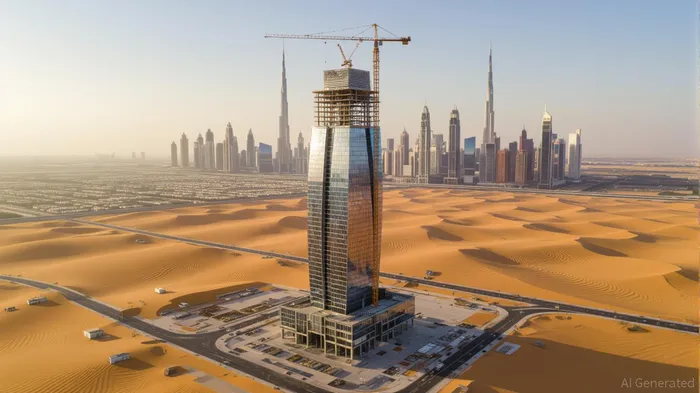
Operational Prowess: Wynn's track record in Macau and Las Vegas demonstrates its ability to execute large-scale projects. The UAE expansion, however, tests its adaptability. With construction on the 61st floor of the tower underway and key partnerships secured, the company appears on track for a 2027 opening.
Investment Implications: Balancing Risk and Reward
Wynn's Q2 results highlight a company in transition. While near-term metrics are mixed, the UAE project represents a strategic pivot toward diversification and long-term growth. For investors, the key risks include:
- Debt Load: At $10.54 billion, Wynn's debt is substantial, though manageable with its $1.98 billion cash reserves and recent $1.5 billion credit facility expansion.
- UAE Execution Risk: Delays or cost overruns in the UAE could strain cash flow.
- Macau Headwinds: Wynn Palace's declining EBITDAR (down 15% year-over-year) underscores the challenges in its core market.
However, the rewards are equally compelling. If the UAE project meets its $1.375–$1.875 billion net revenue forecast, Wynn could achieve a more balanced global earnings profile, reducing its historical reliance on Macau. Deutsche Bank's 14.4–16.1% free cash flow yield estimate, while optimistic, reflects the potential for value creation.
Conclusion: A Strategic Inflection Point?
Wynn Resorts is at a crossroads. Its capital allocation discipline—buybacks, dividends, and prudent debt management—supports near-term stability, while its premium positioning and UAE expansion aim to redefine its long-term trajectory. The UAE project, in particular, could be a game-changer, offering a new revenue stream in a market with significant upside.
For investors, the decision hinges on confidence in Wynn's ability to execute. The company's history of innovation and luxury branding suggests it is well-equipped to navigate this transition. However, patience is required. The UAE's 2027 opening is still two years away, and the path to profitability will demand careful management of costs and expectations.
In the end, Wynn's strategic inflection pointIPCX-- is not a binary event but a continuum. The question is whether the company's bold bets will pay off in a world where luxury gaming is no longer confined to Las Vegas or Macau—but is now a global phenomenon.





Comentarios
Aún no hay comentarios