
WTI Oil Price Dynamics: Navigating Short-Term Bearish Pressures and Contrarian Opportunities
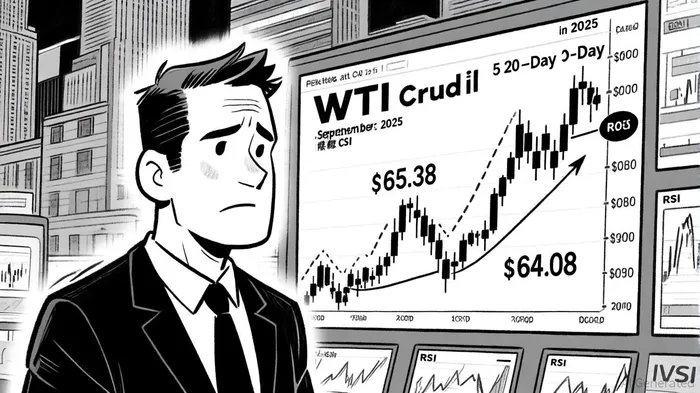
The West Texas Intermediate (WTI) crude oil market in Q3 2025 has been shaped by a complex interplay of OPEC+ supply adjustments, geopolitical tensions, and evolving demand dynamics. While the recent 547,000 barrels-per-day (bpd) production hike by OPEC+ members—fully reversing earlier voluntary cuts—has injected additional supply into the market, the actual impact on prices has been tempered by underproduction from key members and persistent bearish sentiment[1]. This article dissects the short-term bearish pressures on WTIWTI-- prices and identifies strategic entry points for contrarian investors navigating this volatile landscape.
Short-Term Bearish Pressures: OPEC+ Flexibility and Global Oversupply Risks
OPEC+'s September 2025 production increase, while gradual, signals a strategic shift toward reclaiming market share amid stable global economic growth and low inventory levels[3]. However, the group's flexibility to pause or reverse the hike if conditions deteriorate underscores lingering uncertainties. Goldman SachsGS-- estimates that the effective supply increase will be around 1.7 million bpd, lower than the nominal 2.5 million bpd, due to underperformance by some members[1]. This discrepancy highlights the challenges of enforcing compliance in a coalition with diverse geopolitical and financial constraints.
Meanwhile, the International Energy Agency (IEA) has warned of an impending global oil surplus, driven by supply growth outpacing demand forecasts[3]. WTI prices have already reflected this bearish outlook, slipping below $67.31 in early September 2025 and consolidating near $62.56 by month-end—a 8.87% year-over-year decline[3]. Geopolitical tensions, including U.S. threats of tariffs on Russian crude and Ukrainian strikes on Russian energy infrastructure, further cloud the outlook, creating a tug-of-war between supply-side adjustments and demand-side risks[1].
Technical Analysis: Oversold Conditions and Key Support Levels
From a technical perspective, WTI's price action in September 2025 reveals a strongly bearish trend. The 5-Day and 20-Day moving averages stand at $63.15 and $65.14, respectively, with the price currently below the critical $63.00 resistance level[4]. The Relative Strength Index (RSI) at 32.79 indicates oversold conditions, while the MACD (12,26,9) at -0.2200 reinforces bearish momentum[4].
Historical rebounds around key support levels—particularly $65.38 and $64.08—have shown resilience, with prices frequently testing and bouncing off these thresholds[2]. For instance, in early September 2025, WTI drifted lower to $62.70 but found temporary support near $63.00 amid OPEC+ policy uncertainty[2]. Analysts suggest that a sustained break below $61.45–$62.05 could trigger further declines toward $58.19 or even $56.83–$57.21[4]. However, these levels also present strategic entry points for contrarian investors betting on a short-term rebound.
Strategic Entry Points for Contrarian Investors
For investors seeking to capitalize on WTI's volatility, the following strategies emerge:
1. Buy-the-Dip Opportunities at $65.38–$64.08: These levels have historically acted as psychological floors for WTI. A rebound above the 200-day moving average at $63.31 could signal a short-term reversal, particularly if OPEC+ pauses its production hike or global demand stabilizes[2].
2. Hedging Against Oversupply Risks: Given the IEA's surplus warnings, investors might consider short-term options or inverse ETFs to hedge against further declines if WTI breaks below $61.45[3].
3. Monitoring OPEC+ Flexibility: The group's ability to adjust production in response to market conditions remains a wildcard. A pause in the September 2025 hike could catalyze a near-term rally, while continued output increases may prolong bearish pressure[1].
Conclusion: Balancing Bearish Fundamentals with Technical Resilience
WTI's near-term trajectory remains heavily influenced by OPEC+'s supply management and global demand uncertainties. While the bearish bias persists, technical indicators and historical rebounds at key support levels offer contrarian investors a roadmap to navigate the volatility. The critical challenge lies in timing entries around $65.38 and $64.08 while remaining cognizantCTSH-- of broader macroeconomic risks, including U.S. monetary policy and geopolitical shocks. As the market approaches winter, the interplay between these factors will likely determine whether WTI finds a floor or continues its descent.





Comentarios
Aún no hay comentarios