
WTI Crude: A 2026 Glut, Tested by Historical Analogies
The dominant trend for 2026 is a supply-driven bear market. The setup is a projected global surplus that OPEC+ appears largely powerless to stop. The latest consensus, a Reuters poll conducted in December, already pointed to this path, forecasting WTI crude to average $58.15 per barrel for the year. That forecast was made before the recent political crisis in Venezuela, which could eventually add to supply. The core thesis, however, is structural: analysts expect supply to exceed demand.
This expectation is shared by major institutions. The International Energy Agency and the U.S. government both project that global production will outstrip consumption, with output reaching a 4-year high in 2025 and a record this year. The market is already pricing in this imbalance, with prices tumbling to 2-week lows last week on these concerns. The surplus is expected to persist, with one forecast predicting Brent crude will fall to an average of $55 per barrel in the first quarter of 2026 and remain near that level for the rest of the year.
Viewed through a historical lens, this is a familiar pattern. When supply consistently outpaces demand, even coordinated production cuts struggle to create a lasting floor. The recent OPEC+ meeting, which left output unchanged, underscores this dynamic. As one analyst noted, holding production steady helps limit near-term volatility but does not materially alter the underlying surplus. The path for WTI is therefore downward, tested by a glut that structural forces are set to deepen.
OPEC+'s Limited Toolkit: Policy vs. Reality
The group's recent actions reveal a stark gap between stated policy and the reality of a massive supply overhang. At its meeting last week, OPEC+ agreed in principle to maintain steady output, a decision made despite significant internal tensions and the political upheaval in Venezuela. This stance is a direct response to the market's clear message: prices have already fallen more than 18% in 2025, their steepest yearly drop in years, as oversupply fears took hold.
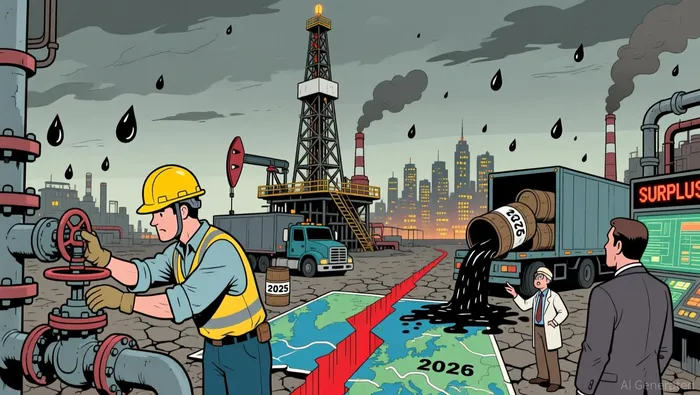
Yet the group's own past moves undermine this stability narrative. The eight core OPEC+ members have already raised their output targets by around 2.9 million barrels per day for the latter half of 2025, a volume equal to almost 3% of world demand. This expansion was a deliberate choice to meet demand, not a sign of restraint. Their current pause on production hikes for February and March 2026 is a seasonal adjustment, not a structural reduction. As they reiterated, the 1.65 million barrels per day may be returned in part or in full if market conditions warrant, retaining full flexibility to reverse course.
This is a familiar script. It mirrors the 2014-2016 period, when OPEC's decision to maintain output despite a surging U.S. shale glut failed to halt a sustained price decline. Then, as now, the group's primary tool was managing the pace of supply growth, not stopping it. The current setup-a projected global surplus, a record-high production base, and a policy of holding steady-creates a structural headwind that even coordinated output management cannot easily overcome. The toolkit is limited, and the market is testing its limits.
Geopolitical Noise vs. Market Reality
The market is caught between two forces: short-term geopolitical noise and a long-term structural reality. Recent price action shows a market in indecision. Over the past four sessions, average fluctuations have been limited to around 3%, a move that remains insufficient to define a clear trend. This consolidation reflects a phase of uncertainty, where recurring geopolitical announcements add volatility but fail to break the dominant bearish bias.
Consider the recent U.S. capture of Venezuela's President Maduro. In theory, this could be bearish, with the U.S. aiming to boost production. In practice, the event is a small geopolitical spark. Venezuela produces less than 1 million barrels of oil a day, a volume that is dwarfed by the projected global surplus. More importantly, any meaningful increase in output from U.S. investment will take years to materialize. The immediate market impact is muted by this fundamental scale.
Geopolitical risk premiums have indeed increased, with protests in Iran and uncertainty over Venezuelan exports adding a bullish tilt at times. Prices rose last week on fears of supply disruptions from Iran. Yet these premiums are capped by the overwhelming force of oversupply. As one analysis notes, broader supply concerns were reinforced by worries about the Russia-Ukraine war, even as rising global inventories and oversupply risks continued to cap gains. The market's focus remains fixed on inventory builds and demand destruction, not on isolated production shocks.
This dynamic is structurally familiar. It mirrors the 2022 Russia-Ukraine war, where initial supply shocks were quickly overshadowed by the market's focus on inventory accumulation and weakening demand. Then, as now, the fundamental imbalance between supply and demand set the long-term trajectory. Geopolitical events can cause short-term price spikes, but they cannot alter the path of a glut. For now, the market is testing the limits of that noise, with the structural headwind proving far more powerful.
Catalysts and Guardrails for the 2026 Thesis
The 2026 thesis is not a closed loop; it is a dynamic setup where specific events and price levels will act as catalysts or guardrails. The market's next major test comes in early February, when OPEC+ meets to review conditions. The group has already signaled its flexibility, with the eight core members reiterating that the 1.65 million barrels per day may be returned in part or in full if needed. A decision to reverse its pause and cut output would be a direct policy shift against the surplus forecast. Conversely, a continuation of the status quo would reinforce the structural bearish bias.
Technical levels provide a clear, immediate guardrail. WTI has formed a double-bottom pattern, with the critical point at $55.39. A sustained break below this level would signal the pattern has failed and could accelerate the decline toward the next major support at $50. This is a structural test: the pattern's failure would validate the oversupply narrative in real-time price action, while a bounce above it would offer a temporary reprieve.
The most direct, weekly signal comes from U.S. crude oil inventories. The Energy Information Administration's weekly report is a key gauge of the surplus. Rising stocks are a direct bearish signal, confirming that supply is outstripping demand in the world's largest consumer. The market is already pricing in this reality, but the weekly data will show whether the forecast is being met or exceeded. As one analysis notes, rising global inventories and oversupply risks continued to cap gains in the past, and the same dynamic will govern the near-term path.
The bottom line is that the 2026 thesis is being tested on multiple fronts. The February OPEC+ meeting offers a potential policy catalyst, the $55.39 technical level defines a near-term price guardrail, and weekly inventory data provides the fundamental confirmation. For now, the structural headwind remains intact, but these are the specific points where the market will decide if the forecast is accelerating or stalling.







Comentarios
Aún no hay comentarios