
Wormhole's Strategic Reserve and Tokenomics: A New Paradigm for Value Stability
In the rapidly evolving landscape of cross-chain infrastructure, Wormhole's W 2.0 tokenomics and governance upgrades represent a bold reimagining of how decentralized protocols can stabilize token value while fostering community alignment. By introducing a Strategic Reserve funded by on-chain and off-chain protocol revenues, WormholeW-- aims to create a self-sustaining ecosystem where token value is intrinsically tied to network growth and utility. This analysis explores how these innovations—coupled with a restructured token supply schedule and multichain governance—position Wormhole as a compelling case study in token value engineering.
Strategic Reserve: A Foundation for Token Value Stability
Wormhole's Strategic Reserve is designed to act as a counterbalance to market volatility by locking up W tokens using protocol-generated revenues. According to a report by The Block, the reserve will accumulate income from cross-chain transactions, the Wormhole Portal, and ecosystem applications, using these funds to buy back and burn W tokens or allocate them to long-term value-creation initiatives [1]. This mechanism mirrors traditional corporate treasury practices but operates entirely on-chain, ensuring transparency and decentralization.
The reserve's impact is amplified by a 4% base yield for W token stakers, funded by protocol revenues without introducing inflation [2]. This yield is further boosted for users engaging with the Wormhole Portal through “Portal Earn,” creating a flywheel effect where increased usage directly benefits token holders. By aligning incentives between users, developers, and validators, Wormhole reduces the risk of speculative dumping and encourages long-term participation.
Tokenomics 2.0: Supply Dynamics and Unlock Schedules
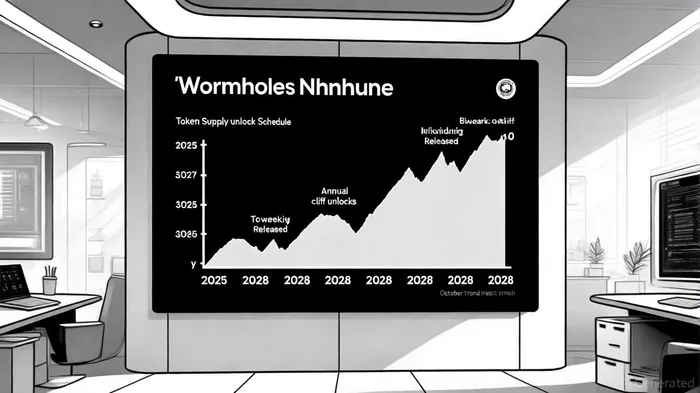
A critical component of Wormhole's value proposition is its revised token supply schedule. Previously, large annual cliff unlocks posed significant downward pressure on W's price. Under W 2.0, these have been replaced with bi-weekly unlocks starting October 3, 2025, and extending through October 2028 [3]. This gradual release reduces market saturation while maintaining liquidity for key stakeholders, including Guardian Nodes and ecosystem participants.
The token supply remains capped at 10 billion, with 31% allocated to ecosystem growth and 23.3% to the Foundation Treasury [4]. By preserving time-locked agreements for Core Contributors and the Foundation Treasury, Wormhole ensures that token distribution remains aligned with long-term network development rather than short-term profit extraction.
Governance Alignment: Stake for Governance and MultiGov
Wormhole's governance model, now live via the Tally Governance Portal, represents a significant step toward decentralization. The “Stake for Governance” mechanism allows W holders to delegate voting power to trusted delegates across EthereumETH--, ArbitrumARB--, Optimism, and Base [5]. This system, part of the MultiGov framework, enables cross-chain governance proposals to be executed seamlessly, ensuring that decision-making reflects the interests of a globally distributed community.
The Wormhole DAO, set to launch in Q1 2025, will further decentralize control by empowering token holders to vote on critical upgrades, fee structures, and chain integrations [6]. This transition from centralized governance to a community-driven model reduces the risk of regulatory scrutiny and enhances trust in the protocol's long-term viability.
Implications for Investors
For investors, Wormhole's Strategic Reserve and tokenomics upgrades present a compelling risk-rebalance. The reserve's buyback mechanism and yield incentives create a floor for W's value, while the revised unlock schedule mitigates supply-side volatility. Additionally, the governance framework ensures that token holders have a direct stake in the protocol's evolution, fostering a virtuous cycle of participation and growth.
However, challenges remain. The success of the Strategic Reserve depends on sustained protocol revenue, which could be impacted by broader market conditions or competition in the cross-chain space. Investors should also monitor the DAO's early governance outcomes to assess whether community-driven decisions enhance or hinder adoption.
Conclusion
Wormhole's W 2.0 represents a paradigm shift in how blockchain protocols approach token value stability. By integrating on-chain governance, strategic reserves, and yield incentives, Wormhole addresses key pain points in decentralized finance while positioning itself as foundational infrastructure for the internet economy. For investors seeking exposure to innovation at the intersection of tokenomics and governance, Wormhole's ecosystem offers a unique opportunity—one where value creation is as much about design as it is about adoption.






Comentarios
Aún no hay comentarios