
Wormhole's W 2.0 Tokenomics: A Strategic Play for Institutional Adoption and Token Value Stability
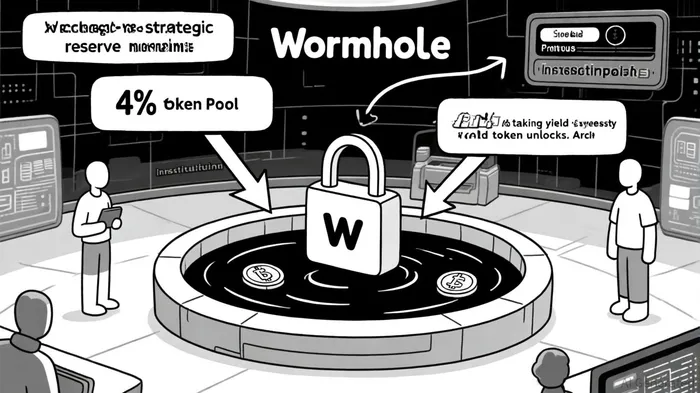
In the ever-evolving crypto landscape, tokenomics have become a battleground for protocols seeking to balance growth, stability, and institutional appeal. Wormhole's recent W 2.0 upgrade introduces a suite of innovations—most notably a strategic reserve, a 4% base staking yield, and bi-weekly token unlocks—that aim to redefine how cross-chain infrastructure tokens accrue value. These changes are not just technical tweaks but a calculated response to market volatility and institutional skepticism. Let's dissect how these mechanics could catalyze adoption and position WormholeW-- as a cornerstone of institutional-grade crypto infrastructure.
Strategic Reserve: A Permanent Holder of Value
At the heart of W 2.0 is the Wormhole Reserve, a mechanism designed to accumulate protocol revenues from on-chain activities like the Wormhole PortalPORTAL-- and ecosystem applications into a pool of W tokens [1]. This reserve functions as a “permanent holder,” systematically purchasing W tokens on the open market to create sustained demand [3]. By locking up protocol-generated value, the reserve directly ties token appreciation to ecosystem growth—a critical shift from traditional token models that often decouple token value from utility.
For example, fees from the Wormhole Portal—used to tokenize real-world assets (RWAs) across chains—are now funneled into the reserve [4]. This creates a flywheel: as more institutions tokenize assets via Wormhole (e.g., BlackRockBLK-- and ApolloAPO-- leveraging its infrastructure [4]), the reserve grows, further supporting W's price. According to a report by TheBlock, this mechanism ensures that token value is “derived from active usage rather than speculative inflows” [1], a key differentiator in an industry plagued by vaporware.
4% Staking Yield: No Inflation, Maximum Incentive
Wormhole's 4% base staking yield is funded entirely by protocol revenues and existing token supply, avoiding the inflationary pitfalls of traditional staking models [2]. This yield is variable and tied to governance participation, with users earning additional rewards through the Portal Earn program by interacting with the Wormhole Portal [3]. For institutional investors, this structure offers a predictable return stream without diluting token value—a rare combination in crypto.
Consider the math: with 4.7 billion W tokens in circulation (out of a 10 billion cap [4]), a 4% yield on staked tokens translates to ~188 million W tokens annually being distributed as rewards. Since these tokens are sourced from the reserve (not newly minted), the model avoids inflation while incentivizing long-term holding. As stated by Blockonomi, this “aligns token holder incentives with protocol growth” [4], a critical factor for institutional adoption.
Bi-Weekly Unlocks: Smoothing the Volatility Curve
Historically, annual cliff unlocks of Wormhole's token supply caused market pressure and volatility. W 2.0 replaces this with bi-weekly unlocks, starting October 3, 2025, and extending through October 2028 [1]. This gradual release applies to guardian nodes, community allocations, and strategic participants, ensuring a more stable supply schedule.
Data from TheBlock highlights that this change reduces “predictable sell pressure” by spreading token availability over time [1]. For institutions, this predictability is invaluable—it lowers operational risk and aligns with traditional financial instruments like ETFs, which thrive on stable, measurable returns. The extended lock periods for core contributors further reinforce long-term alignment, a trait increasingly valued in institutional portfolios.
Institutional Adoption: From RWAs to ETFs
Wormhole's strategic reserve and yield model are not just theoretical—they're already attracting institutional attention. Major players like BlackRock and Apollo are using Wormhole to tokenize and distribute assets across multiple chains, boosting total value locked (TVL) and transaction volumes [4]. This infrastructure role positions Wormhole as a backbone for RWA tokenization, a sector projected to grow exponentially as regulators clarify frameworks for digital assets.
Moreover, the structured staking yield aligns with emerging trends in institutional staking. As noted by Coin Telegraph, innovations like distributed validator technology (DVT) are making staking safer and more accessible for institutions [4]. Wormhole's 4% yield, combined with its cross-chain utility, could position it as a preferred asset for ETFs and other institutional vehicles—especially under a regulatory environment that may favor structured, low-volatility tokens [1].
Conclusion: A Blueprint for Institutional-Grade Tokenomics
Wormhole's W 2.0 upgrade is more than a technical overhaul—it's a strategic repositioning. By creating a self-sustaining reserve, offering inflation-free staking yields, and smoothing token unlocks, Wormhole addresses three core pain points for institutional investors: volatility, predictability, and alignment with real-world utility. As RWA tokenization and structured staking gain traction, Wormhole's model could serve as a blueprint for protocols seeking to bridge the gap between crypto and traditional finance.
For investors, the question isn't whether Wormhole's tokenomics are innovative—it's whether the market will recognize their potential to drive adoption and institutional capital. With bi-weekly unlocks starting in October and institutional players already on board, the next few quarters could be pivotal.





Comentarios
Aún no hay comentarios