
World Liberty Financial's Recent Price Decline and Market Implications: Navigating Short-Term Volatility Amid Long-Term Banking Sector Dynamics
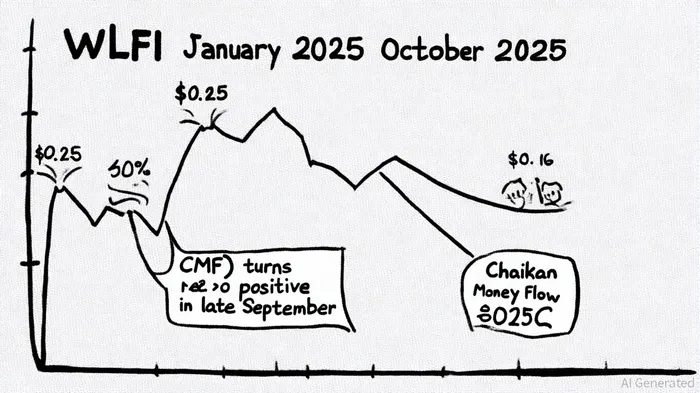
World Liberty Financial's (WLFI) token has become a lightning rod for debates about short-term volatility versus long-term value in the crypto and banking sectors. Since its token generation event (TGE) in late 2024, WLFIWLFI-- has experienced a 40% post-launch decline, with its price plummeting from $0.331 to $0.169 as of October 2025, according to a CoinEdition prediction. This collapse has been driven by a toxic mix of governance controversies, regulatory risks, and broader macroeconomic headwinds. Yet, amid the chaos, some analysts argue that WLFI's token burns and governance-driven strategies could yet unlock long-term value-if the project survives the current turbulence.
Short-Term Volatility: Governance Crises and Market Sentiment
WLFI's recent freefall has been exacerbated by governance-related scandals. The blacklisting of 272 wallets-including one belonging to major investor Justin Sun-has fueled accusations of centralized control and market manipulation, according to an FXLeaders report. Critics argue that these actions undermine the token's decentralized ethos, eroding trust in its governance model. Compounding this, the FXLeaders report also suggests technical analysis that points to further declines to $0.15 or $0.10 as the token trades below key support levels.
However, not all is bleak in the short term. A cautious optimism persists among some traders, who point to a cup-and-handle pattern forming on the 4-hour chart and a positive turn in the Chaikin Money Flow (CMF) indicator, according to a CCN analysis. If WLFI breaks above the $0.23 resistance level, it could surge toward $0.25 and even $1 by year-end, according to bullish scenarios. The governance team's pledge to burn 100% of protocol fees to reduce supply also offers a theoretical floor for value, though investor confidence remains fragile, the CoinEdition prediction notes.
Long-Term Value: Crypto's Parallels to Regional Banking Challenges
To contextualize WLFI's struggles, it's instructive to compare its trajectory to broader trends in the regional banking sector. According to Deloitte, regional banks with $10–$100 billion in assets face existential risks from commercial real estate (CRE) exposure and evolving regulatory frameworks. Similarly, WLFI's crypto treasury-anchored in assets like USDCUSDC--, WBTC, and ETH-has seen mixed performance, with a 50% drop in ETH value alone contributing to a $4.28 million loss in its portfolio, according to Analytics Insight.
The parallels extend to regulatory uncertainty. Just as the Basel III endgame's delayed implementation has created a fragmented landscape for traditional banks, WLFI faces existential threats from the pending GENIUS Act, which could impose stricter rules on stablecoin operations tied to its Trump family affiliations, per a CoinMarketCap prediction. Yet, both sectors share a common playbook for resilience: capital optimization. For regional banks, this means reducing excess capital and boosting noninterest income, a theme echoed in industry coverage. For WLFI, it translates to aggressive token burns and buybacks, which some analysts see as catalysts for a rebound to $0.40 by year-end and $0.90 by 2030 under optimistic scenarios, according to the CoinEdition prediction.
The Path Forward: Balancing Act or House of Cards?
WLFI's future hinges on its ability to navigate two critical junctures. First, it must prove that its governance model can decentralize control while maintaining liquidity and transparency. The recent wallet freezes have done little to assuage fears of centralization, and further missteps could trigger a liquidity crisis. Second, the token must weather regulatory scrutiny. The GENIUS Act's potential impact on stablecoin operations could mirror the Basel III endgame's ripple effects on traditional banks, forcing WLFI to adapt or face obsolescence.
For investors, the key question is whether WLFI's token burns and governance reforms can offset its short-term volatility. While the cup-and-handle pattern and CMF reversal offer hope, these signals must be validated by sustained buying pressure and regulatory clarity. In the broader market, WLFI's struggles underscore a recurring theme: the tension between innovation and stability in both crypto and traditional finance.
Conclusion
WLFI's price decline is a microcosm of the challenges facing high-growth assets in 2025. Short-term volatility is driven by governance crises and regulatory risks, while long-term value depends on the project's ability to align with macroeconomic trends and investor trust. For now, the token remains a high-risk, high-reward proposition-much like the regional banks grappling with CRE exposure and Basel III revisions. Whether WLFI emerges as a success story or a cautionary tale will depend on its capacity to adapt to a rapidly shifting landscape.






Comentarios
Aún no hay comentarios