
World Liberty Financial: A Disruptive Force in Digital Banking or a Regulatory Quagmire?
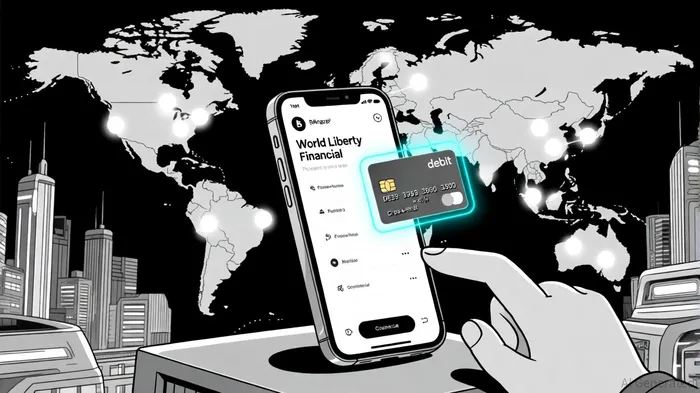
The fintech landscape in 2025 is defined by two competing forces: the relentless push for innovation and the tightening grip of regulatory scrutiny. At the center of this tension stands World Liberty Financial (WLF), a Trump-backed project aiming to bridge traditional finance and crypto through its new app and debit card. With a bold vision to make stablecoins like USD1USD1-- a staple of everyday transactions, WLF's offerings—dubbed “Venmo meets Robinhood”—are positioned as a disruptive entry point in digital banking. But can they overcome the headwinds of token volatility, regulatory skepticism, and stiff competition?
The Product: A Chain-Agnostic Bridge to Mainstream Adoption
WLF's flagship products—a debit card and retail app—are designed to democratize access to stablecoins and digital assets. The debit card, integrated with AppleAAPL-- Pay, allows users to spend USD1 stablecoin at millions of merchants globally, effectively transforming the token into a “digital dollar” for in-person and online purchases [1]. The app, meanwhile, combines peer-to-peer payments with trading features, targeting younger users and crypto newcomers with a user-friendly interface that mirrors the simplicity of Venmo and the investment appeal of RobinhoodHOOD-- [2].
Critically, WLF has adopted a chain-agnostic philosophy, avoiding the creation of a proprietary blockchain to ensure compatibility across EthereumETH--, BNBBNB-- Chain, and other EVM-compatible networks [3]. This approach reduces friction for users and developers, aligning with broader industry trends toward interoperability. However, it also raises questions about the platform's ability to differentiate itself in a crowded market.
Competitive Edge: Robinhood vs. WLF
Robinhood's dominance in the retail trading space—boasting 25 million funded accounts and $220 billion in assets as of mid-2025—makes WLF's ambitions audacious [4]. Yet, WLF's focus on stablecoin integration and Apple Pay synergy could carve out a niche. Unlike Robinhood, which relies on commission-free trading, WLF's value proposition lies in bridging fiat and crypto through low-fee, near-instant transactions.
The company's Lend program, offering competitive interest rates on stablecoin deposits, further distinguishes it from traditional platforms [4]. However, Robinhood's established user base and institutional partnerships remain a formidable barrier. For WLF to gain traction, it must convince users that USD1 is not just a speculative asset but a functional currency for daily use.
Market Traction: Volume vs. Volatility
USD1's performance in Q3 2025 suggests growing adoption. The stablecoin's daily transaction volume exceeded $1.25 billion, with a total market cap of $2.28 billion [5]. This growth is driven by multi-chain deployment on Ethereum and BNB Chain, supported by reserves of U.S. Treasuries and cash equivalents [6]. Yet, the WLFIWLFI-- governance token tells a different story. Despite a $105 million funding round in 2025, the token has plummeted 37% from its launch price, trading at $0.21 as of September 2025 [7].
WLF has responded with a token buyback program to stabilize demand, but critics argue that the lack of tradable governance tokens and centralized control over project decisions undermine long-term utility [8]. Folkman, however, remains bullish, emphasizing a focus on product development over short-term volatility [9].
Regulatory Risks: A Political Quagmire
WLF's association with the Trump family and its high-profile backers have drawn regulatory scrutiny. The SEC has signaled it will apply strict compliance measures to WLFI, with Commissioner Mark Uyeda explicitly stating no “special treatment” for projects tied to prominent figures [10]. Additionally, a $9 million dispute with TronTRX-- founder Justin Sun over frozen funds highlights operational risks [11].
The project's expansion into Asia via a partnership with South Korean exchange Bithumb is a strategic move, but regulatory uncertainty in the U.S. and abroad could delay execution [12]. Lawmakers like Elizabeth Warren have also raised ethical concerns about potential conflicts of interest, given Trump-linked entities' significant WLFI holdings [13].
Financials and Long-Term Viability
WLF's financials remain opaque. While the company reported $57.35 trillion in 2024 revenue (a figure that appears implausibly high and may reflect a data error), no Q3 2025 metrics are publicly available [14]. The USD1 stablecoin's $2.65 billion market cap as of August 2025, however, underscores its growing role in the ecosystem [15].
The project's reliance on institutional backing—such as a $100 million investment from the Aqua1 Foundation and $90 million from Justin Sun—provides liquidity but raises questions about dependency on external capital [16]. For WLF to succeed, it must demonstrate sustainable user growth and revenue diversification beyond token sales.
Conclusion: Disruption or Distraction?
World Liberty Financial's new app and debit card represent a compelling attempt to mainstream stablecoins. The integration of USD1 with Apple Pay and the “Venmo meets Robinhood” model address real pain points in digital finance. However, the project's success hinges on navigating three critical challenges:
1. Regulatory compliance in a rapidly evolving legal landscape.
2. Token volatility and the need to establish USD1 as a functional currency, not just a speculative asset.
3. Competition from entrenched players like Robinhood and emerging fintech startups.
For investors, WLF embodies the dual-edged nature of fintech innovation: high potential, but with equally high risks. As Folkman aptly puts it, “We're building for the long game.” Whether that game pays off depends on execution, regulatory grace, and the enduring appeal of a digital dollar in a decentralized world.





Comentarios
Aún no hay comentarios