
World Kinect Corp: Navigating AI-Driven Industrial Automation Amid Energy Sector Challenges
World Kinect Corp (WKC) finds itself at a crossroads in 2025, balancing the turbulence of its traditional energy operations with the tantalizing promise of AI-driven industrial automation. While the company's recent financial results highlight a mixed performance across its Aviation, Land, and Marine segments, its strategic moves—divestitures, restructuring, and shareholder returns—signal a pivot toward resilience. Yet, in the context of a rapidly evolving industrial automation landscape, WKC's absence of explicit AI partnerships raises questions about its long-term positioning.
Financial Performance: Aviation Shines, Land and Marine Struggle
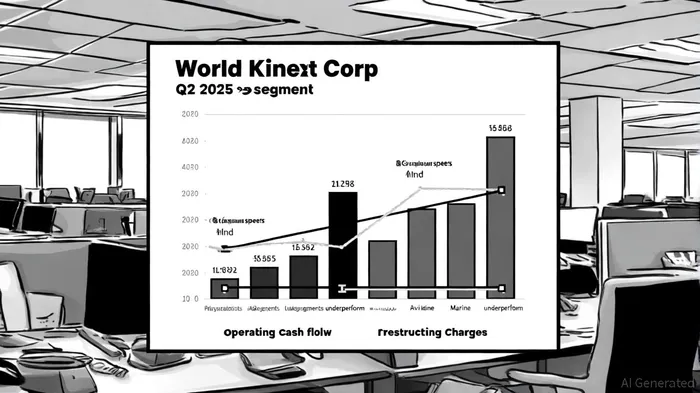
World Kinect's Q2 2025 results underscored divergent trajectories. The Aviation segment delivered a gross profit of $138 million, an 8% year-over-year increase, driven by improved European airport operations and business aviation activities [1]. This outperformance contrasts sharply with the Land segment's 17% decline to $67 million, attributed to the sale of its U.K. land fuels business and reduced North American demand [2]. The Marine segment fared worse, with a 26% drop to $27 million, citing unfavorable tax settlements and weak demand [3].
Despite these challenges, the company generated $114 million in operating cash flow and repurchased $35 million of stock, demonstrating financial discipline [4]. However, restructuring charges of $15 million and a $44.5 million asset impairment from the U.K. divestiture highlight the costs of streamlining operations [5].
Strategic Restructuring: A Path to Resilience
World Kinect's strategic focus on divesting non-core assets and optimizing operations aligns with broader industry trends. The sale of its U.K. land fuels business, while resulting in an $82 million pre-tax loss, is part of a deliberate effort to concentrate on core energy infrastructure and sustainable aviation fuel (SAF) [6]. The company aims to achieve a 30% operating margin by 2026 and an adjusted EBITDA range of $480–$520 million, balancing buybacks with renewable energy investments [7].
This approach mirrors the industrial automation sector's shift toward AI-driven efficiency. For instance, companies like ABB and Siemens are leveraging AI for predictive maintenance and digital twins, reducing downtime and costs [8]. While World KinectWKC-- has not announced similar partnerships, its integration of AI in energy trading and predictive maintenance for infrastructure suggests a foundation for future expansion into automation [9].
Competitive Positioning: Energy Sector Struggles vs. Automation Sector Opportunities
In the energy sector, World Kinect trails peers like Valero EnergyVLO-- and Marathon PetroleumMPC--, which reported net incomes of $761 million and $3.756 billion, respectively, in Q2 2025 [10]. WKC's 7.49% market share and 17.53% revenue decline outpace the industry's average 12.79% drop, but its net loss underscores vulnerabilities [11].
Meanwhile, the industrial automation sector—dominated by ABB, Fanuc, and Yaskawa Electric—is accelerating AI adoption. These firms are deploying intelligent robotics and edge computing to enhance productivity, a trend World Kinect could capitalize on if it expands into AI-driven energy management solutions [12]. However, the absence of direct AI automation partnerships in WKC's recent disclosures raises concerns about its agility in this space [13].
The AI Automation Landscape: A Missed Opportunity?
The global industrial861072-- automation market is projected to grow at 8.5% CAGR through 2033, driven by AI, IIoT, and collaborative robotics [14]. While World Kinect's current focus remains on energy, its technological capabilities—such as AI-powered data analytics for trading and predictive maintenance—position it to explore adjacent opportunities. For example, AI-driven optimization of energy consumption in industrial settings could align with its SAF initiatives, creating a bridge between energy and automation [15].
Yet, competitors in the automation sector are already leveraging AI to redefine efficiency. NVIDIA's partnerships with Universal Robots and Vention, for instance, highlight how AI is enabling real-time decision-making and supply chain optimization [16]. World Kinect's lack of similar collaborations suggests a gap in its strategic vision, at least for now.
Conclusion: A Cautionary Optimism
World Kinect's Q2 2025 results reflect a company in transition. While its Aviation segment demonstrates resilience, the underperformance of Land and Marine segments underscores the challenges of its energy-centric model. The company's strategic divestitures and restructuring efforts are prudent, but its absence from the AI industrial automation forefront could limit long-term growth.
For investors, the key question is whether World Kinect can pivot from its energy roots to embrace AI-driven automation. Its current technological capabilities and focus on sustainability provide a foundation, but concrete partnerships or initiatives will be critical to unlocking value in this high-growth sector. Until then, WKCWKC-- remains a story of cautious optimism—a company navigating the crossroads of tradition and transformation.





Comentarios
Aún no hay comentarios