
WorkQuest's Seed Round and the Emergence of AI-Driven Decentralized Employment Platforms
The post-pandemic labor market has undergone a seismic shift, with the gig economy evolving into a cornerstone of global employment. As remote work adoption accelerates and businesses seek cost-effective, flexible talent solutions, AI-driven decentralized platforms are emerging as disruptive forces. WorkQuest, a decentralized employment marketplace, recently raised $1.16 million in a seed funding round led by Black Dragon Capital, with participation from Prometeus Labs, TrustDAO Capital, and other notable investors according to Chainwire. This development underscores a broader trend: the convergence of blockchain, artificial intelligence, and decentralized governance to redefine how work is structured, compensated, and governed.
WorkQuest's Strategic Position in the AI-Driven Gig Economy
WorkQuest's platform is designed to address systemic inefficiencies in traditional labor markets, such as high fees, centralized control, and opaque reputation systems. The seed funding will accelerate the relaunch of its platform, which integrates AI-powered job matching, cross-chain execution, DAO governance, and work-to-earn modules. By leveraging smart contracts and stablecoin payments, WorkQuest aims to create a trustless employment system where workers and employers interact directly, bypassing intermediaries.
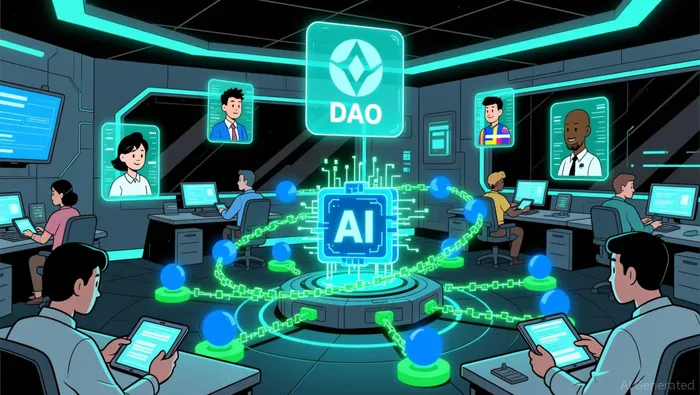
Key enhancements include an AI engine that automates contract creation and routing, cross-chain infrastructure for low-cost global access, and on-chain reputation scoring to incentivize accountability according to Chainwire. These features align with broader market demands for transparency and efficiency. For instance, data from Precedence Research indicates that the global gig economy tech platforms market is projected to reach $2.17 trillion by 2034, driven by AI advancements such as intelligent matching and predictive analytics. WorkQuest's focus on AI and blockchain positions it to capitalize on this growth while addressing pain points like centralized control and high transaction costs.
Market Potential and AI's Dual Role in the Gig Economy
The gig economy's expansion is not merely a byproduct of remote work trends but a structural shift accelerated by AI. According to a report by Trends Research, AI-powered automation optimizes client-freelancer matching by aligning worker qualifications with project requirements, reducing search friction. This efficiency is critical in a market where 60% of companies now outsource tasks to freelancers for short-term or specialized projects according to Precedence Research.
However, AI's integration is a double-edged sword. While it creates opportunities for high-value roles-such as AI training data annotation, prompt engineering, and AI auditing-it also threatens to displace workers in routine, pattern-based jobs like content writing and customer support according to Forbes. For example, Forbes notes that prompt engineers and AI automation specialists now command premium salaries, reflecting the growing demand for niche expertise according to the same report. WorkQuest's emphasis on work-to-earn modules and DAO governance could mitigate displacement risks by rewarding verified contributions and fostering community-driven value creation according to Chainwire.
Challenges and Risks in a Fragmented Regulatory Landscape
Despite its promise, the AI-driven gig economy faces significant hurdles. Regulatory uncertainties around worker rights, data privacy, and cross-border compliance remain unresolved. For instance, gig workers in routine roles often lack benefits like healthcare and retirement plans, raising ethical concerns according to Precedence Research. Additionally, the reliance on stablecoin payments and cross-chain infrastructure exposes platforms like WorkQuest to volatility in crypto markets and potential regulatory scrutiny according to Chainwire.
Investors must also weigh the risks of technological obsolescence. As AI models evolve, platforms that fail to adapt their algorithms or governance structures may lose relevance. WorkQuest's DAO governance model, however, offers a degree of resilience by decentralizing decision-making and allowing stakeholders to vote on platform upgrades according to Chainwire. This aligns with the broader trend of community-driven innovation in decentralized ecosystems.
Investment Thesis: Balancing Innovation and Pragmatism
The seed round for WorkQuest reflects investor confidence in the long-term potential of AI-driven decentralized employment platforms. With $1.16 million in capital, the team plans to prioritize deploying its AI engine, expanding cross-chain infrastructure, and activating DAO governance according to Chainwire. These steps are critical to establishing a scalable, trustless system that appeals to both gig workers and employers.
From an investment perspective, the gig economy's projected growth-particularly in Asia-Pacific markets, which are expected to see the fastest CAGR-presents a compelling opportunity according to Precedence Research. However, success hinges on WorkQuest's ability to navigate regulatory challenges, retain top talent, and differentiate itself from centralized competitors. The platform's focus on AI-driven automation and decentralized governance offers a unique value proposition, but its execution will determine whether it becomes a market leader or a niche player.
Conclusion
WorkQuest's seed round is a microcosm of the broader transformation reshaping the gig economy. As AI and blockchain converge to redefine labor markets, startups that address systemic inefficiencies while fostering innovation will attract significant capital. However, investors must remain cautious about the risks-regulatory, technological, and ethical-that accompany this disruption. For WorkQuest and similar platforms, the path to success lies in balancing cutting-edge technology with pragmatic governance, ensuring that the future of work is not only decentralized but also equitable.







Comentarios
Aún no hay comentarios