
Workhorse and Motiv Merger: A Strategic Catalyst for the EV Truck Sector
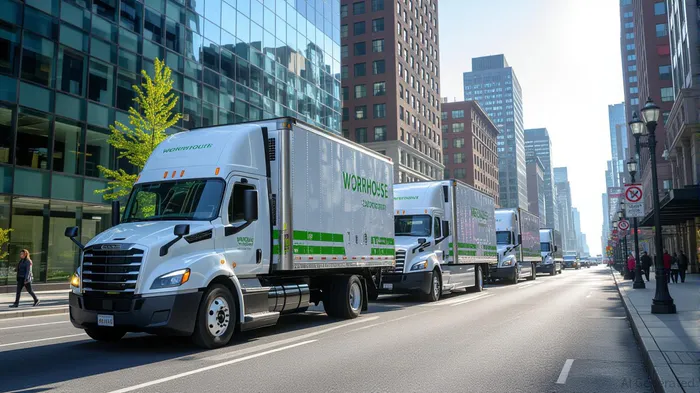
The electric vehicle (EV) truck sector is undergoing a seismic shift, and the recent merger between Workhorse GroupWKHS-- (WKHS) and Motiv Electric Trucks has positioned the combined entity as a formidable contender in the $23 billion medium-duty EV truck market. This strategic alliance, structured as an all-stock transaction, merges Workhorse's manufacturing expertise and national dealer network with Motiv's diverse product portfolio and fleet relationships. The result is a company poised to unlock operational synergies, cost efficiencies, and market capture in a segment projected to grow at a 25% compound annual growth rate (CAGR) through 2033. For investors, this merger represents a rare opportunity to capitalize on the clean energy transition while navigating a sector with structural tailwinds.
Strategic Rationale: Combining Strengths for Scale
Workhorse's proven EV manufacturing capabilities and Motiv's innovative Class 4–6 truck designs create a complementary foundation for dominance in the medium-duty segment. The combined company will offer a broader range of commercial EVs tailored for urban logistics, school bus operations, and short-haul delivery services—applications where electrification is most economically viable. By integrating Motiv's software-driven platforms with Workhorse's hardware expertise, the merger accelerates the development of shared intellectual property (IP) and modular components, reducing unit costs and improving total cost of ownership (TCO) for customers.
The transaction also simplifies Workhorse's capital structure, with Motiv's controlling investor securing 62.5% ownership and WorkhorseWKHS-- shareholders retaining 26.5%. Crucially, the merger eliminates Workhorse's remaining senior debt, replacing it with a $5 million convertible note and a post-closing $20 million debt facility. This restructuring provides the liquidity needed to scale production while aligning incentives between stakeholders.
Operational Synergies and Cost Efficiencies
The merger's value proposition hinges on $20 million in anticipated cost synergies by 2026, driven by R&D consolidation, general and administrative (G&A) streamlining, and facility optimization. For example, the $20 million sale-leaseback of Workhorse's Union City, Indiana, manufacturing facility reduces fixed costs while maintaining production capacity. Shared software and hardware platforms across Motiv's and Workhorse's product lines will further drive economies of scale, enabling the combined company to undercut competitors on pricing without sacrificing performance.
These efficiencies are critical in a market where upfront costs remain a barrier to adoption. While battery electric trucks still carry a 2–3x higher sticker price than diesel equivalents, their 55% greater energy efficiency and 70% lower fuel costs in markets like China and the EU make them increasingly attractive. The combined entity's ability to reduce unit costs through shared IP and manufacturing scale could narrow this gap, accelerating TCO parity and boosting fleet adoption.
Market Capture: A $23 Billion Opportunity
The medium-duty EV truck segment is a linchpin of the broader electrification transition, with demand driven by regulatory mandates, corporate sustainability goals, and the economic advantages of zero-emission vehicles. The U.S. Clean Heavy-Duty Vehicles Grant Program, the EU's Renewable Energy Directive, and China's vehicle scrappage schemes are all fueling demand, while falling battery prices (down 30% since 2020) are making electrification more accessible.
The combined company is uniquely positioned to capitalize on this growth. Workhorse's national dealer network and Motiv's fleet relationships provide immediate access to key markets, while their expanded product portfolio—spanning box trucks, step vans, and shuttle buses—addresses diverse use cases. With over 30% of large fleets already adopting electric trucks and 60% planning to do so, the combined entity's focus on urban logistics and vocational applications aligns with the most urgent electrification needs.
Financial and Leadership Advantages
The merger's financial structure is a strategic win. By eliminating Workhorse's debt and securing post-closing financing, the combined company gains flexibility to invest in R&D, expand manufacturing, and pursue strategic partnerships. The $5 million convertible note, which may convert to equity, also incentivizes performance, ensuring alignment with long-term value creation.
Leadership continuity is another strength. Motiv's CEO, Scott Griffith, will lead the combined entity, bringing a track record of innovation in electric truck design. Rick Dauch, Workhorse's former CEO, will transition to an advisory role, preserving institutional knowledge while allowing for a smooth transition. This leadership stability is critical in a sector where execution risk remains high.
Risks and Mitigants
While the merger is a compelling catalyst, investors must consider risks such as integration challenges, competition from TeslaTSLA--, Daimler, and BYD, and the need for continued government incentives. However, the combined company's focus on niche applications with high TCO advantages—such as urban delivery and school buses—reduces exposure to these risks. Additionally, the merger's all-stock structure and shared IP strategy create a moat against larger competitors by lowering barriers to entry.
Investment Thesis
The Workhorse-Motiv merger is a strategic masterstroke in a sector with explosive growth potential. By combining manufacturing scale, product diversity, and financial discipline, the merged entity is well-positioned to outperform peers and capture a significant share of the $23 billion medium-duty EV truck market. For investors, this represents a high-conviction opportunity to participate in the clean energy transition while leveraging a company with a clear path to profitability.
Conclusion
The EV truck sector is at an inflection pointIPCX--, and the Workhorse-Motiv merger is a catalyst that could redefine the competitive landscape. With operational synergies, cost efficiencies, and a $23 billion market opportunity, the combined company is poised to deliver long-term value to shareholders. For investors seeking exposure to the electrification megatrend, this merger offers a compelling entry point—one that balances innovation with execution and aligns with the structural forces reshaping commercial transportation.





Comentarios
Aún no hay comentarios