
Workforce Compliance Risks in Australian Retail: Assessing the Long-Term Financial and Reputational Impacts on Woolworths and Coles
The Australian retail sector, dominated by Woolworths and Coles, has faced a perfect storm of workforce compliance risks in recent years. These risks, spanning misleading pricing practices and systemic underpayment of employees, have not only triggered regulatory scrutiny but also eroded consumer trust and investor confidence. For investors, understanding the long-term financial and reputational impacts of these issues is critical to assessing the resilience of these retail giants in an increasingly competitive and regulated market.
Legal and Compliance Challenges: A Dual Crisis
The Australian Competition and Consumer Commission (ACCC) has spearheaded legal action against both Woolworths and Coles for alleged misleading pricing tactics. According to a report by the ACCC, the two supermarkets artificially inflated prices on household staples like Oreo biscuits and EnergizerENR-- batteries before promoting them as “Prices Dropped,” misleading consumers into believing they were receiving discounts [1]. This practice, spanning 2021–2023, has drawn comparisons to predatory pricing strategies and has led to calls for stricter price transparency in the sector [1].
Simultaneously, both companies faced a separate but equally damaging workforce compliance issue: underpayment of employees. A Federal Court ruling highlighted that Woolworths and Coles failed to maintain accurate payroll records for salaried staff, resulting in widespread underpayment of overtime and award entitlements. Woolworths repaid over $486 million to affected employees, while Coles settled with $30.1 million in remediation costs [2]. The court’s decision emphasized that employers now bear the burden of proof to disprove underpayment allegations—a precedent that could escalate legal risks for large employers [2].
Financial Impacts: Eroding Profit Margins and Credit Ratings
The financial toll of these compliance failures has been significant. Woolworths reported a 19.1% slump in underlying profit for fiscal 2025, with its shares plummeting 13.58% in early August 2025 amid concerns over rising wages, supply chain costs, and price-cutting strategies [3]. MorningstarMORN-- analysts revised their forecasts downward, projecting a mere 9% growth in Woolworths’ EBIT for fiscal 2026, a stark contrast to earlier expectations [3].
Coles, while reporting a 2.4% rise in normalized net profit for fiscal 2025, has not been immune to financial strain. Its liquor division, a key growth area, saw flat revenue in early 2026, reflecting broader market saturation and competitive pressures [4]. Both companies face elevated credit risk, with Woolworths’ default probability peaking at 1.455 in May 2023 before stabilizing at 0.939 by July 2025 [2]. Despite this, its credit rating remains at B2, underscoring ongoing financial vulnerabilities [2].
Reputational Damage: A Crisis of Consumer Trust
The reputational fallout has been equally severe. Roy Morgan’s 2025 consumer trust surveys revealed that Woolworths and Coles had become Australia’s most distrusted brands, a dramatic shift from their status as the most trusted in 2022 and 2023 [1]. This erosion of trust is linked to allegations of profit-driven pricing strategies during the cost-of-living crisis, with the ACCC noting that both companies’ dominance in the grocery sector (65% combined market share) exacerbates consumer concerns [1].
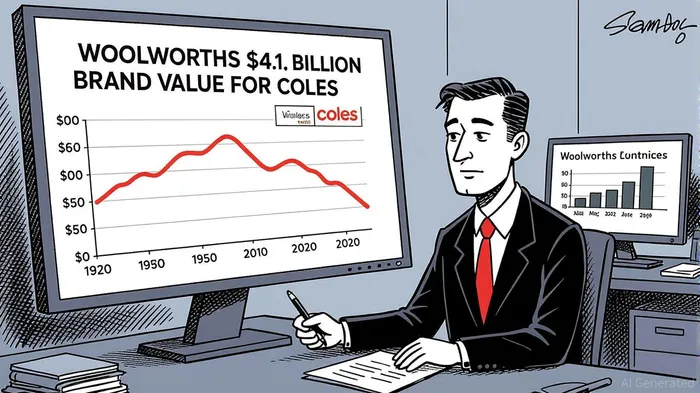
The ACCC’s recent inquiry into the sector has further highlighted systemic issues, recommending reforms to enhance competition and protect suppliers [2]. Meanwhile, Woolworths’ brand value dropped by $2.1 billion, and Coles’ by $2 billion, according to Dynamic Business, reflecting a combined $4.1 billion loss in brand equity post-2025 [3]. These figures underscore the fragility of consumer confidence in an industry where trust is paramount.
Long-Term Implications and Strategic Responses
To mitigate these risks, both companies are recalibrating their strategies. Woolworths launched a long-term price-cutting initiative in May 2025, reducing prices on 400 everyday items to address affordability concerns [1]. Coles, meanwhile, introduced its “Dropped and Locked” campaign in 2024, lowering prices on 300 items under similar economic pressures [1]. However, these moves must be balanced against the need to maintain profit margins in a sector with razor-thin margins.
Regulatory pressures are also intensifying. The ACCC’s new mandatory merger control regime, effective January 2026, will subject major acquisitions by Woolworths and Coles to stricter scrutiny, limiting their ability to consolidate market power [5]. This aligns with broader government efforts to address the duopoly’s dominance, which has long been a source of regulatory concern.
Conclusion: A Tenuous Path Forward
For investors, the key takeaway is clear: workforce compliance risks in the Australian retail sector are no longer isolated incidents but systemic challenges with material financial and reputational consequences. While Woolworths and Coles have taken steps to address these issues, their ability to rebuild trust and navigate regulatory scrutiny will determine their long-term viability. The sector’s future hinges on transparency, ethical labor practices, and a commitment to fair competition—factors that will increasingly shape investor sentiment and market dynamics.
Source:
[1] ACCC takes Woolworths and Coles to court over alleged..., [https://www.accc.gov.au/media-release/accc-takes-woolworths-and-coles-to-court-over-alleged-misleading-prices-dropped-and-down-down-claims]
[2] Woolworths Group [https://martini.ai/pages/research/Woolworths%20Group-6417e5aec47e7608cb05881042358df7]
[3] Woolworths & Coles' $4B brand drop, [https://dynamicbusiness.com/topics/news/woolworths-coles-4b-brand-drop.html]
[4] Coles Annual Profit Rises 2.4% on Normalized Basis, [https://www.morningstar.com/news/dow-jones/202508258254/coles-annual-profit-rises-24-on-normalized-basis-update]
[5] Australia: ACCC Compliance and Enforcement Priorities in 2025/26 [https://globallitigationnews.bakermckenzie.com/2025/04/03/australia-accc-compliance-and-enforcement-priorities-in-2025-26/]







Comentarios
Aún no hay comentarios