
Workday's Stock Valuation: Is the Long-Term Growth Premium Justified?
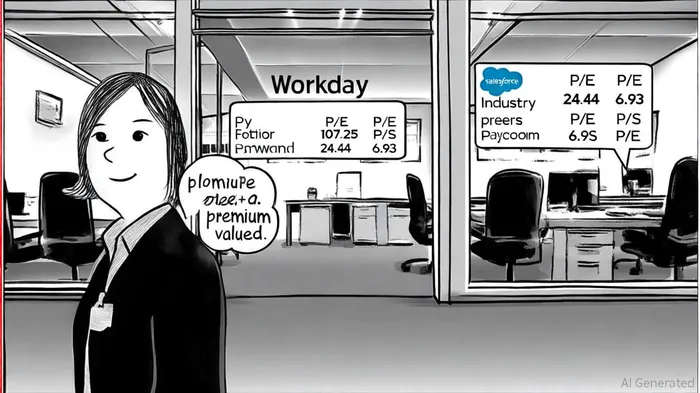
Workday (WDAY) has long been a poster child for high-growth SaaS stocks, but its valuation has increasingly diverged from industry norms. As of Q3 2025, the stock trades at a trailing price-to-earnings (P/E) ratio of 107.25 and a price-to-sales (P/S) ratio of 6.93, metrics that starkly contrast with its peers. Salesforce (CRM) and Paycom (PAYC), for instance, command P/E ratios of 40.7 and 30.5, respectively, while their P/S ratios hover near 6.14 and 7.82, as shown in Workday valuation ratios and the Workday P/E listing. This raises a critical question: Does Workday's recent financial performance justify its premium valuation, or is the market overbaking optimism into its future?
Financial Performance: Strong Revenues, Modest Margin Expansion
Workday's Q2 and Q3 2025 results underscore its resilience in a maturing SaaS market. Total revenue for Q3 reached $2.16 billion, a 15.8% year-over-year increase, with subscription revenue-the company's core offering-growing to $1.959 billion, according to Workday's Q3 2025 results. The 12-month subscription backlog now stands at $6.8 billion, up 16.1% YoY, as reported in the Q3 2025 earnings report. Operating income also improved, with non-GAAP operating margins hitting 24.9% in Q2, up from 10.1% in the prior-year period, per the Q2 2025 results.
However, growth rates have moderated. Subscription revenue growth decelerated from 18.1% in Q1 2025 to 15.0% in Q4, a trend highlighted in the SignalBloom analysis. Workday's forward guidance for fiscal 2026-a projected 14% subscription revenue growth-further underscores this trend, per the company's Workday guidance.
Valuation Metrics: A Premium Built on Optimism
Workday's valuation remains anchored in its growth narrative. At a trailing P/E of 107.25, the stock trades at more than triple the software industry average of 36.1x, according to Yahoo Finance. While its forward P/E of 24.44 suggests expectations of robust future earnings, this metric still outpaces peers like Salesforce (forward P/E ~15) and Paycom (forward P/E ~12), as shown in the Salesforce ratios data and Paycom's published results. The company's P/S ratio of 6.93 also exceeds Paycom's 7.82 and Salesforce's 6.14, despite Workday's slower revenue growth, per the Paycom Q4 results.
The disconnect is perhaps most glaring in the PEG ratio, a metric that adjusts valuation for growth. Workday's PEG ratio of 4,768.65-effectively infinite-suggests the market is pricing in near-perfect execution on its long-term targets, including a 15% subscription growth rate and 30% operating margin by 2027, according to the WDAY forecast. By contrast, Salesforce's PEG ratio of 1.67 indicates a more balanced valuation relative to its growth prospects, per Salesforce PEG.
Analyst Sentiment: Bullish but Cautious
Analysts remain divided on whether Workday's premium is sustainable. A consensus of 29 analysts rates the stock as a "Buy," with an average price target of $285.72-implying a 22.5% upside from its current price, according to the MarketBeat consensus. However, 30 Wall Street analysts have tempered expectations, issuing a "Moderate Buy" rating and emphasizing macroeconomic risks, including potential slowdowns in corporate IT spending, as noted in the Q3 earnings highlights.
The optimism is partly fueled by Workday's strategic bets on AI and global expansion. The company reported that 30% of customer expansions in Q3 involved AI-driven solutions, a trend highlighted in the Capyfin report. Additionally, its restructuring plan-aimed at reducing costs by 8% of its workforce-signals a focus on margin preservation, according to a FullRatio analysis.
Peer Comparison: A Tale of Two Strategies
Workday's valuation divergence from peers like Salesforce and Paycom reflects differing strategic priorities. While WorkdayWDAY-- has prioritized aggressive R&D and market share gains, Salesforce and Paycom have focused on operational efficiency and steady cash flow generation. For example, Paycom's forward guidance for 2025 includes 8% revenue growth and 41% adjusted EBITDA margins, metrics that justify its lower valuation (as disclosed in Paycom's reported results).
Salesforce's 7–8% revenue growth guidance for 2026, coupled with its 1.67 PEG ratio, further highlights Workday's premium, per the Salesforce press release. This suggests investors are paying a premium for Workday's innovation bets, particularly in AI and government markets, where it has carved out a niche.
Conclusion: A High-Stakes Bet on the Future
Workday's valuation is a double-edged sword. Its financial results-strong revenue growth, expanding margins, and a robust backlog-justify a premium to some extent. However, the stock's lofty P/E and P/S ratios, coupled with a PEG ratio that borders on absurdity, imply the market is pricing in near-perfect execution on its long-term targets.
For long-term investors, the key question is whether Workday can sustain its growth trajectory while delivering meaningful margin expansion. Its AI-driven innovation and global expansion plans offer upside, but macroeconomic headwinds and competitive pressures could temper expectations. Analysts' cautious optimism suggests a balanced approach: the stock may reward patience if Workday's strategic bets pay off, but its current valuation leaves little room for error.
Historical context from earnings events also raises caution. A backtest of Workday's stock performance around quarterly earnings releases from 2022 to 2025 reveals a mixed picture: over a 30-day window, the stock has averaged a -5.2% excess return, with a win rate of ≤60% across all timeframes. These results suggest that even in periods of strong fundamentals, the market's reaction to earnings has been inconsistent, with no statistically significant outperformance.





Comentarios
Aún no hay comentarios