
Workday's Insider Selling and Its Implications for Shareholder Value
In the dynamic landscape of corporate governance and investor sentiment, insider transactions often serve as a barometer for market confidence. WorkdayWDAY--, Inc. (WDAY) has recently drawn attention due to a series of insider sales in early October 2025, raising questions about their implications for shareholder value. While the company's Q3 2025 financial results underscored robust growth and strategic momentum, the timing and nature of these transactions warrant a nuanced analysis of governance practices and market psychology.
Insider Transactions: Routine Compliance or Signal of Concern?
Workday's insider selling in October 2025 included significant activity by its CFO, Zane Rowe, who sold 6,000 shares under a Rule 10b5-1 trading plan adopted in March 2025, according to an SEC Form 4 filing. These sales, executed at prices ranging from $230.28 to $238.85, were part of a pre-scheduled strategy to manage tax obligations tied to restricted stock unit (RSU) vesting. Similarly, CEO Carl Eschenbach sold 6,250 shares, and major shareholder David Duffield offloaded 75,053 shares, per a MarketBeat alert. While such transactions are often routine-particularly when structured under regulatory frameworks-they can still trigger investor skepticism.
The key distinction lies in the intent and transparency of these sales. Workday's adherence to Rule 10b5-1 plans, which are designed to mitigate insider trading risks, suggests a governance framework prioritizing compliance, as discussed in a Troutman analysis. However, the cumulative volume of shares sold by multiple insiders-exceeding 90,000 shares in a span of eight days-could be interpreted as a lack of confidence in short-term stock performance, even if the company's fundamentals remain strong, as noted by MarketBeat.
Corporate Governance: Policies and Perceptions
Workday's corporate governance policies emphasize ethical conduct and regulatory compliance, as outlined in its governance documents. The company has implemented restricted trading periods during quarterly earnings windows and prohibits short-swing profits under Section 16(b) of the Securities Exchange Act. These measures aim to align insider behavior with long-term shareholder interests.
Notably, the recent transactions by CFO Rowe and others were disclosed via SEC Form 4 filings, reflecting transparency. For instance, Rowe's withholding of 3,950 shares to satisfy tax obligations was a standard administrative process, not an open-market sale. Such disclosures reinforce trust, as they demonstrate adherence to legal and ethical standards. Yet, the sheer scale of insider selling-particularly by a major shareholder like Duffield-may still erode confidence, especially in a market sensitive to valuation metrics.
Market Reaction and Investor Sentiment
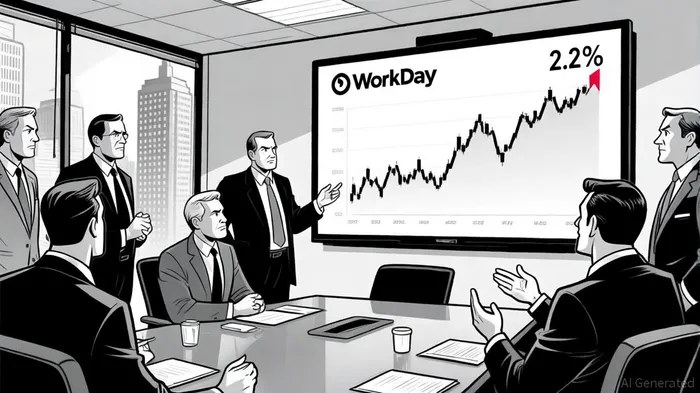
The stock price of Workday fell 2.2% to $233.17 following insider sales by Richard Sauer and others on October 7, 2025, according to MarketBeat. While this decline could be attributed to broader market volatility or sector-specific trends, the timing of the transactions likely amplified short-term jitters. Analysts, however, remain cautiously optimistic, with a consensus "Moderate Buy" rating and a target price of $287.83, as reported by MarketBeat. This optimism is underpinned by Workday's Q3 2025 results, which included a 15.8% year-over-year revenue increase to $2.16 billion and a non-GAAP operating margin of 26.3%.
The disconnect between insider selling and analyst sentiment highlights the complexity of investor psychology. On one hand, the company's AI-driven innovations and expanding subscription backlog ($22.19 billion) signal long-term growth potential. On the other, its price-to-earnings ratio of 107.95-well above industry peers-raises concerns about overvaluation. Institutional investors have adjusted their positions accordingly, with hedge funds both increasing and decreasing stakes in WDAYWDAY--, reflecting divergent views on its future trajectory.
Balancing Governance and Market Dynamics
The challenge for Workday lies in harmonizing its governance practices with market expectations. While its insider trading policies are robust, the perception of insider selling-particularly by high-profile executives-can overshadow positive fundamentals. This is especially true in a high-growth stock like Workday, where investor sentiment is often driven by narratives around leadership confidence.
To mitigate risks, Workday must continue to emphasize the routine nature of these transactions and reinforce its commitment to long-term value creation. For instance, the CEO's emphasis on AI monetization and margin expansion to 30% by FY27 provides a clear roadmap for growth. Additionally, the company's recent acquisitions, such as Evisort for document intelligence, underscore its strategic agility. These factors should be leveraged to contextualize insider activity as part of broader operational and financial planning rather than a sign of distress.
Conclusion
Workday's insider selling in October 2025 reflects a mix of routine compliance and strategic asset management, but it also underscores the delicate balance between governance transparency and investor sentiment. While the company's financial performance and governance policies provide a strong foundation, the market's reaction highlights the need for proactive communication. For investors, the key takeaway is to view these transactions through a lens of context: insider selling is not inherently negative, but it demands scrutiny in light of broader corporate strategy and market conditions. As Workday navigates its AI-driven transformation, the alignment of governance practices with investor expectations will remain critical to sustaining shareholder value.





Comentarios
Aún no hay comentarios