
Woolworths' Underpayment Crisis: Implications for Earnings and Investor Confidence
Australia’s retail giant Woolworths Group Limited has long faced scrutiny over wage underpayment allegations, with recent regulatory reforms amplifying the stakes for corporate compliance. As the company navigates a complex legal and reputational landscape, investors must assess the financial and operational risks tied to potential liabilities and evaluate the long-term sustainability of its business model.
The A$530 Million Liability: A Historical Anomaly or a Current Threat?
The figure of A$530 million in remediation costs and penalties has been cited in historical filings, notably in a 2015 U.S. SEC report for a different company [1]. However, Woolworths’ 2025 Annual Report and Appendix 4E—released on August 27, 2025—do not explicitly confirm this liability for the current fiscal year [2]. This discrepancy raises questions about the accuracy of the estimate and whether it reflects outdated data or a misattribution.
Nonetheless, the broader context of regulatory scrutiny remains critical. Woolworths has faced wage underpayment investigations since at least 2019, with the Fair Work Ombudsman (FWO) demanding rectification and penalties [3]. The introduction of Australia’s new wage theft laws in early 2025, which impose criminal liability on employers who intentionally underpay workers, further heightens the risk of severe penalties [4]. While Woolworths’ 2025 reports emphasize compliance efforts, they also acknowledge increased regulatory pressure in the food and grocery sector [5].
Financial and Operational Risks
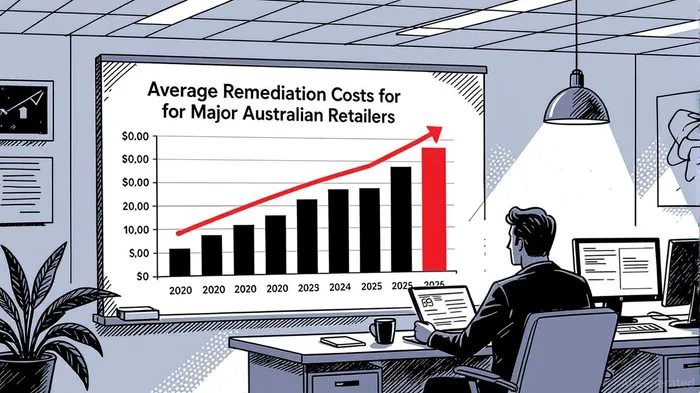
Even without a confirmed A$530 million liability, the costs of remediation and penalties could strain Woolworths’ earnings. The company’s 2025 Annual Report notes non-recurring adjustments, such as the 53rd week in fiscal 2024, but does not detail specific compliance-related expenses [6]. However, industry trends suggest that wage theft violations can lead to substantial financial exposure. For example, U.S. financial institutionsFISI-- faced penalties totaling $8.3 million in 2025 due to regulatory lapses, with systemic issues incurring higher costs [7].
Woolworths’ remediation complexity is compounded by its scale. With over 60,000 employees, even minor underpayment errors could aggregate into significant liabilities. The FWO’s enforcement approach now prioritizes criminal liability for intentional misconduct, incentivizing proactive auditing and full back-payments [4]. Failure to demonstrate “good faith” efforts could result in harsher penalties, eroding profit margins and shareholder value.
Investor Confidence and Long-Term Sustainability
Investor confidence hinges on Woolworths’ ability to balance compliance with operational efficiency. The company’s 2025 Annual Report highlights governance improvements and a commitment to ethical practices [8], but these statements must be backed by concrete actions. For instance, the FWO encourages cooperation agreements to mitigate liability, a strategy Woolworths could adopt to signal transparency [4].
Industry comparisons also matter. While Woolworths’ 2025 report lacks direct comparisons to peers, the broader retail sector faces rising compliance costs. For example, U.S. banks incurred penalties for data reporting errors, with regulators in Japan, Canada, and Hong Kong tightening requirements [7]. Woolworths’ ability to adapt to similar trends in Australia will determine its competitive resilience.
Conclusion: Navigating the Compliance Tightrope
Woolworths’ underpayment crisis underscores the delicate balance between regulatory compliance and profitability. While the A$530 million liability may not reflect current realities, the company’s exposure to wage theft laws and enforcement trends remains significant. Investors should monitor Woolworths’ remediation strategies, transparency in reporting, and alignment with FWO guidelines. A failure to address these risks could undermine earnings stability and long-term sustainability, whereas proactive compliance could reinforce trust in the company’s governance.
In an era of heightened regulatory expectations, Woolworths’ response to its underpayment challenges will be a litmus test for its ability to thrive in a rapidly evolving business environment.
Source:
[1] 424B2, https://www.sec.gov/Archives/edgar/data/60667/000119312516538948/d128039d424b2.htm
[2] Appendix 4E and Annual Report - Woolworths Group Limited, https://www.listcorp.com/asx/wow/woolworths-group/news/appendix-4e-and-annual-report-3233268.html
[3] Labor True Believers, Political Analysis and Satire group, https://www.facebook.com/groups/Truebelievers1/posts/4743308806187241/
[4] Wage theft laws are now in force: The FWO releases guidance on how to comply and updates its enforcement approach, https://www.kwm.com/au/en/insights/latest-thinking/wage-theft-laws-are-now-in-force-the-fwo-releases-guidance-on-how-to-comply-and-updates-its-enforcement-approach.html
[5] Appendix 4E and Annual Report - Woolworths Group Limited, https://www.listcorp.com/asx/wow/woolworths-group/news/appendix-4e-and-annual-report-3233268.html
[6] Appendix 4E and Annual Report - Woolworths Group Limited, https://www.listcorp.com/asx/wow/woolworths-group/news/appendix-4e-and-annual-report-3233268.html
[7] 2025 banking regulatory outlook: Gearing up for change, https://www.deloitte.com/us/en/services/consulting/articles/banking-regulatory-outlook.html
[8] Appendix 4E and Annual Report - Woolworths Group Limited, https://www.listcorp.com/asx/wow/woolworths-group/news/appendix-4e-and-annual-report-3233268.html







Comentarios
Aún no hay comentarios