
Woolworths' A$530M Underpayment Crisis and Its Impact on Retail Sector Valuation in Australia
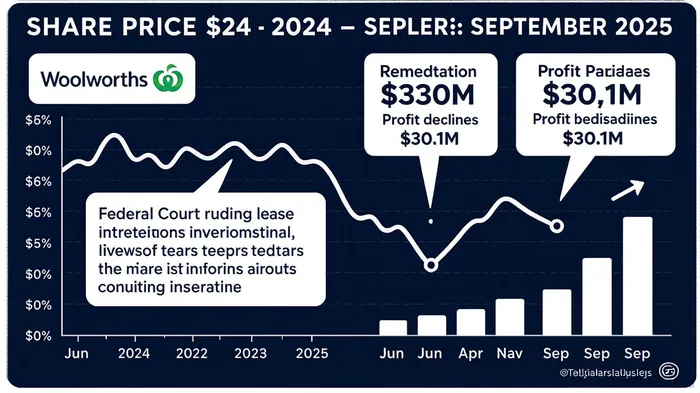
, exposing systemic governance and compliance risks that investors cannot ignore. This crisis, rooted in invalid contractual set-off clauses and record-keeping failures, has not only dented Woolworths’ financials but also signaled a broader reckoning for an industry long plagued by wage violations and opaque pricing practices. For investors, the implications are twofold: a near-term valuation hit to Woolworths and a long-term contagion risk across the sector.
The Legal and Financial Fallout
Federal Court Justice ’s ruling in September 2025 was a watershed moment. By invalidating Woolworths’ use of contractual set-off provisions to balance over- and underpayments across pay periods, the court effectively dismantled a flawed mechanism that allowed the company to defer award entitlements [1]. , . However, , as highlighted by the [4].
The financial toll on Woolworths has been severe. , , supply chain disruptions, and reputational damage [1]. . These penalties, , underscore the vulnerability of a business model that prioritized short-term cost-cutting over compliance [6].
Systemic Risks Across the Retail Sector
The Woolworths crisis is not an isolated incident. Coles, its arch-rival, has faced similar scrutiny, . Even Aldi, often seen as a disruptor, is not immune. , while smaller retailers struggled [5]. This concentration of market power has led to calls for reforms, including mandatory online price transparency and dynamic pricing APIs for third-party comparison tools [1].
The regulatory environment is tightening. The ACCC’s 2025/26 enforcement priorities emphasize misleading pricing, unfair contract terms, and wage compliance [4]. For instance, the ACCC’s ongoing legal battle with Woolworths and Coles over “illusory” discount claims—where products were temporarily marked up before being “discounted”—highlights the sector’s susceptibility to consumer trust erosion [2]. These practices, if proven, could result in penalties, community service orders, or even mandatory meal delivery programs for affected Australians [2].
Investor Implications and Strategic Adjustments
For investors, the key takeaway is clear: the retail sector’s valuation is increasingly tied to governance and compliance risks. , illustrating how proactive compliance and improved execution can insulate companies from sector-wide headwinds [1]. However, Coles’ own history of underpayments and ACCC scrutiny means it is not a safe haven [1].
The contagion risk extends beyond supermarkets. , owned by (which also owns Coles), faces similar exposure given its parent company’s compliance challenges [1]. Meanwhile, , a trend likely to continue if wage and pricing issues persist [6].
Strategic Recommendations for Investors
1. Avoid Overexposure to High-Risk Retailers: Companies with a history of wage violations or opaque pricing practices, such as Woolworths and Coles, warrant caution. Their valuation volatility and regulatory exposure make them poor long-term bets.
2. Lean into Resilient Alternatives: , with its lower-cost structure and less centralized wage practices, offers a more attractive risk profile. Similarly, private-label-focused retailers like (if it decouples from Wesfarmers’ compliance risks) could benefit from shifting consumer priorities.
3. Monitor Regulatory Developments: The ACCC’s push for price transparency and competition reforms could reshape the sector. Investors should track upcoming case management hearings (e.g., Woolworths’ October 2025 hearing) and legislative changes like the Fair Work Amendment (Protecting Penalty and Overtime Rates) Bill 2025 [3].
Conclusion
The Woolworths underpayment crisis is a canary in the coal mine for Australia’s retail sector. As regulatory scrutiny intensifies and consumer trust erodes, investors must prioritize companies with robust compliance frameworks and transparent pricing models. The sector’s valuation is no longer just about sales growth—it’s about survival in an environment where governance failures can swiftly translate into financial and reputational ruin.
Source:
[1] Federal Court rules out contractual set-off of award entitlements between pay periods [https://www.kwm.com/au/en/insights/latest-thinking/federal-court-rules-out-contractual-set-off-of-award-entitlements-between-pay-periods.html]
[2] ACCC takes Woolworths and Coles to court over alleged misleading prices [https://www.accc.gov.au/media-release/accc-takes-woolworths-and-coles-to-court-over-alleged-misleading-prices-dropped-and-down-down-claims]
[3] Recent developments in employment law [https://www.allens.com.au/insights-news/insights/2025/09/recent-developments-in-employment-law/]
[4] Australia: ACCC Compliance and Enforcement Priorities in 2025/26 [https://globallitigationnews.bakermckenzie.com/2025/04/03/australia-accc-compliance-and-enforcement-priorities-in-2025-26/]
[5] From price gouging to promotion tactics, here are the key ... [https://www.abc.net.au/news/2025-03-21/accc-supermarkets-inquiry-key-takeaways-coles-woolworths-aldi/105079916]
[6] Woolworths fined $1.2 million for underpaying Victorian staff [https://www.abc.net.au/news/2024-04-26/woolworths-underpayment-long-service-leave-court-penalty/103772456]







Comentarios
Aún no hay comentarios