
Won and yuan fall over 1%, leading declines in Asian currencies.
PorAinvest
domingo, 22 de junio de 2025, 9:29 pm ET1 min de lectura
Won and yuan fall over 1%, leading declines in Asian currencies.
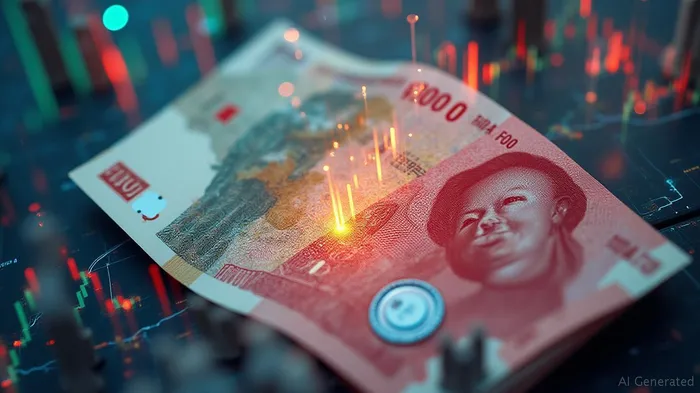
Asian currencies continued to face significant downward pressure on June 19, 2025, following a sharp decline in the South Korean won and the Chinese yuan. The Vietnamese dong and other regional currencies were also affected by the broader market sentiment.The South Korean won dropped by 1.1% against the U.S. dollar, reaching a new low, while the Chinese yuan weakened by 0.9%. The declines were attributed to geopolitical tensions, particularly the risk of U.S. military action against Iran and ongoing trade disputes between the U.S. and China [1].
In Vietnam, the dong fell to a record low of 26,130 per dollar, a decline of 0.1% from its previous session. This was the fifth consecutive session of depreciation, driven by a rebound in the U.S. dollar and the potential impact of a 46% tariff on Vietnamese goods [1]. The dong's weakness is expected to persist until trade tensions ease.
The Chinese yuan, on the other hand, remained relatively stable despite the overall market volatility. The People's Bank of China (PBOC) reiterated its commitment to maintaining currency stability, with the yuan trading at 7.1877 per dollar. The offshore yuan, USDCNH, edged up by 0.01% against the dollar. The PBOC's proactive macro policy and continued efforts to stabilize the yuan have contributed to its resilience [2].
The broader Asian market, including stocks and currencies, was negatively impacted by the geopolitical risks. The U.S. dollar index, DXY, fell by 0.086% to 98.75, reflecting the overall market sentiment [2].
China's central bank governor, Pan Gongsheng, highlighted the country's ambitions to develop a multi-polar global currency system, where several currencies coexist with checks and balances in place. This is part of China's broader strategy to reduce reliance on the U.S. dollar and promote the international use of the digital yuan [3].
The ongoing geopolitical tensions and trade disputes are likely to continue exerting pressure on Asian currencies. Investors and financial professionals should closely monitor these developments and their potential impact on regional and global financial markets.
References:
[1] https://www.bloomberg.com/news/articles/2025-06-19/vnd-usd-vietnamese-dong-drops-to-record-low-as-asian-currencies-weakens
[2] https://www.tradingview.com/news/reuters.com,2025:newsml_L4N3SL068:0-yuan-holds-steady-against-dollar-as-regulators-vow-stability/
[3] https://www.business-standard.com/world-news/china-talks-up-digital-yuan-in-push-for-multi-polar-currency-system-125061801484_1.html


Divulgación editorial y transparencia de la IA: Ainvest News utiliza tecnología avanzada de Modelos de Lenguaje Largo (LLM) para sintetizar y analizar datos de mercado en tiempo real. Para garantizar los más altos estándares de integridad, cada artículo se somete a un riguroso proceso de verificación con participación humana.
Mientras la IA asiste en el procesamiento de datos y la redacción inicial, un miembro editorial profesional de Ainvest revisa, verifica y aprueba de forma independiente todo el contenido para garantizar su precisión y cumplimiento con los estándares editoriales de Ainvest Fintech Inc. Esta supervisión humana está diseñada para mitigar las alucinaciones de la IA y garantizar el contexto financiero.
Advertencia sobre inversiones: Este contenido se proporciona únicamente con fines informativos y no constituye asesoramiento profesional de inversión, legal o financiero. Los mercados conllevan riesgos inherentes. Se recomienda a los usuarios que realicen una investigación independiente o consulten a un asesor financiero certificado antes de tomar cualquier decisión. Ainvest Fintech Inc. se exime de toda responsabilidad por las acciones tomadas con base en esta información. ¿Encontró un error? Reportar un problema


SOBRE NOSOTROS
Nuestra historiaAutores de noticiasBase de conocimientosPolítica de privacidadTérmino de usoDescargo de responsabilidad de corretaje de tercerosTérminos de uso de AIMEDivulgaciones de riesgos de AInvest AICarrerasCONTÁCTENOS
Email: support@ainvest.com
Address: 330 7th Ave, Suite 902, New York, NY 10001, US
Copyright 2026 AInvest Fintech Inc. All rights reserved.


Comentarios
Aún no hay comentarios