
WLFI's Volatile Surge and Ethereum's Reversal Potential: A Deep Dive into Market Sentiment and Capital Flows
WLFI: Regulatory Headwinds and Investor Optimism in Tandem
World Liberty Financial's token price has been a rollercoaster in recent weeks. A 2.18% hourly decline in November 2025, pushing the price below $0.15, was driven by a high-profile inquiry from U.S. Senators Elizabeth Warren and Jack Reed. The lawmakers demanded a formal investigation into WLFI's compliance safeguards, citing concerns over potential sales to entities linked to North Korean hacking groups, sanctioned Russian wallets, and Iranian exchanges. Compounding the issue, an emergency burn of $22.1 million in compromised tokens-meant to prevent dumping by hackers-further eroded investor confidence.
Yet, amid the bearish noise, bullish voices have emerged. According to Yi Lihua of Liquid Capital, a 50-point price increase over three sessions, urged investors to focus on WLFI's fundamentals, including its user base and long-term vision. Similarly, Daniel Wang of the same firm noted a 50% surge in WLFIWLFI--, attributing it to optimism around the USD1USD1-- stablecoin mechanism and ongoing buybacks. These divergent narratives underscore a polarized market, where regulatory risks clash with speculative optimism.
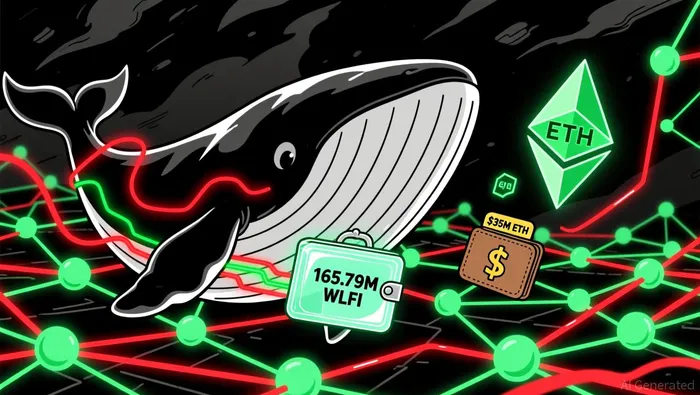
On-chain data reveals a strategic shift in WLFI's capital flows. A strategic reserve wallet executed an $11 million buyback on CowSwap, while a whale accumulated 165.79 million WLFI tokens at $0.1508 using $25 million USD1 stablecoin. Such activity suggests a coordinated effort to stabilize the token's price, though the lack of a clear unlock schedule for 80% of public sale tokens remains a wildcard.
Ethereum's Short-Term Reversal: Support Levels and On-Chain Resilience
Ethereum's price action in 2025 presents a compelling case study in technical resilience. If ETH holds above $3,000, analysts project a rebound toward $3,450 and potentially $3,800, with a breakout above the latter signaling a broader trend reversal. Conversely, a breakdown below $2,900 could push the price toward the $2,150–$2,200 range, a historically significant reversal zone.
On-chain metrics add depth to this analysis. The MVRV ratio for staked ETH stands at 1.7, compared to 1.5 for circulating ETHETH--, indicating stronger unrealized gains among long-term holders. This divergence suggests growing network conviction. Meanwhile, the surge in short positions across exchanges has created a potential short-squeeze scenario, with funding rates pointing to rising liquidation risks-a classic precursor to relief rallies.
Interdependencies: WLFI and Ethereum in a Symbiotic Dance
The relationship between WLFI and Ethereum extends beyond price correlations. World Liberty Financial has aggressively accumulated Ethereum, adding 48,477 ETH in the past two weeks alone. This strategic move transformed an initial $777,000 unrealized loss into a profit, reflecting WLFI's dual approach of managing short-term volatility while maintaining a long-term bullish stance on ETH.
Capital flow dynamics further highlight this interplay. WLFI's treasury has staked 2,221 ETH on Lido Finance and expanded into other DeFi tokens like ChainlinkLINK-- (LINK) and AaveAAVE-- (AAVE). These actions align with a broader strategy to leverage Ethereum's ecosystem for macroeconomic stability. Meanwhile, Ethereum's strengthening position-supported by layer-2 adoption and improved staking yields-creates a favorable backdrop for WLFI's buybacks and whale-driven accumulation.
Investor Behavior and Cross-Asset Correlations
Recent shifts in investor behavior underscore the interconnectedness of WLFI and Ethereum. The resumption of WLFI buybacks and whale accumulation has drawn capital into the token, even as Ethereum experienced a $169 million outflow in November 2025. This divergence suggests that WLFI's narrative-rooted in DeFi innovation and strategic buybacks-has attracted a distinct cohort of investors, separate from Ethereum's broader market dynamics.
However, cross-asset correlations remain significant. WLFI's $35 million investment in Ethereum over the past year, now valued at $54.62 million, illustrates a symbiotic relationship where WLFI's treasury acts as both a buyer of dips and a stabilizer of its own token's value. This dual role positions WLFI as a hybrid asset, straddling the line between speculative token and DeFi infrastructure play.
Conclusion: Navigating the Crossroads of Risk and Opportunity
For investors, the WLFI-Ethereum dynamic presents a complex but navigable landscape. WLFI's regulatory challenges and token burn highlight the risks of centralized governance, yet its buybacks and whale activity signal resilience. Ethereum's technical indicators and on-chain strength offer a more predictable path, though short-term volatility remains a concern.
The key takeaway lies in capital flow interdependencies. WLFI's strategic accumulation of Ethereum and its DeFi diversification efforts create a feedback loop that could amplify Ethereum's recovery while insulating WLFI from broader market downturns. As the year progresses, monitoring these interdependencies-and the sentiment shifts that drive them-will be critical for positioning in this high-stakes arena.






Comentarios
Aún no hay comentarios