
WLFI’s Security Crackdown and Its Implications for DeFi Governance and Investor Trust
In the rapidly evolving DeFi landscape, security and governance remain twin pillars of institutional credibility. World Liberty Financial (WLFI), a project entangled in both technological innovation and political controversy, has recently intensified its security measures while navigating the complexities of decentralized governance. This analysis examines WLFI’s strategic moves, their implications for DeFi governance structures, and the broader lessons for investor trust in emerging crypto projects.
Security Measures: A Double-Edged Sword
WLFI’s 2025 security crackdown includes a $11 million token burn of 47 million WLFI tokens, aimed at stabilizing its price and reducing supply volatility [4]. This deflationary strategy aligns with broader buyback-and-burn initiatives, a common tactic in DeFi to create scarcity and incentivize long-term holding. However, the project’s response to phishing attacks and Ethereum’s EIP-7702 vulnerabilities—blacklisting suspected compromised wallets—has sparked debates about centralized control. Critics argue that such measures, while effective in mitigating immediate risks, undermine the ethos of decentralization [4].
Cross-chain interoperability via Chainlink’s CCIP, supporting EthereumETH--, SolanaSOL--, and BNBBNB-- Chain, further enhances WLFI’s utility but introduces new attack vectors. The reliance on third-party protocols like CCIP raises questions about the project’s ability to maintain security across multiple ecosystems [4]. For institutional investors, these moves highlight a critical trade-off: enhanced short-term security versus long-term governance flexibility.
Governance Fractures and Centralized Realities
WLFI’s governance model, theoretically community-driven, remains heavily influenced by its founding team and the TrumpTRUMP-- family, who hold a 37.5% stake in the project [2]. This concentration of power contradicts DeFi’s foundational principles and has led to conflicts, such as the Aave-WLFI governance dispute in 2025. The incident, where conflicting partnership claims caused market volatility and legal uncertainty, exposed the fragility of on-chain governance agreements [4].
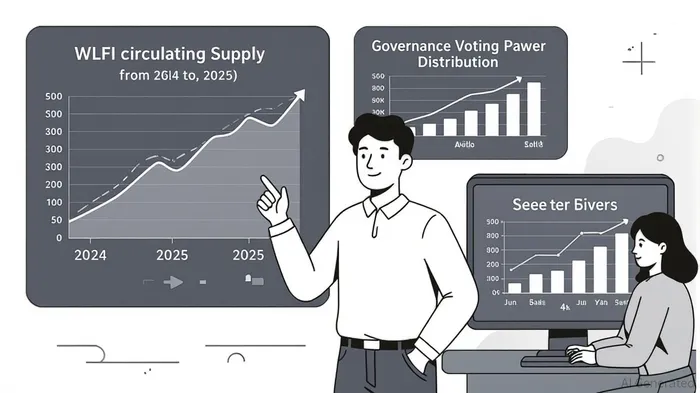
Efforts to decentralize authority—such as transitioning mint and freeze capabilities to a DAO—are steps in the right direction but face skepticism. Data from governance proposals shows that voting power per wallet is capped at 5%, a design intended to prevent centralization [1]. Yet, the Trump family’s political and financial influence, coupled with their ownership stake, creates inherent conflicts of interest. For example, Donald Trump’s role in shaping U.S. crypto policy while his family profits from WLFI raises ethical concerns about regulatory capture [5].
Investor Trust: Scarcity vs. Controversy
WLFI’s introduction of USD1, a U.S. dollar-pegged stablecoin, aims to provide a less volatile asset within its ecosystem and fund future buybacks [1]. This move could stabilize investor sentiment, particularly for institutions wary of WLFI’s price swings. However, trust has been eroded by high-profile controversies, such as the freezing of tokens belonging to major investor Justin Sun. Such actions, even if justified as security measures, risk alienating the community and undermining governance legitimacy [4].
Phased token unlock schedules, designed to align long-term incentives with project goals, have also been met with mixed reactions. While these mechanisms reduce early liquidity risks, they do little to address the root issue of centralized control. Institutional investors, in particular, demand transparency in governance decisions and fee generation models to assess WLFI’s sustainability [1].
Institutional Credibility: A Political Quagmire
WLFI’s association with the Trump family is a double-edged sword. On one hand, partnerships with entities like DWF Labs and Jump Crypto—now supporting WLFI as collateral—signal institutional interest [3]. On the other, the project’s political entanglements complicate regulatory compliance. For example, WLFI’s governance freeze on wallets linked to geopolitical adversaries has drawn comparisons to U.S. Treasury sanctions, blurring the lines between DeFi and state power [1].
The project’s reliance on BitGo and other regulated custodians for asset security is a positive step, but it also highlights the tension between decentralization and institutional credibility. Investors must weigh whether WLFI’s security-first approach justifies its governance compromises, particularly in a market where regulatory scrutiny is intensifying.
Conclusion: Balancing Act in a High-Risk Ecosystem
WLFI’s security crackdown underscores the challenges of balancing innovation with decentralization in DeFi. While token burns, cross-chain support, and stablecoin integration offer tangible benefits, the project’s governance structure and political affiliations remain significant liabilities. For institutional investors, the key takeaway is that security measures alone cannot compensate for centralized control or reputational risks.
As WLFI rolls out staking and lending features in Q4 2025, the market will test whether its governance model can evolve into a truly decentralized framework. Until then, the project serves as a cautionary tale: in DeFi, institutional credibility is not just about code—it’s about the people behind the code.
**Source:[1] World Liberty Financial (WLFI) Price: Key Insights [https://www.okx.com/en-us/learn/world-liberty-financial-wlfi-price-insights][2] Assessing the High-Risk, High-Reward Potential of Donald [https://www.bitget.com/news/detail/12560604938649][3] Gold Prices Hit New High [https://www.bitget.com/price/world-liberty-financial@@/news][4] WLFI–Aave Drama Exposes Onchain Governance Risks [https://thedefiant.io/newsletter/defi-daily/wlfiaave-drama-exposes-onchain-governance-risks][5] Trump's WLFI Token Launch: 27 Billion Supply And More! [https://blog.mexc.com/wilfi-launch-news/]






Comentarios
Aún no hay comentarios