
Can WLFI Reach $1 by 2030? Assessing the Trump-Backed Token’s Viability Amid Volatility and Institutional Backing
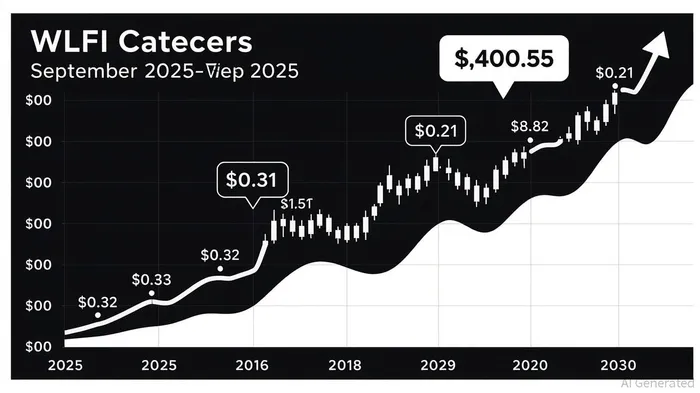
World Liberty Financial (WLFI), the TrumpTRUMP-- family’s foray into decentralized finance, has ignited both fervent speculation and regulatory scrutiny since its September 2025 trading debut. Backed by a blend of political clout, institutional capital, and a governance model steeped in controversy, WLFI’s journey toward a $1 price tag by 2030 hinges on balancing structural risks with catalyst-driven growth. This analysis dissects the token’s viability through the lens of risk-rebalancing and politically influenced crypto dynamics.
Institutional Backing: A Double-Edged Sword
WLFI’s institutional partnerships—such as DWF Labs’ $25 million investment and ALT5 Sigma’s $1.5 billion treasury strategy—signal confidence in its utility as a governance and stablecoin platform [1]. The Trump family’s 22.5 billion token stake (22.5% of total supply) and 75% of token-sale proceeds further underscore their vested interest in the project’s success [2]. However, this concentration of ownership raises red flags. As noted by Bloomberg, the Trumps’ control over 83% of initial liquidity creates a “centralized illusion” in a DeFi ecosystem that prides itself on decentralization [4].
The USD1 stablecoin, pegged to the U.S. dollar and integrated into Binance’s $2 billion Abu Dhabi-backed strategy, adds another layer of institutional credibility [1]. Yet, the token’s volatility—spiking to $0.31 before plummeting 50% to $0.21 within days—exposes fragility in its market fundamentals [3]. This volatility is exacerbated by whale activity, including the unlocking of 20% of presale tokens on day one, which triggered mass sell-offs [5].
Political Catalysts and Regulatory Risks
The Trump family’s political branding of WLFI as a “financial freedom” tool has been a potent catalyst. President Trump’s self-proclaimed title of “crypto president” and his alignment with the Genius Act—a regulatory framework mandating stablecoin transparency—position WLFI as a bridge between traditional finance and crypto [3]. However, this political entanglement introduces unique risks. For instance, the token’s performance has drawn comparisons to the defunct TRUMP token, which collapsed after a similar hype cycle [4].
Regulatory scrutiny looms large. While WLFI’s USD1 stablecoin complies with the Genius Act, the Trump family’s ownership of 60% of the project and their reported $57.4 million in 2024 earnings have raised ethical concerns about conflicts of interest [2]. As CoinDCX analysts caution, “The line between public servicePEG-- and private gain is perilously thin here” [5].
Catalyst-Driven Price Potential: A $1 Target in 2030?
Price projections for WLFI vary widely. Conservative estimates peg 2025 prices at $0.40–$0.45, with 2026 targets reaching $1.20 if multi-chain expansion and stablecoin adoption accelerate [3]. Long-term forecasts suggest a $1–$3 range by 2030, contingent on WLFI becoming a mainstream financial tool [5]. However, these projections hinge on several assumptions:
- Token Burns and Supply Reduction: A 47 million token burn (worth $11.34 million) aims to reduce supply and boost scarcity, but its impact on price has been minimal so far [4].
- Exchange Listings and Liquidity: Listings on Gemini, BinanceETH--, and CoinbaseCOIN-- enhance accessibility, but further expansion is needed to attract retail and institutional buyers [1].
- DeFi Integration: Partnerships with AaveAAVE-- and ChainlinkLINK-- could unlock staking and lending use cases, but execution risks remain [3].
A $1 price tag by 2030 would require WLFI to overcome its current market cap of $5.25 billion (assuming 100 billion tokens at $0.525). To reach $1, the token would need to capture a 1.5% share of the $1.2 trillion crypto market—a ambitious but not impossible feat if institutional adoption accelerates and political narratives drive mass adoption.
Risk Rebalancing: Mitigating Volatility and Centralization
For WLFI to achieve long-term stability, it must address its structural risks. Community-driven unlock schedules for Trump family tokens could reduce sell-pressure volatility, while transparent governance mechanisms would alleviate centralization concerns [2]. Additionally, diversifying institutional partnerships beyond politically aligned entities (e.g., DWF Labs, MGX Fund) could insulate the project from regulatory backlash [1].
Conclusion: A High-Risk, High-Reward Proposition
WLFI’s path to $1 by 2030 is fraught with challenges but not implausible. Institutional backing and political narratives provide tailwinds, while regulatory scrutiny and market volatility act as headwinds. Investors must weigh the token’s potential as a catalyst-driven asset against its structural risks. For risk-tolerant participants, WLFI represents a speculative bet on the intersection of politics and crypto. For others, it serves as a cautionary tale of centralized governance in a decentralized world.
**Source:[1] World Liberty Financial: $WLFI Launch and $USD1 [https://www.dwf-labs.com/research/world-liberty-financial-why-the-wlfi-token-launch-matters][2] Trump Family's WLFI Token Debuts 5 To 15 Times Above [https://www.forbes.com/sites/zacheverson/2025/09/02/trump-crypto-token-wlfi-world-liberty-financial/][3] The Trump-Backed Crypto and Its Volatile Launch [https://www.lbank.com/es/explore/wlfi-explained-trump-backed-crypto-volatile-launch][4] Is World Liberty Financial a Game-Changer or Trump's ... [https://www.ccn.com/education/crypto/world-liberty-financial-beyond-the-hype/][5] Trump-linked WLFI's 40% decline causes millions in losses ... [https://cointelegraph.com/news/trump-wlfi-40-decline-millions-losses-crypto-whales-finance-redefined]







Comentarios
Aún no hay comentarios