
WLFI's Institutional Market-Making Momentum: A Strategic Inflection Point?
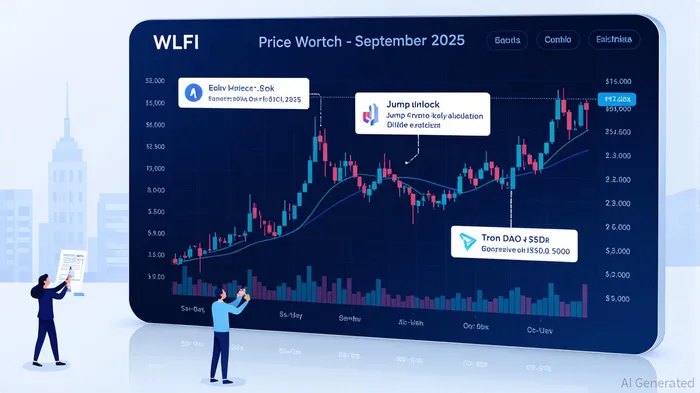
The launch of World Liberty Financial’s (WLFI) token in September 2025 has ignited a contentious debate about the role of institutional market makers in volatile token markets. With Jump Crypto and DWF Labs stepping into the fray, WLFI’s trajectory raises critical questions: Can institutional credibility and liquidity provision mitigate the inherent risks of speculative tokens? Or do these interventions distort the decentralized ethos of DeFi?
Institutional Credibility: A Double-Edged Sword
Jump Crypto’s involvement in WLFI’s market-making infrastructure has been a focal point of analysis. According to a report by MEXC, the firm received 485 million WLFI tokens—16.2% of the liquidity pool—to facilitate trading on centralized and decentralized exchanges [2]. This allocation, coupled with an initial 47-token test transfer, signals a strategic commitment to stabilizing WLFI’s price discovery process. Institutional validation often acts as a credibility signal, as seen in traditional markets, where tier-1 firms underwrite securities to attract retail investors. However, WLFI’s ties to the Trump family and its USD-pegged stablecoin, $USD1, complicate this narrative. While such connections may attract politically aligned capital, they also risk overshadowing the project’s technical merits with speculative hype [2].
Justin Sun’s TronTRON-- DAO further amplified institutional interest by acquiring 600 million WLFI tokens to expand the USD1 stablecoin supply by $200 million [3]. This move underscores Tron’s ambition to dominate the stablecoin sector, leveraging WLFI’s governance token to incentivize liquidity. Yet, the 32% price drop following the token’s unlock on September 1, 2025, highlights the fragility of market confidence. Despite attracting $550 million in sales, the token’s volatility suggests that institutional backing alone cannot guarantee stability in a market where liquidity is often a zero-sum game [3].
Liquidity Catalysts and Market Dynamics
Market makers like Jump Crypto play a dual role: they provide liquidity to reduce slippage for traders while acting as price anchors in thinly traded assets. On-chain data reveals that Jump Crypto’s 485M token allocation is designed to sustain trading activity across multiple venues, a strategy that could mitigate flash crashes. However, the same mechanism risks creating artificial price floors if market makers front-run large orders or manipulate order books—a concern amplified by WLFI’s lack of transparent governance protocols [2].
The token’s presale unlock further illustrates the tension between liquidity and volatility. While the release of 20% of presale tokens generated $550 million in sales, it also triggered a 32% price drop, exposing the fragility of WLFI’s demand curve [3]. This pattern mirrors historical precedents in crypto, where token unlocks often lead to short-term dumping, eroding trust among long-term holders.
Competing for Credibility in a Crowded Ecosystem
WLFI’s challenges are compounded by the rise of alternatives like Ruvi AI (RUVI), which has attracted institutional validation and exchange partnerships, with analysts forecasting a 100x rally [4]. RUVI’s success underscores a growing investor preference for projects with clear use cases and decentralized governance, contrasting with WLFI’s reliance on high-profile affiliations. For WLFI to compete, it must demonstrate that its institutional partnerships translate into tangible value—such as expanded USD1 adoption or cross-chain interoperability—rather than merely serving as a marketing tool.
Strategic Inflection PointIPCX-- or Illusion?
WLFI’s institutional market-making momentum could represent a strategic inflection point if it catalyzes sustainable liquidity and broadens the token’s utility beyond speculative trading. However, the absence of credible price projections—Bitget’s models predict WLFI at $0 across all timeframes [1]—suggests that market fundamentals remain unproven. Institutional credibility is valuable, but it is not a substitute for robust product-market fit.
In volatile token markets, liquidity is both a lifeline and a liability. Jump Crypto’s and Tron DAO’s interventions may stabilize WLFI in the short term, but long-term success hinges on whether the project can evolve from a governance token into a foundational infrastructure asset. Until then, WLFI’s trajectory will remain a high-risk bet, where institutional signals are both a beacon and a mirage.
**Source:[1] World Liberty Financial@@ Price Prediction [https://www.bitget.com/price/world-liberty-financial@@/price-prediction][2] Shocking Revelation: Jump Crypto WLFI Link Uncovered in DeFi Space [https://www.mexc.co/en-IN/news/shocking-revelation-jump-crypto-wlfi-link-uncovered-in-defi-space/80751][3] Latest TRON (TRX) News Update [https://coinmarketcap.com/cmc-ai/tron/latest-updates/][4] Looking Beyond Tron (TRX)? Analysts Suggest Ruvi AI ... [https://coincentral.com/looking-beyond-tron-trx-analysts-suggest-ruvi-ai-ruvi-it-is-predicted-to-be-the-next-to-rally-over-100x-as-daily-token-sales-hit-millions/]







Comentarios
Aún no hay comentarios