
WLFI's $120M Treasury Allocation: A Strategic Catalyst for USD1's Market Dominance
The stablecoin market in 2025 is a battlefield of innovation, regulation, and institutional credibility. World Liberty Financial (WLFI) has thrown its hat into the ring with a $120 million treasury allocation to accelerate the adoption of its USD1USD1-- stablecoin, a move that could redefine its position in a crowded field dominated by giants like Tether's USDTUSDT-- and Circle's USDCUSDC--. This analysis evaluates whether WLFI's treasury-driven strategy is a viable path to long-term value creation-or a risky gamble in a market where trust and transparency are paramount.
The Strategic Rationale: Treasury as a Growth Engine
WLFI's $120 million allocation-5% of its $2.4 billion treasury-aims to incentivize CeFi and DeFi partners to integrate USD1 into their ecosystems. By offering WLFIWLFI-- tokens as rewards, the project seeks to replicate the success of yield-bearing campaigns pioneered by platforms like Binance, which have historically driven liquidity and user adoption according to reports. This approach mirrors the playbook of USDC, which leveraged institutional partnerships and regulatory compliance to grow its market cap to $67.74 billion by 2025 as data shows.
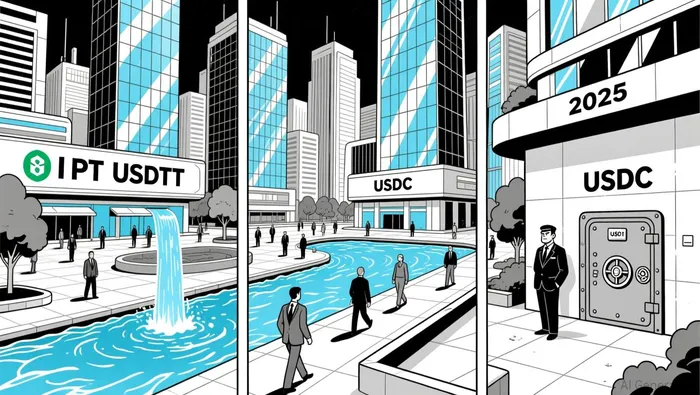
The allocation's focus on cross-chain compatibility (Ethereum, BNBBNB-- Chain) and institutional partnerships (e.g., Binance, Bitget, Uniswap) positions USD1 to capture both retail and institutional demand. Notably, USD1's recent $2 billion transaction with Abu Dhabi's MGX, used as a payment vehicle, demonstrates its potential to scale through high-net-worth institutional flows. If WLFI can replicate this model, the stablecoin could transition from a niche player to a critical infrastructure asset.
Competitive Landscape: USDT, USDC, and the "Regulatory Arms Race"
USDT and USDC have carved distinct niches in the stablecoin wars. USDT's dominance ($165.96 billion market cap) stems from its first-mover advantage and liquidity ubiquity, but its opaque reserve structure has drawn regulatory scrutiny according to analysis. USDC, by contrast, has prioritized transparency-monthly audits and U.S. Treasury-backed reserves-positioning it as the "safe" choice for compliance-driven institutions as research indicates.
WLFI's strategy to secure a national banking charter for the "World Liberty Trust Company" could bridge this gap. By formalizing USD1's reserve management and custody under a regulated entity, WLFI aims to align with the U.S. GENIUS Act's requirements, which mandate stablecoin issuance through regulated banks or state-qualified entities according to reports. This move would not only mitigate regulatory risk but also differentiate USD1 from USDT's legacy model and USDC's institutional focus.
Risks and Realities: Transparency, Governance, and Market Skepticism
Despite its ambitions, WLFI faces significant headwinds. First, transparency concerns linger: USD1's monthly attestation reports have been delayed, with the most recent available from July 2025 according to Coindesk. This lags behind USDC's rigorous audit schedule and raises questions about the project's operational discipline. Second, the treasury allocation itself is contentious. Early governance voting showed 67.7% opposition, with critics fearing treasury dilution and unclear vesting schedules as voting data shows.
The Trump family's political influence, while a unique advantage in securing partnerships, also introduces volatility. Any operational shifts or reputational risks tied to this connection could destabilize investor confidence. Furthermore, USD1's offshore token distribution (78% held on overseas exchanges) complicates its ability to capture U.S.-centric demand according to reports.
Long-Term Value Creation: A Calculated Bet
WLFI's strategy hinges on three pillars: liquidity incentives, regulatory alignment, and institutional adoption. If successful, the $120 million allocation could catalyze USD1's growth from $3.07 billion in circulating supply to a top-5 stablecoin by 2026 as analysis indicates. The proposed trust bank would further solidify its infrastructure, enabling cross-border payments and treasury operations that compete with traditional banking systems according to reports.
However, the path to dominance is fraught. USDT's liquidity moat and USDC's regulatory credibility are formidable barriers. For USD1 to succeed, WLFI must execute flawlessly: delivering on transparency, securing high-profile partnerships, and navigating the GENIUS Act's compliance requirements without missteps.
Conclusion: A High-Stakes Play in a High-Stakes Market
WLFI's $120 million treasury allocation is a bold bet on USD1's future. It reflects a strategic understanding of the stablecoin market's evolving dynamics-liquidity, regulation, and institutional trust. Yet, the project's success will depend on its ability to address transparency concerns, win over skeptical token holders, and outmaneuver entrenched competitors. If WLFI can turn these challenges into strengths, USD1 may yet carve out a niche as a hybrid stablecoin bridging the gap between DeFi's innovation and CeFi's compliance. For now, the market watches closely.





Comentarios
Aún no hay comentarios