
WLFI's 100% Fee-Funded Buyback and Burn Strategy: A Catalyst for Long-Term Value Accretion
World Liberty Financial (WLFI), the Trump-backed DeFi project, has unveiled a 100% fee-funded token buyback and burn program in response to a 41–58% price decline in September 2025[4]. This strategic shift, approved by 99% of token holders[2], aims to stabilize WLFI's value by reducing its circulating supply through perpetual market purchases and permanent token destruction. For investors, the initiative raises critical questions: Can this deflationary mechanism drive sustainable value accretion? How does it align with WLFI's broader market positioning? And what risks might undermine its effectiveness?
Strategic Rationale: Deflationary Mechanics and Market Psychology
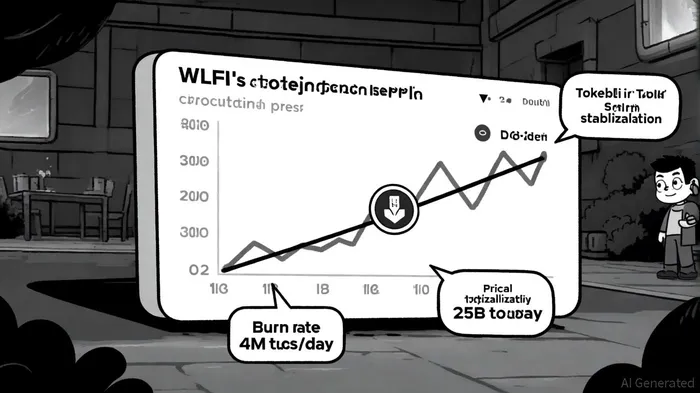
WLFI's buyback and burn program leverages fees from liquidity pools on EthereumETH--, BNBBNB-- Chain, and SolanaSOL-- to fund token repurchases[1]. By redirecting these revenues to reduce supply, the project creates a self-reinforcing cycle: lower supply, higher scarcity, and potentially upward price pressure. Analysts estimate the burn rate could reach 4 million tokens daily, equivalent to ~2% of the total 25 billion supply annually[2]. This approach mirrors successful models like Binance Coin (BNB), where consistent buybacks have historically correlated with price resilience.
The psychological impact is equally significant. In a market climate marked by volatility and skepticism toward new crypto projects, WLFI's transparency—publicly disclosing all buyback and burn transactions[5]—builds trust. This aligns with investor sentiment favoring projects with clear, auditable value propositions. As stated by CoinCentral, “The program's fee-funded nature ensures no dilution of existing holders, a critical factor in maintaining community confidence during downturns”[5].
Market Positioning: TrumpTRUMP-- Backing and Institutional Partnerships
WLFI's unique positioning as a DeFi platform endorsed by the Trump family[1] adds a layer of political and media visibility. However, its institutional partnerships may prove more impactful. DWF Labs, a major crypto market maker, has committed $25 million to WLFIWLFI-- governance tokens and pledged liquidity for USD1USD1--, the project's stablecoin[1]. Such backing notNOT-- only legitimizes WLFI's financial infrastructure but also ensures its integration into broader DeFi ecosystems.
The project's expansion into consumer finance—such as a debit card integrated with Apple Pay[6]—further diversifies revenue streams. These initiatives could generate consistent fee income to sustain buybacks, even in a weak market. As noted by CoinSpeaker, “The combination of political influence and institutional credibility positions WLFI to attract both retail and institutional capital”[6].
Long-Term Value Drivers: Scarcity and Governance Utility
WLFI's tokenomics emphasize utility beyond speculation. Holders enjoy staking rewards, transaction fee discounts, and governance voting rights[3]. By reducing supply, the buyback program enhances the intrinsic value of these utilities. For instance, a lower supply could increase the weight of individual votes in governance proposals, incentivizing active participation.
Moreover, WLFI's USD1 stablecoin, fully backed by U.S. treasuries and dollar deposits[1], provides a revenue base for ongoing buybacks. If USD1 gains traction on lending protocols like Euler Finance[1], the fees generated could scale the burn rate exponentially. This creates a flywheel effect: increased adoption → higher fees → accelerated supply reduction → higher token value.
Challenges and Risks
Despite its merits, the strategy faces headwinds. First, the effectiveness of buybacks hinges on liquidity pool fees remaining robust. In a bear market, reduced trading activity could limit the funds available for repurchases[1]. Second, the project's reliance on Trump's political influence introduces regulatory and reputational risks, particularly in jurisdictions with strict crypto laws.
Critics also question whether burning presale tokens—held by early investors—should be included in the program. While the current model excludes them[2], future proposals to address supply concentration could spark governance debates.
Conclusion: A High-Risk, High-Reward Proposition
WLFI's buyback and burn strategy represents a bold attempt to stabilize its token's value through deflationary mechanics and institutional credibility. For investors, the key variables will be the sustainability of fee revenue, the pace of USD1 adoption, and the project's ability to navigate regulatory scrutiny. While the Trump family's backing offers visibility, it is the underlying financial infrastructure and governance model that will determine long-term success.






Comentarios
Aún no hay comentarios