
Can WLFI's $0.18 Support Level Stabilize the Trump-Backed Token Amid Governance, Whale Control, and Liquidity Risks?
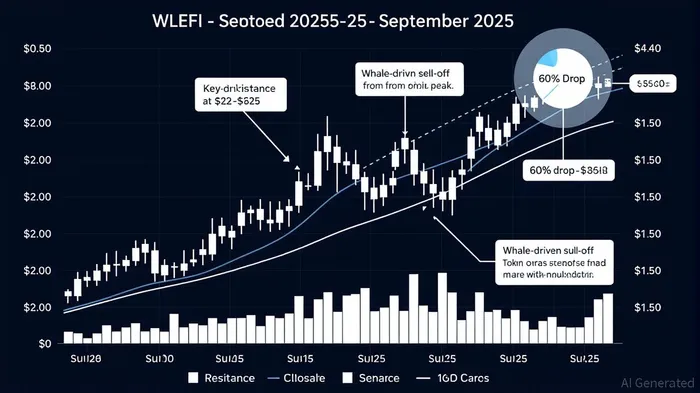
World Liberty Financial (WLFI), the Trump-backed token launched in September 2025, has become a case study in the interplay between technical support levels and systemic risks in crypto markets. After a 60% collapse from its $0.46 all-time high, the token now tests its $0.18 support level—a psychological floor that could either catalyze a rebound or signal further capitulation. For risk-aware traders, the question is not just whether $0.18 holds, but whether the token’s fundamentals and governance structure can withstand the headwinds of whale-driven volatility, concentrated ownership, and fragile liquidity.
Technical Analysis: A Fragile Floor
WLFI’s $0.18 level has emerged as a critical battleground. If buyers defend this level, a rebound toward $0.20–$0.22 is plausible, driven by short-covering and speculative buying [2]. However, technical indicators paint a bearish picture. The Parabolic SAR remains above price, reinforcing the downtrend, while the Bull–Bear Power (BBP) indicator shows bears in control [4]. On-chain data adds to the concern: over $23 million in WLFI tokens have been moved to exchanges in recent weeks, signaling waning confidence [5].
Historically, similar tokens like OVERTAKE (TAKE) have bounced off key support levels during corrections, but this behavior depends on liquidity and whale activity [5]. WLFI’s case is complicated by its thin order book and the fact that 96% of its supply is concentrated in a small number of addresses [4]. A breakdown below $0.18 could trigger a cascade to $0.15–$0.10, as seen in tokens with similar distribution profiles [3].
Fundamental Risks: Governance and Whale Control
WLFI’s governance model, while community-driven, is undermined by its token allocation. Founders and early investors hold 35% of the supply (20% for founders, 15% for the team), with 40% allocated to community rewards and 10% to public sales [1]. This structure creates inherent conflicts, as whale wallets—such as Justin Sun’s blacklisted address—can manipulate price action. Recent events underscore this risk: a 40% price drop followed Sun’s wallet being frozen, while whale 0x432 lost $1.6 million on a leveraged long position [1].
The project’s attempt to stabilize price via a 47 million token burn—a 0.19% reduction of its 24.66 billion supply—had minimal impact, with WLFI continuing its decline [5]. This highlights a core issue: token burns alone cannot offset the selling pressure from concentrated ownership. Even as WLFI expands to BNBBNB-- Chain and partners with DeFi aggregators, its governance remains vulnerable to whale-driven decisions, such as the recent 99.94% community vote to unlock trading [4].
Liquidity and Market Manipulation
WLFI’s liquidity profile is a double-edged sword. While listings on Binance, HTX, and Upbit have driven $1.77 billion in 24-hour trading volume [4], this liquidity is artificially inflated by whale activity. For example, whale 854RaR’s $2 million investment in WLFI at $0.27 per token dropped to $1.35 million in three days, reflecting extreme volatility [6]. Similarly, TechnoRevenant’s $30 million presale investment—now valued at $245 million—shows how whale accumulation can temporarily buoy price, but also amplify swings [6].
The token’s order book depth is equally concerning. A 299.79% 24-hour price drop and a 53.53% surge within hours indicate a market prone to manipulation [2]. When whales like 0x92bb profit $1.8 million from short positions, it signals a lack of consensus among large holders. This fragmentation increases the likelihood of further volatility, particularly as WLFI’s token unlock schedule allows early investors to trade 20% of their holdings [2].
Conclusion: A High-Risk Proposition
For risk-aware traders, WLFI’s $0.18 support level is a technical curiosity but not a reliable indicator of long-term stability. The token’s fundamentals—concentrated ownership, whale-driven volatility, and fragile liquidity—pose systemic risks that outweigh bullish technical scenarios. While Michaël van de Poppe’s $0.30 target [1] and short-term rebounds to $0.22 may attract speculative buyers, the broader picture remains bearish.
Traders should treat WLFI as a high-risk, high-volatility asset. A break below $0.18 would likely accelerate the decline toward $0.15, while a rebound to $0.22 would remain precarious without broader institutional confidence. Until governance transparency improves and liquidity deepens, WLFI’s price action will remain a function of whale whims rather than market fundamentals.
Source:
[1] World Liberty Financial WLFI Token Analysis Guide [https://www.bitget.com/wiki/world-liberty-financial-wlfi-token-analysis]
[2] WLFI Price at Critical Level as Traders Watch for Breakout [https://cryptodnes.bg/en/wlfi-price-at-critical-level-as-traders-watch-for-breakout/]
[3] OVERTAKE (TAKE) Price History: Patterns Every Trader [https://www.mexc.com/en-GB/crypto-pulse/article/overtake-take-price-history-3777]
[4] WLFI Token – Why Is Everyone Talking About It Now? [https://www.cryptoninjas.net/news/wlfi-token-why-is-everyone-talking-about-it-now/]
[5] WLFI Price Prediction: Can $0.18 Hold After a 60% Collapse? [https://www.mexc.com/fa-IR/news/wlfi-price-prediction-can-0-18-hold-after-a-60-collapse/86198]
[6] Whale 854RaR Down $650K on $WLFI in 3 Days [https://blockchain.news/flashnews/whale-854rar-down-650k-on-wlfi-in-3-days-on-chain-data-shows-32-drawdown-and-0-27-cost-basis]






Comentarios
Aún no hay comentarios