
WK Kellogg's Q1 Earnings Signal a Tough Road Ahead for Cereal Giants
WK Kellogg Co (NYSE: KLG) reported its first-quarter 2025 financial results, revealing a stark reality for the cereal industry: declining sales, shrinking margins, and a stock price hovering near its 52-week low. The company’s revenue fell 6% year-over-year to $663 million, while net income plummeted 45% to $18 million. Earnings per share (EPS) of $0.20 missed estimates by 44%, prompting a 2.9% pre-market decline in its stock price to $16.85.
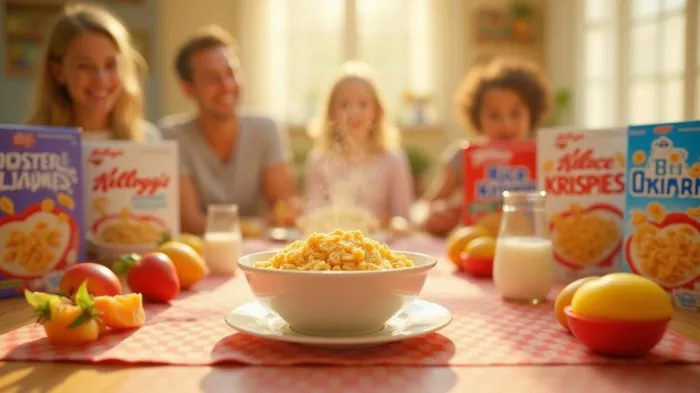
The results underscore the challenges facing cereal manufacturers in a shifting consumer landscape. Declining demand for traditional breakfast foods, competition from health-focused alternatives, and supply chain pressures have created headwinds for WK KelloggKLG--. Yet management remains undeterred, outlining a strategy to pivot toward healthier products, optimize operations, and reclaim market share.
The Numbers Tell a Story of Struggle
The earnings miss was unequivocal. highlights a drop from $707 million to $663 million, driven by lower volume across key categories. Gross margins were further squeezed as the company grappled with inventory adjustments and rising promotional spending to clear older stock.
CEO Gary Pilnik acknowledged the “reset” in expectations, attributing the slump to broader industry trends. “The U.S. cereal market declined by 80 basis points year-over-year,” he noted, citing shifting consumer preferences toward protein-forward snacks and wellness-focused alternatives. Competitors like smaller, health-centric brands are capitalizing on this shift, while WK Kellogg’s traditional cereal portfolio faces pricing pressure and declining volume.
Management’s Playbook: Health, Efficiency, and Reinvention
To counter these headwinds, WK Kellogg is doubling down on health-centric innovation. Key initiatives include:
- A multi-brand fiber campaign to highlight nutritional benefits, with Kashi relaunched to emphasize fiber content.
- A reinvigorated marketing push for Special K, which has underperformed but will now feature front-of-pack labeling and nutrient-density claims.
- Strategic reallocation of promotional spending to prioritize ROI, shifting from broad advertising to targeted campaigns.
Operationally, the company is prioritizing its supply chain modernization program, which aims to cut costs and improve efficiency. CFO Dave McKinstry emphasized that while Q2 will see the most significant gross margin contraction due to inventory adjustments, stabilization is expected by mid-2025. The long-term goal remains a 500 basis-point EBITDA margin expansion by 2026, supported by cost reductions in SG&A and manufacturing.
Risks and Opportunities Ahead
The path forward is fraught with challenges. The U.S. cereal market’s decline shows no signs of abating, and macroeconomic pressures could further dampen discretionary spending. WK Kellogg’s liquidity, with a current ratio of 0.74, also raises near-term concerns.
However, the company’s iconic brands—Frosted Flakes, Rice Krispies, and Kashi—retain strong equity, and its EV/EBITDA multiple of 6.85x suggests the stock is undervalued. Analysts at InvestingPro argue that if WK Kellogg delivers on its margin targets and regains distribution momentum, the stock could rebound.
Conclusion: A Make-or-Break Year for Kellogg’s Strategy
WK Kellogg’s Q1 results are a wake-up call. The company is at a crossroads: its traditional cereal business is contracting, and its ability to pivot to health-focused products and operational efficiency will determine its fate.
The numbers are clear: a 500 basis-point EBITDA margin expansion by 2026 hinges on executing supply chain improvements and product relaunches flawlessly. If successful, the stock could recover from its depressed valuation. However, if execution falters, the company risks becoming a relic in an evolving food landscape.
For investors, the question is whether WK Kellogg can translate its strategic vision into sustained growth. With its brands still resonating with consumers and a leaner cost structure on the horizon, the odds are not insurmountable—but the path is narrow. The next few quarters will be critical in determining whether Kellogg can “feed happiness” to its shareholders once again.





Comentarios
Aún no hay comentarios