
Are We Witnessing a New ESG-Driven Market Bubble?
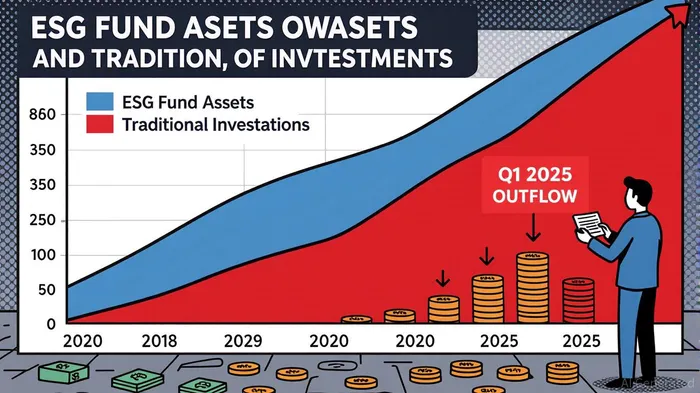
The ESG investment boom has long been hailed as a paradigm shift in finance, blending moral imperatives with market logic. Yet, as the sector matures, a critical question emerges: Is ESG becoming a speculative bubble, driven by sentiment rather than substance? Recent data and academic research suggest a nuanced answer—one where growth and resilience coexist with signs of overvaluation and capital misallocation.
The ESG Growth Story: Resilience Amid Volatility
Global ESG fund assets remain robust at $3.16 trillion as of March 2025, despite a record $8.6 billion outflow in Q1 2025, marking Europe’s first major exodus since 2018 [1]. This resilience is underpinned by structural trends: Asia’s ESG inflows, fueled by policy incentives in South Korea and Thailand, and a tripling of sustainable bond issuance to $918 billion by 2024 [3]. Meanwhile, ESG-integrated funds have delivered competitive long-term returns, with a hypothetical $100 investment growing to $136 by 2025 versus $131 for traditional funds [1].
Regulatory tailwinds further reinforce this trajectory. The EU’s Corporate Sustainability Reporting Directive (CSRD) and U.S. state-level climate disclosure laws are pushing firms to align with material ESG metrics, reducing greenwashing and enhancing transparency [4]. In Q2 2025, sustainable equity indices rebounded strongly, outperforming traditional benchmarks in technology and energy efficiency sectors [2].
The Bubble Hypothesis: Overvaluation and Behavioral Biases
Despite these positives, cracks in the ESG narrative are emerging. A surge in “green” asset valuations—driven by framing bias and social proof—has created a disconnect between investor sentiment and fundamentals. For instance, renewable energy stocks and ESG funds have attracted capital based on moral narratives rather than rigorous due diligence, inflating valuations beyond earnings potential [2].
Academic models underscore this risk. A CAPM-adjusted framework reveals that ESG preferences skew required returns, with wealthier investors prioritizing sustainability over yield [1]. Meanwhile, studies highlight a cubic S-shaped relationship between ESG ratings and firm value, which varies by institutional quality and sustainability context [1]. This volatility suggests that ESG valuations are as much about perception as performance.
The greenwashing crisis exacerbates these inefficiencies. Firms overstate ESG credentials to attract capital, increasing crash risk when discrepancies are exposed [2]. Inconsistent ESG ratings across agencies—such as MorningstarMORN-- and Sustainalytics—create arbitrage opportunities, with investors exploiting valuation gaps to generate alpha [4].
Capital Misallocation: The Hidden Cost of ESG Hype
The misalignment between ESG sentiment and economic reality risks distorting capital allocation. For example, the climate adaptation market, valued at $1 trillion, is growing at 21% annually, yet much of this investment may target low-impact initiatives [2]. Similarly, AI-driven ESG reporting tools, while improving transparency, often prioritize data aggregation over actionable insights, leading to “analysis paralysis” in portfolio construction [4].
Regulatory shifts also introduce uncertainty. The U.S. withdrawal from global ESG promotion under President Trump and divergent EU-U.S. disclosure standards have created a fragmented landscape, complicating long-term strategy for asset managers [1].
Conclusion: Bubble or Evolution?
The ESG market is neither a classic bubble nor a flawless revolution. It reflects a generational shift toward sustainability, tempered by the same behavioral biases that have historically distorted markets. While overvaluation risks exist—particularly in sectors reliant on narrative-driven growth—the sector’s resilience and regulatory momentum suggest a more complex reality.
For investors, the key lies in distinguishing between ESG as a fad and ESG as a framework for long-term value. As one study concludes, “The economics of ESG disclosure will ultimately depend on whether firms can align their sustainability claims with material financial outcomes” [5]. Until then, the ESG bubble debate will remain a cautionary tale of capital chasing virtue.
Source:
[1] ESG insights for 2025 and beyond [https://www.rothschildandco.com/en/newsroom/insights/2025/06/wm-business-with-humanity-esg-insights-for-2025-and-beyond/]
[2] Inefficiently Efficient: Decoding Market Madness Through ... [https://www.linkedin.com/pulse/inefficiently-efficient-decoding-market-madness-through-pandey-ykl5c]
[3] Sustainable investing outlook: Strong returns amid net flow pressures [https://ieefa.org/resources/sustainable-investing-outlook-strong-returns-amid-net-flow-pressures]
[4] ESG Mid-Year Update: Who Still Cares and Why You Should [https://www.fticonsulting.com/insights/articles/esg-mid-year-update-who-still-cares-why-you-should]
[5] The economics of ESG disclosure regulation [https://link.springer.com/article/10.1007/s11142-025-09900-9]







Comentarios
Aún no hay comentarios