
Wistron Corp’s $455 Million U.S. Investment: A Strategic Pivot in AI Manufacturing
Wistron Corporation, a Taiwanese electronics manufacturing giant, has announced an additional $455 million investment in its new U.S. subsidiary, marking a bold move to counter U.S. tariffs and capitalize on soaring demand for AI infrastructure. The expansion, which brings total investment to $500 million since April 2024, underscores Wistron’s ambition to solidify its position as a key player in the global AI server supply chain.
Strategic Context: Tariffs and Trade Dynamics
The $455 million injection follows escalating U.S. reciprocal tariffs on Taiwanese imports, which now stand at 32%. By relocating production to Texas—a hub for advanced manufacturing—Wistron aims to bypass these penalties while meeting U.S. demand for AI infrastructure. This aligns with broader industry shifts, as Taiwanese tech firms like Foxconn and Quanta also expand U.S. operations to mitigate tariff risks.
Location and Job Creation: Texas as the New Manufacturing Heartland
Wistron’s Texas subsidiary, SMS InfoComm, is the focal point of this expansion. The company has already invested $25 million in renovating its Texas facility to support AI server production, with plans to create 2,000 jobs by 2025. These roles span manufacturing, technical support, and management, offering an average annual wage of $66,418. The expansion has received $1.9 million in state incentives, underscoring Texas’s strategic appeal for high-tech manufacturing.
Product Focus: AI Servers Drive Growth
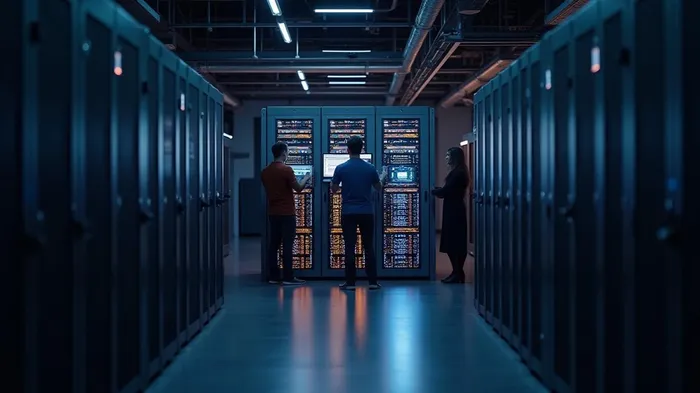
The investment is explicitly tied to AI server manufacturing, a sector where Wistron holds a dominant position. As a key supplier to tech giants like NVIDIANVDA-- and Apple, Wistron’s Texas facility will produce high-performance servers for data centers and cloud infrastructure. This aligns with U.S. initiatives like the “Stargate” program, which prioritizes domestic AI infrastructure development.
Notably, Wistron’s AI servers are designed to meet stringent U.S. energy efficiency standards, such as ENERGY STAR certifications, ensuring competitiveness in a market increasingly focused on sustainability.
Global Expansion: Beyond the U.S.
While the U.S. is central to this strategy, Wistron is also diversifying its footprint. In India, the company plans to invest $176 million in a laptop manufacturing plant in Karnataka, targeting a growing consumer electronics market. Meanwhile, Vietnam is set to host a $37 million facility for server and PC production. These moves reflect a deliberate effort to balance tariff risks and global supply chain resilience.
Risks and Challenges
Despite the strategic advantages, Wistron faces hurdles. The Texas facility’s $3–5 billion price tag for full automation could strain margins, while geopolitical tensions—such as U.S. semiconductor tariffs—remain unpredictable. Competitors like Foxconn, which has invested $128 million in California, also pose a threat.
Conclusion: A Calculated Bet on the Future
Wistron’s $500 million U.S. investment is a masterstroke in navigating trade headwinds and capitalizing on AI’s exponential growth. By anchoring its AI server production in Texas—a region with strong tech infrastructure and incentives—the company is positioning itself to capture a significant slice of the $50 billion AI hardware market.
The 2,000 jobs created in Texas not only bolster local economies but also signal long-term commitment to U.S. manufacturing. With clients like NVIDIA demanding advanced server capabilities, Wistron’s focus on energy-efficient, modular designs positions it as a critical partner for cloud providers.
While risks persist, Wistron’s strategic foresight—evident in its early pivot to Texas and its global diversification—is likely to pay dividends. As the AI revolution accelerates, this investment could cement the company’s role as a linchpin of the next-generation digital infrastructure.
In an era defined by geopolitical tension and technological upheaval, Wistron’s bet on the U.S. is not just about avoiding tariffs—it’s about building the future.







Comentarios
Aún no hay comentarios