
Winnebago's Strategic Turnaround: Can Operational Overhauls and New Product Launches Drive a Recovery in 2025?
Winnebago Industries (WGO) has long been a bellwether for the cyclical recreational vehicle (RV) industry, navigating booms and busts tied to macroeconomic shifts. As of Q4 2024, the company appears to be executing a strategic pivot aimed at stabilizing its operations and repositioning for growth in 2025. This analysis evaluates whether Winnebago's operational overhauls, new product launches, and financial discipline can catalyze a meaningful recovery in a sector still grappling with post-pandemic volatility.
Operational Overhauls: A Mixed Bag of Progress and Challenges
Winnebago's Q4 2024 results revealed a nuanced picture of progress and lingering headwinds. , driven by favorable product mix and price increases, though higher discounts and allowances tempered gains. The Towable RV segment, , saw , reflecting margin improvement. Meanwhile, , but its operating income margin turned negative , underscoring the short-term pain of long-term restructuring.
The Marine segment, however, emerged as a standout, . This turnaround was attributed to the absence of goodwill impairment charges and operational efficiencies, signaling potential for sustained profitability. These mixed results highlight Winnebago's ability to optimize certain segments while grappling with the costs of broader operational overhauls.
New Product Launches: Targeting Premiumization and Affordability
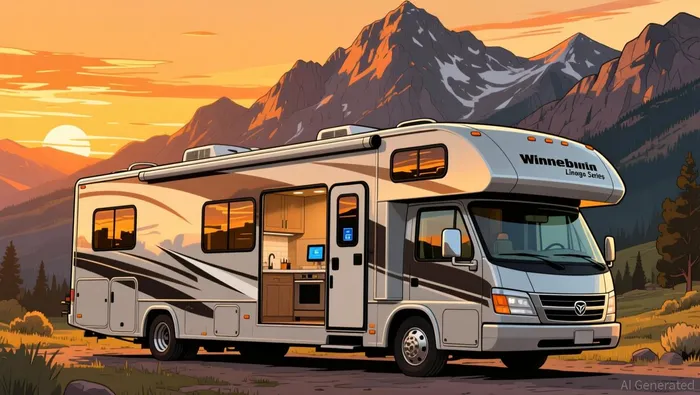
Winnebago's product strategy in Q4 2024 focused on dual tracks: premiumization and affordability. The company introduced the Grand Design Lineage Series M, a Class C motorhome targeting the premium segment, with a for its first fiscal year. This aligns with broader industry trends toward high-end RVs, as consumers increasingly prioritize quality and innovation. Complementing this, the Winnebago Sunflyer and Grand Design Transcend travel trailers were designed to attract budget-conscious buyers without compromising on features, reflecting a strategic push to diversify its customer base.
These launches are critical for capturing market share in a sector where product differentiation is key. According to a report by RV Business, Winnebago's CEO, Michael Happe, emphasized the importance of ", " strategies, including leveraging supply chain partnerships to mitigate potential tariff impacts. Such forward-looking measures could insulate the company from external shocks while maintaining pricing flexibility.
Valuation Metrics: A Tale of Two P/E Ratios
Winnebago's valuation metrics present a paradox. As of October 2025, , suggesting undervaluation relative to future earnings potential. This discrepancy reflects investor skepticism about near-term profitability but optimism about long-term recovery. , however, highlight a leveraged balance sheet. By December 2025, the net debt-to-EBITDA had , indicating progress in deleveraging.
Comparisons with peers like Thor Industries Forest River underscore Winnebago's structural disadvantages in scale and purchasing power. Yet, its focus on premium products and operational efficiency may allow it to outperform in niche segments, even if it lags in broader market share.
Industry Cyclicality: Navigating a Reset in the RV Market
The RV industry's cyclical nature remains a double-edged sword. Post-pandemic, the sector faced a correction in 2022–2023 due to inflation and supply chain disruptions, but 2025 has seen stabilization with rebalanced inventories and a shift toward selective, high-end purchases. , .
Winnebago's strategic focus on operational efficiency and product innovation positions it to capitalize on the next upcycle. hinges on sustained growth in the Motorhome segment and flat-to-modest gains in Towable RVs. While the Marine segment faces softer retail conditions, its recent turnaround suggests resilience.
Conclusion: A Calculated Bet on Recovery
Winnebago's strategic turnaround is a calculated bet on operational discipline, product diversification, and navigating industry cycles. While its leveraged balance sheet and smaller scale compared to peers pose risks, the company's focus on premiumization, margin improvement, and supply chain resilience offers a compelling value proposition. For value investors, the key question is whether WinnebagoWGO-- can execute its transformation without overextending its resources. Given the RV industry's projected growth-driven by remote work trends and electrified RVs-and Winnebago's forward P/E of 13.73, the stock appears undervalued for those willing to weather short-term volatility.







Comentarios
Aún no hay comentarios