
The Widening U.S.-China AI Divide: Implications for Global Tech Equity Markets
The U.S.-China rivalry in artificial intelligence (AI) has evolved into a defining geopolitical and economic contest of the 21st century, with profound implications for global tech equity markets. As both nations deploy divergent strategies to secure AI leadership, capital allocation patterns are shifting in response to regulatory headwinds, technological constraints, and geopolitical risks. For investors, understanding these dynamics is critical to navigating the fragmented yet high-potential AI landscape.
U.S. Strategy: Private Sector Dominance and Export Controls
The United States has prioritized a private-sector-led approach to AI, with major tech firms investing over $450 billion in AI-specific capital expenditures in 2026 alone. This strategy emphasizes innovation in advanced AI infrastructure, including high-end semiconductors and supercomputing capabilities. The U.S. government has reinforced this model through strict export controls on advanced AI chips and semiconductor manufacturing equipment, effectively limiting China's access to critical technologies. These controls have kept Chinese chipmaker SMIC behind global leaders like TSMCTSM--, preserving the U.S. edge in hardware development.
However, recent policy shifts hint at a nuanced approach. In late 2025, the U.S. rolled back export restrictions on certain AI chips, such as the NvidiaNVDA-- H200, allowing sales to China in exchange for a 25% revenue stake. This move, framed as a bargaining tool in broader negotiations, signals a willingness to selectively loosen controls while maintaining strategic advantages. Yet, as one analyst notes, "The U.S. is walking a tightrope-balancing short-term economic gains with long-term risks of eroding its technological edge."
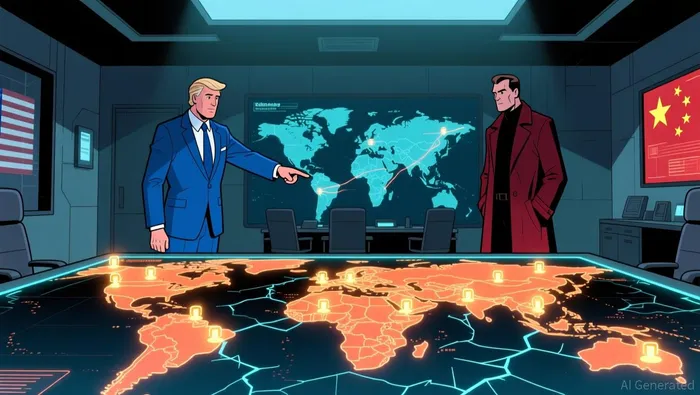
China's Response: State-Driven Self-Reliance and Strategic Efficiency
China's AI ambitions are anchored in its "Made in China 2025" initiative, a state-backed industrial policy aimed at achieving self-reliance in high-tech industries by 2049. Despite U.S. export restrictions, China has invested heavily in domestic semiconductor production and AI infrastructure, including research parks and national compute clusters. A $138 billion venture capital guidance fund announced in 2025 underscores Beijing's commitment to closing the gap with the U.S. in AI and quantum technologies.
Yet, Chinese firms face persistent challenges. Access to advanced AI chips remains constrained, with executives acknowledging that hardware shortages hinder model development. To mitigate this, Chinese startups like DeepSeek and AI2 Robotics have adopted efficiency-driven strategies, achieving competitive performance with fewer parameters and lower costs. These innovations highlight China's ability to adapt, but they also underscore the limitations of its current capabilities compared to U.S. leaders like NVIDIA and OpenAI.
Geopolitical Tensions and Capital Allocation Shifts
The U.S.-China rivalry has introduced volatility into global tech equity markets. Flare-ups in trade disputes-such as China's threats to restrict rare-earth exports and U.S. retaliatory tariffs-have triggered sharp market corrections. Investors are increasingly prioritizing diversification and active management strategies, with 63% of North American institutional investors expecting active strategies to outperform in 2026.
Capital flows reflect this caution. U.S. AI-related stocks surged in 2025 due to robust earnings growth, but concerns about overvaluation are rising, with 40% of investors fearing a tech bubble. Meanwhile, Chinese AI equities, though undervalued, face regulatory risks under the Holding Foreign Companies Accountable Act (HFCAA) and geopolitical uncertainties. Despite these challenges, foreign investors are warming to China's AI sector, drawn by its lower valuations and strategic efficiency.
Investor Strategies: Transparency, M&A, and Infrastructure
Investors are recalibrating their approaches to AI-driven equities. A key trend is the demand for transparency in AI strategies, with less than 40% of investors satisfied with corporate disclosures on AI initiatives. This push for accountability is mirrored by regulatory actions, such as the SEC's crackdown on "AI-washing"- misleading claims about AI capabilities.
M&A activity has also surged, with U.S. tech firms acquiring smaller AI startups to bolster their capabilities. In 2025, AI-related M&A deals in the U.S. reached $63 billion, driven by private equity firms seeking to capitalize on the AI boom. China's TMT sector saw similar momentum, though regulatory scrutiny on data security and antitrust issues tempered some transactions.
The Road Ahead: Balancing Risk and Opportunity
For global investors, the U.S.-China AI divide presents both risks and opportunities. The U.S. remains the dominant hub for AI innovation, with 74% of global high-end supercomputing capacity and a robust venture capital ecosystem. However, its regulatory environment is becoming more complex, with the SEC tightening oversight on AI-related disclosures. China, while lagging in hardware, offers growth potential through state-backed initiatives and cost-efficient models.
The key to successful capital allocation lies in diversification and agility. Investors should prioritize companies with strong governance frameworks, transparent AI strategies, and exposure to both U.S. and Chinese markets. Sectors like energy and infrastructure-critical for powering AI workloads-are also gaining traction.
Conclusion
The U.S.-China AI rivalry is reshaping global tech equity markets, with regulatory and geopolitical factors dictating capital flows. While the U.S. maintains a near-term advantage in infrastructure and private investment, China's state-driven model and strategic efficiency cannot be ignored. For investors, the path forward requires a nuanced understanding of these dynamics, balancing exposure to innovation with mitigation of geopolitical risks. As one industry expert concludes, "The AI race is not just about technology-it's a battle for the future of global capital allocation."





Comentarios
Aún no hay comentarios