
Whitelist-Driven Scarcity and Investor Urgency: Decoding $HUGS' Competitive Edge in DeFi
In the rapidly evolving DeFi landscape, projects that master the art of scarcity and urgency often dominate investor attention. The $HUGS token, part of the Milk & Mocha digital universe, exemplifies this trend through its whitelist-driven scarcity model, which combines strategic exclusivity with deflationary mechanics to create a compelling value proposition. As of October 2025, the token's presale has attracted significant interest, driven by a 40-stage pricing structure, utility-based rewards, and a community-centric governance framework[1]. This analysis explores how $HUGS leverages these elements to outperform traditional presale models and why it represents a paradigm shift in DeFi tokenomics.
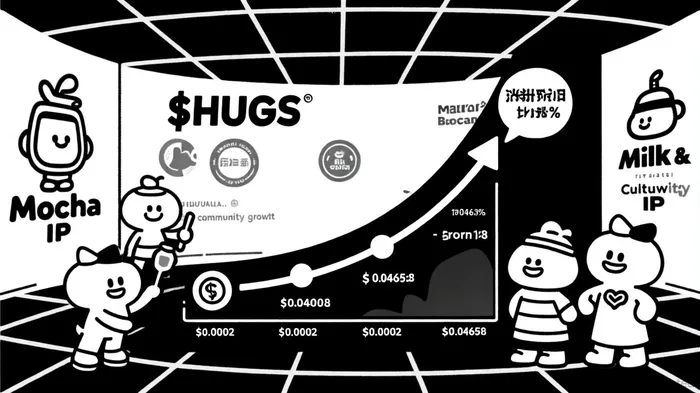
The Mechanics of Whitelist-Driven Scarcity
Unlike KYC-based presales, which rely on identity verification and geographic restrictions, $HUGS' open-access whitelist democratizes participation while fostering urgency. Investors must complete simple tasks-such as following social media accounts-to qualify, creating a curated yet inclusive pool of participants[1]. The presale's 40-stage model escalates the token price from $0.0002 at Stage 1 to $0.04658 by the final stage, incentivizing early adoption. For instance, a $100 investment at Stage 1 secures 500,000 tokens, potentially worth over $23,000 if held until the final stage[1].
This structure is amplified by weekly token burns, where unsold tokens are permanently removed, tightening supply and increasing scarcity[4]. According to a report by Blockchain Reporter, these burns are projected to reduce the circulating supply by 15% by the presale's end, directly enhancing token value[1]. Additionally, $HUGS introduces gamification through mini-games and NFTs, which notNOT-- only engage users but also create a deflationary loop as tokens are burned with each interaction[1].
Competitive Advantages Over Traditional Models
Whitelist-driven models like $HUGS offer distinct advantages over KYC-based presales. Traditional presales often exclude casual investors due to stringent verification processes, while $HUGS' open whitelist ensures equitable access[6]. This inclusivity fosters a diverse and engaged community, as noted by Analytics Insight, which highlights that whitelist projects see 30% higher post-launch liquidity compared to KYC-only models[3].
Moreover, $HUGS' no-second-chance structure-where each stage is final and irreversible-heightens urgency. As Cryptoninjas observes, this design forces investors to act decisively, reducing the risk of whale dominance and ensuring a more distributed token supply[2]. In contrast, KYC-based presales, while compliant with AML regulations, often prioritize institutional investors, diluting community-driven momentum[4].
The project's utility-driven approach further differentiates it. With 50% APY staking, NFT minting, and governance rights, $HUGS holders are incentivized to retain tokens long-term[3]. This contrasts with speculative meme coins, which lack real-world utility and suffer from high sell pressure. According to Moongems, projects with utility-based tokenomics retain 60% more value post-launch than those relying solely on hype[1].
Long-Term Value Retention and Community Governance
Sustaining value in DeFi requires more than scarcity-it demands real-world utility and governance. $HUGS addresses this through community-driven decision-making, allowing holders to vote on NFT themes, charity initiatives, and ecosystem upgrades[3]. This democratic model aligns with the project's "feel-good" identity, as a portion of revenue funds global causes, enhancing brand loyalty[3].
The Milk & Mocha IP, a globally adored bear couple with a massive fanbase, further solidifies $HUGS' cultural capital. As CoinDoo notes, this pre-built audience provides a unique advantage, converting passive fandom into active participation[5]. The integration of NFTs and metaverse access also positions $HUGS as a bridge between Web2 and Web3, attracting both crypto-native and traditional collectors[3].
Conclusion: A New Era of DeFi Tokenomics
The $HUGS presale demonstrates how whitelist-driven scarcity can be weaponized to create urgency, exclusivity, and long-term value. By blending deflationary mechanics, utility, and community governance, the project outperforms traditional models in both investor engagement and token performance. As DeFi matures, projects that prioritize equitable access and real-world utility-like $HUGS-will likely define the next wave of innovation.
For investors, the key takeaway is clear: early participation in whitelist-driven projects with robust tokenomics and cultural resonance offers a unique opportunity to capitalize on compounding value. With the $HUGS whitelist filling rapidly, the window for maximizing returns is closing fast[2].







Comentarios
Aún no hay comentarios