
WhiteFiber's Q2 2025 Earnings: A Tug-of-War Between Growth Ambitions and Cost-Efficiency
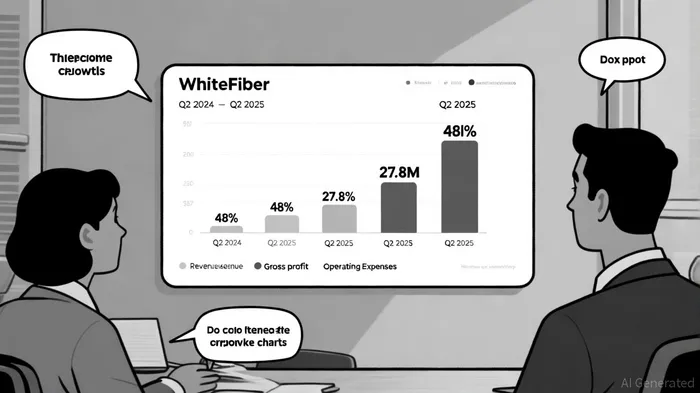
WhiteFiber, Inc.'s Q2 2025 earnings report reveals a company at a critical inflection pointIPCX--. While the firm's revenue surged 48% year-over-year to $18.7 million, driven by robust demand for GPU cloud services and colocation offerings, its cost structure and operational leverage tell a more complex story. The results underscore the tension between aggressive expansion and financial discipline—a tension that will define the company's trajectory in the AI infrastructure race.
Revenue Growth and Gross Margin Resilience
According to the report by WhiteFiberWYFI--, the company's cloud services segment generated $16.6 million in revenue for Q2 2025, reflecting a 33% year-over-year increase and a gross margin of 61%[1]. Colocation services added $1.7 million, maintaining a 60% gross margin[1]. These figures highlight the firm's ability to monetize its infrastructure efficiently, even as it scales. The healthy gross margins suggest that WhiteFiber's pricing power and asset utilization are holding up, a critical factor in an industry where capital intensity often erodes profitability.
However, the path to profitability is obstructed by rising operating costs. Operating expenses ballooned to $27.8 million in Q2 2025, a stark contrast to the $12.3 million reported in the same period in 2024[1]. General and administrative expenses alone accounted for $15.5 million, a significant jump attributed to share-based compensation ($6.5 million) and expansion-related costs[1]. This surge in expenses led to an operating loss of $9.2 million, reversing the $2.4 million operating income from Q2 2024[1].
Operational Leverage: A Double-Edged Sword
The decline in adjusted EBITDA—from $7.0 million in Q2 2024 to $3.3 million in Q2 2025—exposes the fragility of WhiteFiber's operational leverage[1]. While the company's revenue growth is impressive, its cost structure is heavily skewed toward fixed and semi-variable expenses. For instance, the acquisition of a one-million-square-foot data center in North Carolina and the deployment of wafer-scale systems for Cerebras under a 5MW IT load contract are capital-intensive initiatives that will take time to yield returns[1].
The strategic logic here is clear: WhiteFiber is betting on long-term market dominance by securing high-margin AI infrastructure. Yet, the immediate trade-off is a net loss of $8.8 million for the quarter[2]. This raises questions about the company's ability to balance short-term financial health with long-term growth. The recent CAD $60 million debt facility with Royal Bank of Canada[1] provides liquidity, but it also increases financial risk, particularly if revenue growth slows or cost overruns occur.
Strategic Investments and Market Positioning
WhiteFiber's Q2 performance must be contextualized within its broader corporate strategy. The completion of its IPO on August 8, 2025, which raised $183 million in gross proceeds[1], underscores its ambition to scale rapidly. Bit Digital's 71.5% ownership stake post-IPO[1] suggests a continued alignment of interests, though it also highlights potential governance risks if the company prioritizes growth over shareholder returns.
The deployment of wafer-scale systems for Cerebras, expected to generate revenue in Q4 2025[1], is a high-stakes bet. If successful, these systems could differentiate WhiteFiber in the AI infrastructure market. However, the upfront costs and technical complexities of such deployments are substantial, and any delays could exacerbate current losses.
Conclusion: A Calculated Gamble
WhiteFiber's Q2 results illustrate a company willing to sacrifice near-term profitability for strategic positioning in the AI era. The firm's cost-efficiency metrics—while strong in gross margins—are undermined by bloated operating expenses and declining EBITDA. For investors, the key question is whether these investments will translate into durable competitive advantages or become a drag on value creation.
The path forward hinges on two factors: the timely completion of the North Carolina data center and the successful monetization of wafer-scale systems. If these initiatives deliver as promised, WhiteFiber could achieve the operational leverage needed to turn its current losses into gains. Until then, the company remains a high-risk, high-reward proposition in a market where patience is a virtue.





Comentarios
Aún no hay comentarios