
Whitecap Resources: Strategic Resilience in a Low-Price Oil Environment
In a volatile energy market characterized by persistent low oil prices, Whitecap Resources has emerged as a case study in strategic adaptability. The company's landmark merger with Veren Inc. in May 2025, forming a $15 billion energy entity, has positioned it as a leader in Canada's light oil and condensate sector. By leveraging capital discipline and aggressive synergy realization, Whitecap is not only weathering the current price environment but also laying the groundwork for sustained value creation.
Capital Discipline: A Foundation for Resilience
Whitecap's post-merger strategy has prioritized operational efficiency and cost optimization. According to a report, third-quarter 2025 operating costs averaged $12.49/boe, an 8% improvement over the prior quarter, driven by streamlined workflows and infrastructure optimization. This reflects a disciplined approach to capital allocation, with the combined entity securing $3.5 billion in credit facilities to fund operations while divesting non-core assets, such as its southwest Saskatchewan properties, for $270 million.
The company's 2026 budget further underscores this discipline, allocating $300 million annually in synergies-40% higher than the initial $210 million target-across capital, operating, and corporate efficiencies. These measures are critical in a low-price environment, where margin preservation is paramount. By reducing duplication in procurement and optimizing rig lines, Whitecap has demonstrated its ability to maintain profitability even as commodity prices fluctuate.
Synergy Realization: Unlocking Operational Potential
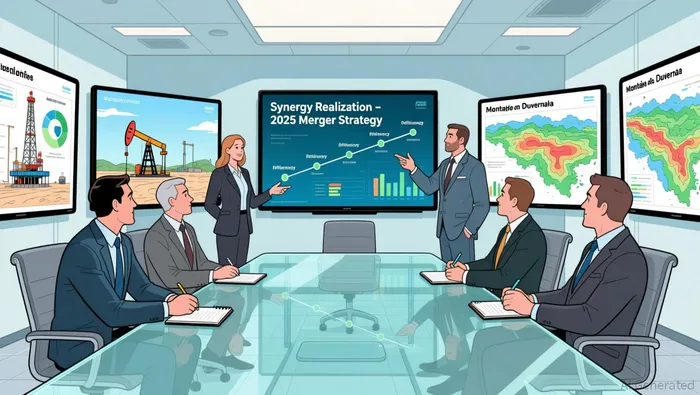 The merger with Veren has unlocked significant operational synergies, particularly in the Montney and Duvernay formations. In the Montney, Whitecap plans to drill a 6-well pad in Musreau by early 2026 and explore throughput enhancements of 10–20%. Similarly, in the Duvernay, the company aims to drill 35 wells in 2025, targeting both volatile oil and liquids-rich gas windows, while leveraging existing infrastructure to reduce capital expenditures.
These initiatives are complemented by strategic investments in conventional assets. In Saskatchewan, Whitecap's Frobisher program has already outperformed initial production expectations by 25%, with plans to expand triple-leg lateral wells to maximize royalty incentives. Such targeted development ensures that the company's low-decline conventional production (under 20% annually) remains a stable cash flow generator.
Long-Term Value Creation: A Path Forward
Whitecap's strategic positioning is further reinforced by its ability to adapt to market conditions. The company raised its 2025 production guidance to 305,000 boe/d (63% liquids), exceeding pre-merger projections. This growth is underpinned by a robust inventory of 4,800 development locations in the Montney and Duvernay, ensuring long-term resource flexibility.
Moreover, the integration of Veren's technical expertise has enabled Whitecap to experiment with advanced development strategies, such as optimized well spacing and completions technology, enhancing asset performance. These innovations, combined with infrastructure synergies in the Kaybob area-where capital duplication in trunk lines and compression is being eliminated-position the company to scale operations efficiently.
Conclusion: A Model for Energy Sector Resilience
Whitecap Resources' post-merger strategy exemplifies how capital discipline and synergy realization can transform a company into a resilient player in a low-price oil environment. By prioritizing cost efficiency, operational innovation, and strategic asset management, the company is not only mitigating near-term risks but also building a foundation for long-term value creation. As the energy sector navigates ongoing volatility, Whitecap's approach offers a compelling blueprint for sustainable growth.







Comentarios
Aún no hay comentarios