
How White House Crypto Policies Are Reshaping Institutional Investment in Digital Assets
The U.S. government's aggressive pivot toward pro-crypto policies in 2025 has catalyzed a seismic shift in institutional investment frameworks. By formalizing BitcoinBTC-- as a sovereign asset and streamlining regulatory clarity, the White House has positioned digital assets as a cornerstone of modern portfolio strategy. This analysis unpacks how executive actions, legislative initiatives, and market infrastructure upgrades are redefining the institutional landscape for cryptocurrencies.
Strategic Bitcoin Reserve: A Sovereign-Grade Asset
The establishment of the Strategic Bitcoin Reserve (SBR) via Executive Order 14233 in March 2025 marked a watershed moment. By designating Bitcoin as a strategic reserve asset—capitalized with seized criminal assets and held indefinitely—the government has normalized its role as a "digital gold" equivalent[4]. This move has sent a clear signal to institutional investors: Bitcoin is no longer a speculative fringe asset but a legitimate, long-term store of value.
The SBR's creation has directly influenced institutional adoption. As of Q2 2025, 59% of institutional investors had allocated at least 10% of their portfolios to Bitcoin and other digital assets[1], a jump from 32% in early 2024. This shift is driven by Bitcoin's scarcity, its non-correlation with traditional assets, and the regulatory certainty provided by the White House's "pro-innovation mindset" [5].
Regulatory Clarity and the GENIUS Act
The GENIUS Act, passed in 2025, has further solidified the U.S. as a crypto-friendly jurisdiction. By establishing a federal framework for stablecoins, the law has enabled institutions to leverage dollar-backed tokens for cross-border payments, hedging, and liquidity management[5]. This has been critical for corporate treasuries and sovereign wealth funds (SWFs), which now treat Bitcoin as a hedge against inflation and geopolitical risk[1].
Complementing this, the rescission of SEC guidance that previously restricted banks from engaging in crypto activities[3] has unlocked new custody solutions. Financial institutions are now offering digital assetDAAQ-- services, with major banks like JPMorgan and Goldman Sachs launching institutional-grade custody platforms[2]. These developments align with the President's Working Group on Digital Asset Markets' recommendation to assign the CFTC oversight of commodity tokens like Bitcoin, while the SEC regulates digital securities[3].
Institutional Investment: From Speculation to Strategy
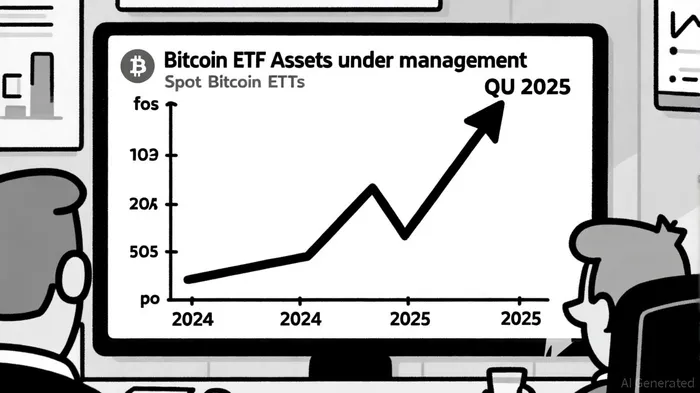
The launch of spot Bitcoin ETFs in early 2025 has been a game-changer. By Q1 2025, these ETFs had amassed $65 billion in assets under management (AUM), with BlackRock's iShares Bitcoin Trust (IBIT) leading the pack at $18 billion[1]. This structured access has reduced barriers for pension funds, endowments, and hedge funds, enabling them to allocate Bitcoin alongside traditional assets.
Moreover, the SBR's budget-neutral acquisition strategy—prioritizing non-taxpayer-funded BTC—has set a precedent for institutional accumulation[4]. Corporate treasuries and SWFs are now following suit, with entities like the Singapore Government Investment Corporation (GIC) and the Abu Dhabi Investment Authority (ADIA) reportedly allocating 5–10% of reserves to Bitcoin[1].
Market Infrastructure and Price Dynamics
The regulatory clarity and institutional influx have reshaped Bitcoin's market structure. Realized volatility has dropped by 75% compared to pre-2024 levels[1], as large-cap ETFs and institutional orders stabilize price swings. This has attracted macro investors and asset managers who previously shunned Bitcoin's volatility.
Analysts project Bitcoin's price to reach $200,000–$210,000 within 12–18 months, driven by stock-to-flow models and continued institutional inflows[1]. The SBR's symbolic role as a sovereign reserve asset further reinforces Bitcoin's legitimacy, with some experts comparing its trajectory to gold's adoption in the 1970s[4].
Conclusion: A New Era for Digital Assets
The White House's 2025 crypto agenda—anchored by the SBR, GENIUS Act, and regulatory modernization—has redefined institutional investment in digital assets. By treating Bitcoin as a strategic reserve and fostering a pro-innovation ecosystem, the U.S. is not only securing its position as the "crypto capital of the world" but also enabling a new generation of investors to integrate digital assets into their portfolios. For institutions, the message is clear: digital assets are here to stay, and the future of finance is being rewritten in real time.





Comentarios
Aún no hay comentarios