
Whale-Driven Momentum in Digital Assets: Strategic Entry Points Amid Regulatory and Market Shifts
The cryptocurrency market in 2025 has been defined by a confluence of regulatory clarity, institutional adoption, and whale-driven momentum. As global frameworks like the EU's Markets in Crypto-Assets (MiCA) and the U.S. GENIUS Act solidified the legal foundation for digital assets, institutional investors began treating BitcoinBTC-- and EthereumETH-- as legitimate portfolio allocations. This shift has amplified the role of institutional whale activity as a leading indicator for strategic entry points, with on-chain analytics and AI-driven tools enabling precise tracking of large holder behavior.
Regulatory Clarity Fuels Institutional Participation
The implementation of comprehensive regulatory frameworks in 2025 marked a turning point for institutional engagement. The U.S. GENIUS Act, for instance, provided a clear roadmap for crypto asset classification, while the EU's MiCA regulations established standardized compliance protocols for exchanges and custodians according to Chainalysis. These developments, coupled with the approval of spot Bitcoin exchange-traded products (ETPs), created a stable environment for traditional financial institutions to allocate capital to digital assets according to SSGA. By late 2025, 55% of hedge funds had some form of crypto exposure, up from 47% in 2024 according to AIMA.
Institutional confidence was further bolstered by the U.S. government's establishment of a Strategic Bitcoin Reserve, alongside corporate treasuries like MicroStrategy and BlackRock's IBIT ETF absorbing significant portions of the Bitcoin supply according to Yellow. This institutional accumulation, often executed during market downturns, has created a bifurcated ownership structure where large holders (100–10,000 BTC) dominate price action while retail investors exhibit divergent behavior according to ForkLog.
Whale Activity as a Leading Indicator
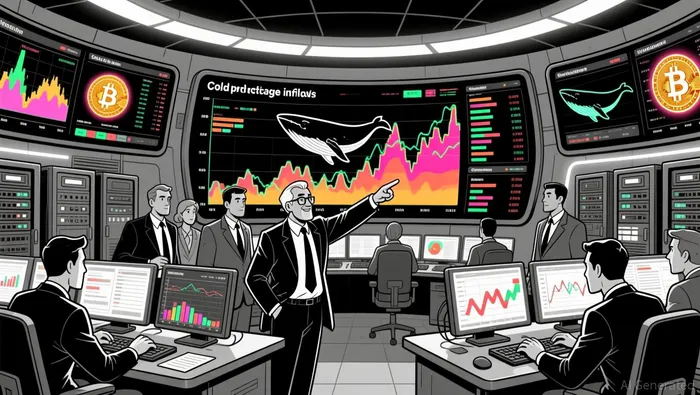 On-chain data reveals that institutional whales-addresses holding 1,000+ BTC-increased their accumulation by 15% year-over-year in 2025 according to Blockchain News. Sustained transfers from dormant wallets to cold storage, particularly in late December, signaled long-term bullish sentiment despite macroeconomic headwinds according to Blockchain News. For example, Bitcoin whales moved billions in 2025, with large transactions often preceding price rallies or corrections according to Blockchain News.
Institutional investors leverage advanced tools like Nansen and Amberdata to monitor whale movements, tracking metrics such as exchange inflows, wallet clustering, and net accumulation thresholds according to Nansen. A key strategy involves identifying "smart money" flows: when whales transfer assets from exchanges to cold wallets, it typically indicates accumulation and potential price support zones according to Kenson Investments. Conversely, spikes in exchange inflows may signal impending dumping, prompting hedging strategies like delta-neutral trading or options deployment according to Crypto Research.
Strategic Entry Points and Quantitative Models
In 2025, institutional players combined on-chain analytics with technical indicators to refine entry points. For instance, sustained accumulation by whales (e.g., 1,000+ BTCBTC-- transfers) was often confirmed by support/resistance levels, creating high-probability entry zones according to Kenson Investments. Machine learning models further optimized volatility surfaces, enabling funds to adjust positions ahead of liquidity shocks according to Crypto Research.
A notable case study is MicroStrategy's accumulation of 629,376 BTC by August 2025, facilitated by an at-the-market program that absorbed Bitcoin during consolidation phases according to Yellow. Similarly, BlackRock's IBIT ETF, with $50 billion in assets under management, demonstrated how institutional demand could stabilize price volatility compared to pre-ETF periods according to PowerDrill. These strategies highlight the importance of timing-whale-driven momentum often precedes broader market trends, allowing early entrants to capitalize on asymmetric risk/reward profiles.
Retail vs. Institutional Dynamics
While institutional whales dominate accumulation, 2025 also saw a surprising surge in retail participation. Wallets holding under 0.1 BTC increased their Bitcoin holdings by 3.31% from July to December 2025, outpacing whale accumulation rates according to ForkLog. This divergence from historical patterns-where whales typically absorb assets from retreating retail investors-raises questions about market sustainability. However, institutional players remain unfazed, maintaining an accumulation score of 0.90 for large holders (10,000+ BTC) amid retail uncertainty according to Yellow.
Conclusion: Whale-Driven Momentum as a Strategic Lens
As 2025 draws to a close, the interplay between regulatory clarity, institutional adoption, and whale activity has reshaped crypto market dynamics. Institutional investors now treat Bitcoin as a high-beta asset, leveraging on-chain analytics and quantitative models to identify entry points ahead of retail-driven volatility. While macroeconomic factors like Federal Reserve policy and geopolitical tensions continue to influence price performance, the strategic accumulation by whales remains a critical leading indicator. For investors, the key takeaway is clear: tracking institutional whale behavior-through tools like Nansen and Amberdata-offers a roadmap to navigate the evolving crypto landscape with precision and discipline.





Comentarios
Aún no hay comentarios