
Whale Dominance in Altcoin Markets: Concentration Risk and the Fragile Future of Speculative Assets
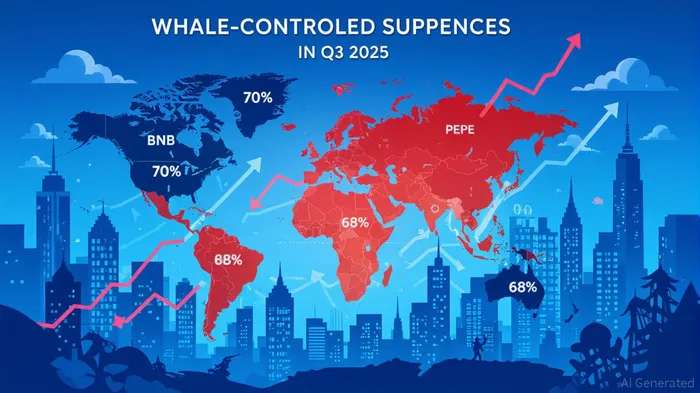
The altcoin market of 2025 is a theater of extremes. While Bitcoin’s dominance has dipped to 57%, the rise of altcoins has not been a democratizing force—it has instead concentrated power in the hands of a few whales. These entities, through strategic accumulation, leveraged trading, and coordinated sell-offs, now dictate the fate of entire ecosystems. The result? A fragile equilibrium where speculative vulnerability and concentration risk collide, threatening price stability and eroding investor trust.
The Concentration Risk Crisis
Whale dominance is no longer a side note—it’s the central narrative. Take BNBBNB--, where a single whale address controls 19.9% of the total supply, and the top 10 wallets collectively hold over 50% [3]. This level of centralization creates a “black swan” risk: a single whale’s decision to liquidate could trigger a cascading sell-off, especially in low-liquidity markets. Similarly, DogecoinDOGE-- (DOGE) has seen whale-controlled supply rise by 27.7% in Q3 2025, with large holders amassing 680 million DOGEDOGE-- [2]. For meme tokens like PEPE, the concentration is even more extreme—70% of the circulating supply is held by the top 100 wallets [4], a pattern historically linked to sharp, unpredictable price swings.
The risks are amplified by leveraged whale positions. In August 2025, a whale deposited $3.25M USDCUSDC-- into Hyperliquid to open a 25x short on 3,000 ETH, betting on a market downturn [4]. Such positions, while profitable in favorable conditions, expose the broader market to volatility. If this whale’s trade goes against them, the liquidation could destabilize ETH’s price and ripple into altcoin markets.
Speculative Vulnerability: The Altcoin Death Spiral
High whale concentration often precedes speculative bubbles—and their collapse. CardanoADA-- (ADA) offers a cautionary tale. Despite institutional adoption (e.g., $71M governance upgrades [5]), ADA’s whales control 10.3% of the total supply, with on-chain metrics like the MVRV Z-score hitting overbought levels [1]. This suggests a potential correction, as whales may offload holdings once narratives lose steam.
The same dynamic applies to TON, where 68% of the supply is controlled by whales [1]. While institutional moves like Verb Technology’s $558M TON treasury allocation initially buoyed sentiment, the token’s 65% decline from its $8.25 all-time high to $2.80 in August 2025 highlights its fragility [2]. Regulatory uncertainty (e.g., the U.S. CLARITY Act reclassifying TON as a digital commodity) adds another layer of risk, as whale-driven supply overhangs could trigger further sell-offs.
High-Risk Altcoins: A Risk Ranking
To assess speculative vulnerability, we analyze whale-controlled supply percentages and on-chain activity:
- BNB (19.9% whale control): The most concentrated major altcoin. A single whale’s exit could destabilize Binance’s ecosystem.
- PEPE (70% top 100 wallets): Meme tokens are inherently volatile, and PEPE’s extreme concentration makes it a prime candidate for a “whale-driven breakout” or collapse [4].
- TON (68% whale dominance): Institutional adoption is offset by macroeconomic and regulatory risks.
- DOGE (27.7% whale increase): Stagnant price action and lack of institutional support make it susceptible to whale-driven corrections.
- ADA (10.3% whale control): Academic rigor and staking growth are positives, but whale accumulation of $157M–$180M [1] signals long-term positioning that could trigger short-term volatility.
Strategic Framework for Navigating Whale Dominance
For investors, the key is to hedge against whale-driven volatility while capitalizing on institutional-grade opportunities:
- Monitor On-Chain Metrics: Track MVRV Z-scores, NVT ratios, and whale inflows/outflows. For example, ADA’s 40% YoD rise in MVRV Z-score [2] suggests overbought conditions.
- Diversify Across Utility-Driven Altcoins: Projects like SolanaSOL-- (SOL), with 29.6% staked supply and institutional inflows of $1.72B [1], offer more resilience than meme tokens.
- Hedge Leveraged Positions: Avoid overexposure to tokens with high whale leverage (e.g., the 25x ETH short [4]). Use derivatives to offset directional bets.
- Leverage Regulatory Clarity: Favor tokens in jurisdictions with clear frameworks (e.g., the U.S. CLARITY Act) to mitigate regulatory risks.
Conclusion
Whale dominance in altcoin markets is a double-edged sword. While it can drive institutional adoption and liquidity, it also creates a fragile ecosystem where a single whale’s move can trigger chaos. For investors, the path forward lies in balancing risk and reward—by prioritizing utility-driven assets, hedging against speculative volatility, and staying attuned to on-chain signals. In 2025, the altcoin market is not just a playground for whales; it’s a minefield where only the most strategic survive.
**Source:[1] Cardano (ADA) Whale Accumulation and Institutional Adoption in Q3 2025 [https://www.ainvest.com/news/cardano-ada-whale-accumulation-institutional-adoption-q3-2025-precursor-multi-fold-bull-run-2508][2] Strategic Whale Accumulation and Market Timing in Dogecoin (DOGE) [https://www.ainvest.com/news/strategic-whale-accumulation-market-timing-dogecoin-doge-2508][3] BNB Rich List 2025: Binance, Whales and Who Really Holds Power [https://www.ccn.com/education/crypto/bnb-rich-list-binance-whales-control-token/][4] Is PEPE on the Brink of a Whale-Driven Breakout? [https://www.ainvest.com/news/pepe-brink-whale-driven-breakout-2508/][5] PEPE & Cardano Whales Back MAGACOIN FINANCE [https://coincentral.com/pepe-cardano-whales-rush-into-magacoin-finance-before-the-2025-altcoin-boom/]






Comentarios
Aún no hay comentarios