
Whale Behavior as a Market Signal: Lessons from 2025–2026 On-Chain Activity
In the volatile landscape of 2025–2026, on-chain whale behavior has emerged as a critical barometer for strategic position-taking and risk management in crypto markets. As institutional adoption accelerates and regulatory frameworks solidify, the actions of large holders-often termed "whales"-have become increasingly predictive of market direction, volatility, and long-term asset valuation. This analysis synthesizes insights from recent on-chain data, institutional strategies, and risk management frameworks to decode how whale activity shapes crypto markets and informs investor decisions.
Whale Accumulation and Market Stability
The late 2025 surge in BitcoinBTC-- whale activity underscores the dual role of large holders as both stabilizers and catalysts for volatility. Over a 24-hour period, major Bitcoin whales acquired over 10,000 BTC-valued at approximately $1 billion-during a period of pronounced price swings near $100,000. This accumulation not only provided immediate support to BTC but also signaled long-term confidence in the asset's fundamentals. Analysts interpret such moves as calculated bets on market rebounds, with whales leveraging technical support levels to optimize institutional exposure.
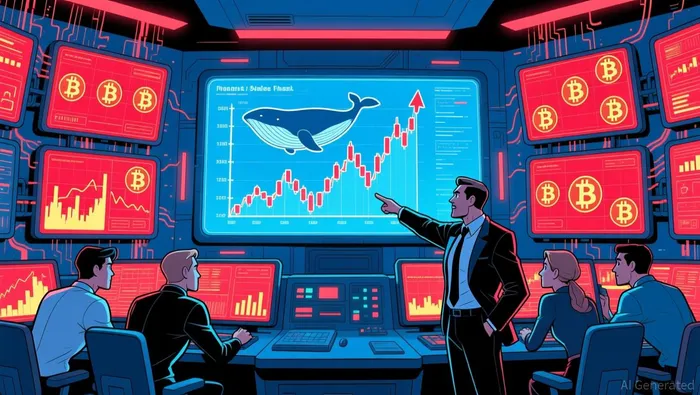 The strategic timing of these purchases aligns with broader trends observed in 2025–2026. For instance, the number of entities holding at least 1,000 BTC rose sharply to 1,436 in late 2025, reversing earlier net selling trends. This shift suggests growing conviction that Bitcoin is undervalued, with whales acting as contrarian indicators. The Glassnode accumulation trend score further reinforces this narrative: entities holding over 10,000 BTC are no longer heavy sellers, while those with 1,000–10,000 BTC show modest accumulation. Such metrics highlight a maturing market where whale behavior reflects institutional-grade risk assessment rather than speculative frenzy.
Strategic Position-Taking by Institutional Actors
Institutional investors have increasingly weaponized on-chain analytics to decode whale behavior and align their strategies with macro trends. A core-satellite portfolio structure-allocating 60% to BTC and ETH, 30% to growth tokens, and 10% to satellite assets-has become a recommended framework for balancing exposure to whale-driven volatility according to research. This approach prioritizes liquidity management and risk mitigation, leveraging whale activity as a proxy for market sentiment.
For example, massive on-chain movements in early 2026 sparked speculation that whales were positioning for a bull run, with transactions interpreted as signals of anticipated price trends. These movements often trigger cascading effects, as retail investors and algorithmic trading systems react to whale-driven liquidity shifts. Institutional actors, however, use advanced tools like Fibonacci extensions and multi-timeframe charts to anticipate these moves, projecting Bitcoin's price could reach $150,000–$200,000 in 2026 due to a growing supply-demand imbalance.
The strategic sophistication of whales extends beyond accumulation. Studies reveal that large holders employ tactics such as spoofing and pump-and-dump schemes to manipulate prices. While such practices amplify short-term volatility, they also create opportunities for institutional investors to hedge using dynamic position sizing and multi-chain strategies according to analysis.
Risk Management Frameworks in a Whale-Dominated Era
The 2025–2026 period has seen the institutionalization of crypto risk management, with frameworks increasingly centered on on-chain intelligence. Automated dollar-cost averaging (DCA), real-time monitoring of whale movements, and tokenization of real-world assets (RWAs) are now standard practices according to institutional reports. For instance, the tokenization of treasuries and funds demonstrates institutional comfort with blockchain infrastructure, while spot BTC and ETH ETFs-managing over $115 billion in assets by late 2025-provide regulated avenues for large-scale allocations according to market data.
Regulatory developments further shape risk management strategies. The EU's Markets in Crypto-Assets (MiCA) regulation and the U.S. GENIUS Act, implemented in 2025, have imposed stringent AML requirements. These frameworks reduce arbitrage opportunities and enhance transparency, indirectly curbing whale-driven manipulation. Institutions now rely on platforms like Beacon Network for real-time information sharing, mitigating risks associated with illicit activity and market shocks.
Conclusion
Whale behavior in 2025–2026 has evolved from a speculative curiosity to a cornerstone of strategic position-taking and risk management. By analyzing on-chain metrics such as accumulation trends, institutional investors can anticipate market cycles, optimize portfolios, and navigate volatility with greater precision. As regulatory clarity and technological infrastructure continue to mature, the interplay between whale activity and institutional strategies will likely define the next phase of crypto's evolution. For investors, the lesson is clear: monitoring whale behavior is no longer optional-it is essential.







Comentarios
Aún no hay comentarios