
Whale Behavior as a Leading Indicator: ASTER's Capitulation and the Path to DeFi Rebalance
The 2025 DeFi market rebalance has been defined by a confluence of macroeconomic pressures, institutional caution, and on-chain behavioral shifts. Among the most telling signals are whale activities-large holder movements that often act as leading indicators of broader market sentiment. For ASTERASTER--, a Binance-backed perpetual DEX, recent whale behavior underscores a capitulation phase, with cascading implications for DeFi liquidity and risk-off dynamics. This analysis dissects the interplay between on-chain sentiment, whale-driven capitulation, and the structural forces reshaping decentralized finance.
ASTER's Capitulation: Whale Transactions and Sentiment Deterioration
Whale activity has emerged as a critical barometer for ASTER's near-term trajectory. A pivotal event occurred in late 2025 when a major whale sold 3 million ASTER tokens at a 22% loss, locking in a $667,000 realized loss. This move, analyzed by on-chain intelligence firm Lookonchain, deviates from routine profit-taking and signals waning confidence in the token's short-term prospects. Compounding this, a separate whale deposited 12.43 million ASTER tokens into Binance, representing a $11.67 million inflow. At the time, ASTER traded at $0.806, below the whale's entry price of $0.9705, suggesting potential selling pressure and a bearish bias.
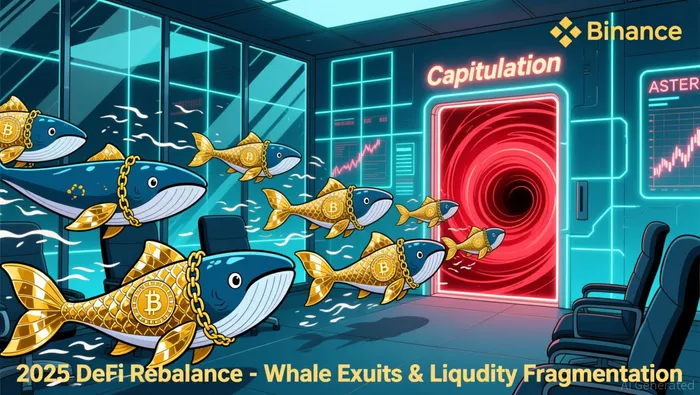 These exits align with broader on-chain metrics. According to technical analysis, ASTER's price has since fallen to $0.7475, breaching key support levels, while technical indicators like the RSI and MACD confirm sustained downward momentum. The cumulative realized losses from whale activity now exceed $35 million, with spot prices hitting 3-month lows as reported by CoinMarketCap. Such capitulation is not merely a function of ASTER's fundamentals but reflects a larger DeFi ecosystem grappling with liquidity fragmentation and macroeconomic headwinds.
DeFi Rebalance Dynamics: Risk-Off Sentiment and Liquidity Constraints
The 2025 DeFi rebalance has been marked by pronounced risk-off dynamics, driven by higher interest rates, geopolitical tensions, and a loss of institutional confidence. According to a report by the Federal Reserve Bank of Philadelphia, large EthereumETH-- holders exhibit a positive correlation with short-term price returns, while smaller holders show negative correlations-a stark asymmetry in market timing. This dynamic has amplified volatility, as whale distributions trigger cascading sell-offs and algorithmic trading systems react preemptively as detailed in a MEXC analysis.
For ASTER, the liquidity crisis is exacerbated by its role in a fragmented DeFi landscape. While the platform has innovated with features like Shield Mode-a high-leverage trading feature designed to mitigate front-running and MEV-it faces structural challenges. On-chain data reveals a sharp decline in wallet activity and reduced transaction volume, signaling a slowdown in network growth. Meanwhile, ETF-related outflows in October 2025, particularly in BitcoinBTC-- ETFs, have created a secondary layer of volatility. Unlike direct whale transactions, which drive sharp price swings, ETF outflows contribute to a more gradual but persistent downward trend.
The broader DeFi ecosystem has also seen order books thin on major exchanges, with sellers vastly outnumbering buyers. A report by Alaric Securities notes that decentralized protocols have effectively shut down as collateral is algorithmically liquidated, creating a self-reinforcing cycle of price declines and forced selling. ASTER's position as a BNBBNB-- Chain-based DEX places it at the intersection of these dynamics, where its ability to attract institutional liquidity will determine its resilience.
The Path Forward: Innovation vs. Sentiment Headwinds
Despite the bearish near-term outlook, ASTER's long-term potential hinges on its ability to execute on product innovation and volume expansion. The platform's launch of Aster Chain-a Layer 1 blockchain aimed at improving transaction speed and privacy-positions it to capitalize on cross-chain interoperability trends. Additionally, AI-driven yield strategies and institutional-grade compliance frameworks could attract TradFi capital, as highlighted in a Phemex analysis.
However, these innovations must overcome immediate sentiment headwinds. Social sentiment analysis reveals a mix of panic and caution, with ASTER's price decline coinciding with Bitcoin's drop below $86,000 in late 2025. The token's 38% monthly price drop and 12% single-day losses have eroded retail confidence, even as institutional whales accumulate. For instance, three whale wallets recently acquired $10 million in ASTER within 24 hours, signaling renewed interest in its long-term potential.
The critical question remains whether ASTER can stabilize its price and rebuild liquidity. On-chain metrics suggest that a rebound would require a catalyst-either a surge in volume from new users or a shift in macroeconomic sentiment. For now, the market remains in a defensive stance, with ASTER's path to recovery contingent on its ability to navigate the 2025 DeFi rebalance without further capitulation.
Conclusion
Whale behavior in 2025 has proven to be a leading indicator of DeFi's structural shifts. For ASTER, the combination of capitulation signals, risk-off dynamics, and liquidity constraints paints a complex picture. While the platform's innovations-such as Shield Mode and Aster Chain-offer a roadmap for growth, the immediate outlook remains bearish. Investors must monitor whale activity indices, on-chain volume trends, and macroeconomic catalysts to gauge when the DeFi rebalance might stabilize. In a market defined by volatility, ASTER's ability to adapt will determine whether it emerges as a resilient player or succumbs to the broader risk-off tide.






Comentarios
Aún no hay comentarios