
Western Forest Products: Navigating Share Consolidation and Institutional Confidence Amid Industry Volatility
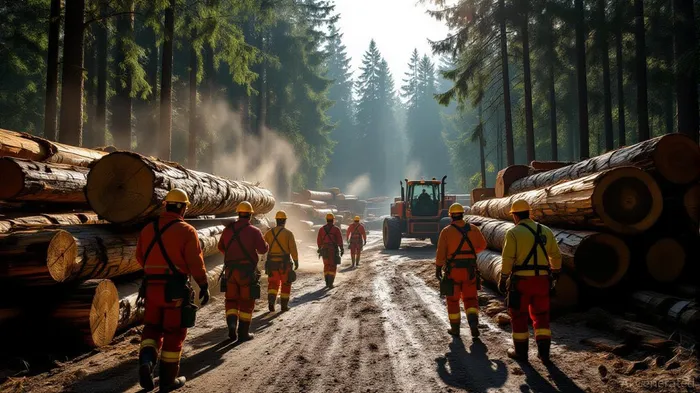
Western Forest Products Inc. (TSX: WEF) has long operated in the volatile forest products sector, where cyclical demand, commodity price swings, and environmental regulations create persistent headwinds. As of July 2025, the company executed a 1-for-30 share consolidation, a strategic move aimed at simplifying its capital structure and potentially enhancing shareholder value. While recent financial data remains elusive, institutional ownership patterns and corporate governance actions offer critical insights into the company's sustainability and investor sentiment.
Share Consolidation: A Structural Reset
The consolidation, approved at the May 2025 Annual General Meeting, reduced the number of outstanding shares from 316.7 million to a significantly lower figure. This move aligns with broader trends in the forestry sector, where companies often streamline operations to reduce administrative costs and improve liquidity. By rounding fractional shares to whole numbers, Western Forest Products may also be addressing liquidity concerns for retail investors, who historically face barriers in trading low-priced stocks.
However, the consolidation's success hinges on the company's ability to demonstrate improved operational efficiency and profitability. Without recent earnings reports, it's challenging to assess whether this structural change will translate into tangible value creation. Investors must remain cautious, as share consolidations can sometimes mask underlying financial weaknesses rather than resolve them.
Institutional Ownership: A Barometer of Confidence
Western Forest Products' institutional ownership structure reveals a cautiously optimistic outlook. As of 2025, 23 institutional investors hold 20.4 million shares, with the Fidelity Low-Priced Stock Fund and Dimensional Fund Advisors leading the pack. These funds, which focus on small-cap and value-oriented strategies, typically adopt long-term, passive investment approaches. Their stable or marginally increasing holdings suggest a belief in the company's resilience amid sector-wide challenges.
The Fund Sentiment Score—a metric tracking institutional buying activity—currently exceeds the 50 average, indicating moderate accumulation. This aligns with broader trends in the forest products industry, where investors are hedging against inflationary pressures and supply chain disruptions. Yet, the absence of a single investor holding more than 5% of shares underscores a diversified but fragmented ownership base, which may limit aggressive strategic shifts.
Operational Challenges and Sector Dynamics
The forest products sector remains vulnerable to external shocks, including softwood lumber price volatility, regulatory changes, and climate-related supply chain disruptions. Western Forest Products' operational metrics—such as production capacity, debt levels, and cost management—will be critical in determining its ability to weather these challenges. However, without access to recent quarterly or annual reports, it's impossible to evaluate these factors directly.
Historically, the company has faced persistent losses during periods of low lumber demand, a common issue in the sector. Its reliance on commodity pricing exposes it to margin compression, particularly when global economic conditions weaken. For example, a 2023 industry report highlighted that North American forest product firms collectively lost $1.2 billion during the post-pandemic demand slump. Western Forest Products' ability to diversify its product mix or adopt cost-cutting measures will be pivotal.
Investment Implications and Forward-Looking Outlook
For investors, Western Forest Products presents a high-risk, high-reward proposition. The share consolidation and institutional confidence suggest a strategic pivot toward stability, but the lack of recent financial transparency raises red flags. The company's reliance on passive institutional investors—rather than activist stakeholders—may delay urgent operational reforms.
A prudent approach would involve monitoring upcoming filings and industry trends. Key indicators to watch include:
1. Debt-to-Equity Ratio: A rising ratio could signal financial strain.
2. Lumber Price Index: Correlation with the company's revenue volatility.
3. Capital Expenditure Trends: Evidence of modernization or cost optimization.
In the absence of concrete financial data, investors should also consider macroeconomic factors. A potential rebound in housing starts or infrastructure spending could boost demand for lumber, indirectly benefiting Western Forest Products. Conversely, a prolonged economic slowdown could exacerbate its challenges.
Conclusion
Western Forest Products' share consolidation and institutional ownership dynamics reflect a company in transition. While the structural changes and moderate investor confidence are encouraging, the lack of recent financial transparency and sector-specific risks necessitate a cautious stance. For long-term investors with a high risk tolerance, the company could offer upside potential if it successfully navigates industry headwinds. However, those seeking immediate clarity or stability may find the risks outweigh the rewards.
As the forestry sector evolves, Western Forest Products' ability to adapt—through innovation, diversification, or strategic partnerships—will ultimately determine its sustainability. Until more data emerges, the path forward remains as unpredictable as the forests it harvests.







Comentarios
Aún no hay comentarios