
Western Digital's Strategic Expansion: Strengthening Supply Chains Amid NAND Flash Demand Surge
In an era where AI-driven data demands are reshaping global storage landscapes, Western DigitalWDC-- (WDC) is doubling down on strategic initiatives to fortify its position as a leader in system integration and NAND flash innovation. The company's recent expansion of its System Integration and Test (SIT) Lab in Rochester, Minnesota, underscores its commitment to accelerating the qualification of high-capacity HDDs for AI and cloud workloads, according to a Business Wire release. This move is not merely operational but a calculated step to enhance supply chain resilience amid volatile NAND flash markets and surging enterprise storage needs.
System Integration as a Strategic Lever
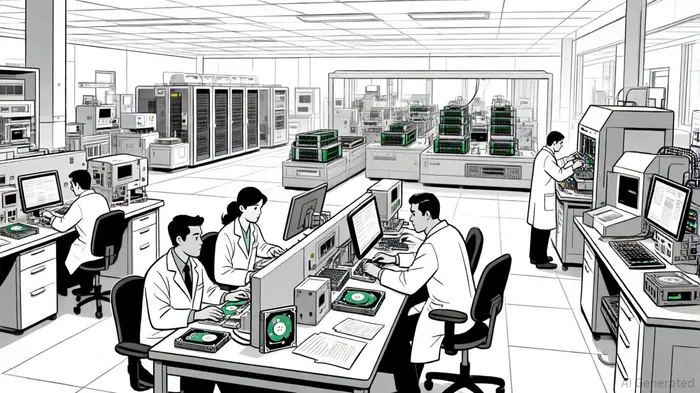
Western Digital's expanded SIT Lab is a cornerstone of its strategy to meet the performance and reliability demands of AI infrastructure. By collaborating with multiple SSD vendors-including DapuStor, Kioxia, Phison, and ScaleFlux-the company is diversifying its supply chain to mitigate risks associated with single-source dependencies, according to Western Digital's news release. This approach aligns with broader industry trends, where firms are prioritizing ecosystem collaboration to navigate production bottlenecks and price fluctuations. For instance, Western Digital's qualification of SSDs from diverse vendors ensures customers have access to optimized solutions tailored for AI, cloud, and software-defined storage, a point emphasized in the news release.
The SIT Lab's role extends beyond testing; it serves as a hub for co-developing storage solutions with hyperscale clients. By accelerating the qualification of next-generation HDDs, Western Digital is positioning itself to capitalize on the projected tripling of global data generation between 2023 and 2028, as noted in the Business Wire release. This is particularly critical as AI workloads, such as text-to-image and text-to-video generation, drive exponential growth in data lakes and training datasets, a trend highlighted by the same release.
NAND Flash Demand: A Tale of Two Markets
While Western Digital's HDD strategy is geared toward AI scalability, its NAND flash business faces a more complex landscape. The company, the world's fifth-largest NAND supplier, has cut production by 15% in early 2025 to address excess inventory and market imbalances, according to a Semimedia report. This aligns with industry-wide production cuts by peers like Samsung, Micron, and Kioxia, who are collectively reducing output by 10–15% to stabilize prices, a development also noted in the Business Wire release.
The NAND market's Q3 2025 outlook, however, is mixed. TrendForce forecasts a 5–10% rise in contract prices, driven by AI infrastructure investments and NVIDIA's Blackwell GPU deployments, as reported in a Guru3D article. Client SSDs are benefiting from restocking momentum, fueled by end-of-support deadlines for Windows 10 and demand for high-capacity QLC products, according to the Business Wire release. In contrast, enterprise SSDs face delivery delays, pushing prices up by 5–10% as North American and Chinese clients surge orders, while mobile storage (eMMC/UFS) remains underperforming due to weak smartphone demand, also reported in the Business Wire release.
Strategic Implications and Risks
Western Digital's dual focus on system integration and NAND resilience is paying dividends. Its development of High-Bandwidth Flash (HBF)-a NAND solution potentially replacing HBM DRAM in certain applications-highlights its innovation edge, according to a TrendForce report. Meanwhile, the planned separation of its Flash business in February 2025 is expected to streamline operations and unlock value for stakeholders, as described in the Business Wire release.
Yet challenges persist. Supply chain constraints, such as wafer shortages and rising production costs, could dampen consumer demand, according to a DRAMeXchange analysis. Additionally, the company's reliance on AI-driven enterprise growth exposes it to macroeconomic headwinds, such as slower corporate IT investments, a risk DRAMeXchange has also highlighted. Analysts remain cautiously optimistic, citing improved operational performance but urging vigilance amid market volatility, as noted in the investor news release.
Conclusion
Western Digital's strategic expansion into system integration and its proactive management of NAND flash demand position it as a key player in the AI storage revolution. By diversifying supply chains, accelerating HDD innovation, and navigating NAND market volatility, the company is balancing short-term resilience with long-term growth. For investors, the critical question is whether these strategies can sustain profitability as AI adoption accelerates-and whether the company can outpace peers in adapting to a rapidly shifting landscape.





Comentarios
Aún no hay comentarios